"Why the heck is there music playing while Feyre is talking?"
That's not me — that's a listener review I stumbled across before pressing play. And honestly? I should've taken it more seriously. But I didn't, because I was shelving returns at the library on a slow Tuesday afternoon, earbuds in, figuring a five-and-a-half-hour breather novella between ACOTAR installments would be the perfect companion to mindless work. I was half right.
Look. I need to be upfront about something: this isn't horror. This isn't even close to my usual lane. But my podcast listeners have been screaming at me to cover the ACOTAR dramatized adaptations because GraphicAudio's full-cast treatment supposedly turns romantasy into something cinematic, and I'm always interested in what a full ensemble can do with source material. So here we are. Jordan Reeves, librarian, cat dad, horror devotee, reviewing a Winter Solstice novella about pretty immortals buying each other presents. Shirley (my cat) was unimpressed. I was... complicated.
The Soap Opera in Your Ears
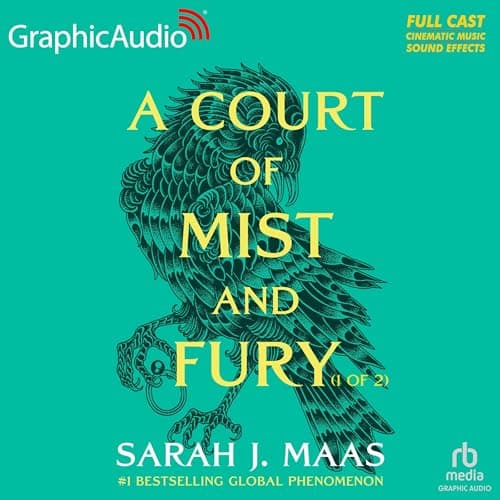
Let's talk about the elephant in the room: the background score. This dramatized adaptation layers music under nearly every scene — not subtle atmospheric textures, but persistent scoring that swells and dips like a daytime television soundtrack. During quiet domestic moments between Feyre and Rhysand, there's this string arrangement hovering behind every whispered exchange, and it undercuts the intimacy rather than enhancing it. When you've got a cast this size — we're talking twenty-plus voice actors — the last thing you need is another layer competing for attention.
The thing is, some of these performers genuinely commit. Anthony Palmini's Rhysand carries this low, controlled warmth that shifts convincingly when the character's inner turmoil bleeds through. And there are moments — the small background giggles during the found-family scenes, someone's breath catching during an emotional beat — where the ensemble approach captures something a single narrator never could. Those tiny human sounds scattered through the group scenes? That's the dramatized format earning its keep. But the music keeps pulling me out right when I'm leaning in.
A Novella Wearing a Novel's Clothes
Here's my actual issue, and it has nothing to do with the production: this is a 5-hour-33-minute bridge novella. It exists to connect A Court of Wings and Ruin to whatever comes next, and it wears that function on its sleeve. The plot — such as it is — follows Feyre navigating her first Winter Solstice as High Lady while everyone around her processes war trauma at varying speeds. There's gift shopping. There are loaded glances. There are seeds planted for future storylines that won't pay off here.
And that's fine, honestly, if you know what you're getting. Maas has always been better at character dynamics than plot mechanics, and ACOFAS leans fully into the found-family hangout energy. The war aftermath stuff — Nesta's spiral, the unspoken weight everyone carries — actually lands with more gravity in audio because you hear the pauses, the way certain characters' voices tighten around specific topics. The cast sells the damage. But if you're coming to this expecting the momentum of Wings and Ruin? You're going to feel the brakes.
What surprised me — and I say this as someone who analyzes atmosphere for a living — is how the festive backdrop works as a pressure cooker for unresolved grief. There's something genuinely unsettling about characters performing holiday joy while they're breaking apart underneath. That's not horror, but it's dread-adjacent. It understands that the scariest thing isn't the war itself — it's the quiet after, when you're supposed to be okay and you're absolutely not. The Warded Man does something similar in its quieter stretches — the horror isn't the demons, it's the people rebuilding themselves in the dark between attacks, pretending the scars aren't still fresh.
Who Should Listen (And Who Should Skip)
If you've been binging the ACOTAR dramatized adaptations and you want the full experience — every novella, every bridge, every crumb — this is for you. The full cast brings a warmth to the domestic scenes that a single narrator would struggle to replicate, and at under six hours, it's not asking much of your time. Skip it if background music during narration makes you want to claw your earbuds out, or if you need forward plot momentum to stay engaged. The music issue isn't subtle — it's there in nearly every scene, and for some listeners it's a dealbreaker. I wouldn't call it a dealbreaker for me, but I'd be lying if I said I didn't notice it constantly.
My podcast listeners are going to love this — not the book itself, but the conversation about what dramatized adaptations gain and lose when they layer production over quiet, character-driven stories. Sometimes less is the scarier choice. Sometimes silence is the special effect.
Shelving This One Under "Cozy With Caveats"
Solid performances buried under an overproduced score. If GraphicAudio had trusted the cast to carry the emotional weight without the orchestral safety net, this would've been something special. Instead, it's a pleasant-enough bridge that occasionally flickers into something genuinely affecting — then gets drowned out by strings.










![A Court of Wings and Ruin (1 of 3) [Dramatized Adaptation] audiobook cover](/_next/image?url=https%3A%2F%2Fm.media-amazon.com%2Fimages%2FI%2F51TsSCZLoZL._SL1200_.jpg&w=1920&q=75)