Look, I'm a Shirley Jackson purist. I believe horror lives in the quiet dread, the creeping wrongness, the thing you can't quite name. So when someone tells me a fantasy novel is 'dark' and 'demon-infested,' I usually prepare myself for gore-as-substitute-for-atmosphere.
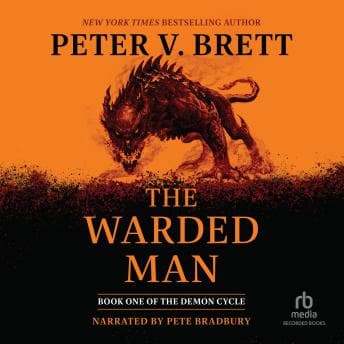
The Warded Man surprised me. And honestly? That doesn't happen often anymore.
Pete Bradbury narrates this thing like he understands something fundamental about storytelling - that pacing isn't about speed, it's about knowing when to breathe. Eighteen hours is a commitment. I started this during a late shift at the library (yes, alone, yes, after dark, yes, I'm aware of the irony), and what I expected was background fantasy noise. What I got was genuinely immersive world-building that had me missing my stop twice on the commute home.
The premise is deceptively simple: demons rise every night, humanity cowers behind magical wards, and everyone's basically accepted that this is just... life now. But Brett does something clever here. He doesn't rush to the heroics. We spend serious time with three kids - Arlen, Leesha, and Rojer - watching their worlds get systematically destroyed by both demons and the humans around them. It's bleak. Really bleak. The kind of bleak that made me text my podcast producer at midnight going 'this is NOT what I expected from epic fantasy.'
Bradbury commits to each of these POVs with distinct voices that never blur together. Arlen's stubborn fury, Leesha's quiet steel, Rojer's damaged charm - they're all there, and they're all consistent across eighteen hours. That's harder than it sounds. (Trust me, I've listened to plenty of multi-POV audiobooks where I genuinely cannot tell who's speaking by hour ten.)
Now. Here's where I have to be honest with you.
This book has content that's going to be a hard no for some listeners. There's sexual violence. It's not gratuitous in the sense that it's there for shock value - it's woven into the story's examination of how people survive trauma - but it's there, and it's graphic enough that I paused the audiobook more than once. If that's something you can't engage with, skip this. I mean it. No judgment. Horror is about consent, and you get to choose what you let into your brain.
For those who can handle it: Brett uses these dark elements to build something genuinely interesting about resilience and rage and what it costs to fight back against a world that's designed to break you. Shirley Jackson walked so this author could run - and I say that as someone who doesn't throw Jackson comparisons around lightly.
Bradbury's narration style is... let's call it 'refined.' Some listeners find it too posh for the gritty content, and I get that. There's a slight disconnect when you're hearing about demon-ravaged villages in what sounds like BBC documentary tones. But honestly? It worked for me. The formality creates this weird contrast that makes the horror hit harder. Like someone describing a massacre in perfectly measured sentences. Unsettling in the right way.
The fight scenes are where Bradbury really shines. The ward magic system - where specific symbols create barriers and weapons against demons - could have been confusing in audio format. Instead, he paces the action so you can actually visualize what's happening. I found myself holding my breath during the climactic sequences, which is not something I do for fantasy novels. The only other fantasy that's done this to me recently was Fourth Wing, though that book earns its tension through very different means. Horror novels, sure. But fantasy?
My podcast listeners are going to love this. It's the kind of book that generates arguments - about the darkness, about the character choices, about whether the ending earns its catharsis. Those are my favorite episodes to record.
Shirley (my cat) was unimpressed by the eighteen-hour runtime. She kept knocking my headphones off the nightstand. I was terrified during the demon attack sequences and had to turn the lights on at 2 AM like a coward. No regrets.
The production quality is clean - no weird audio artifacts, no background noise, just Bradbury's voice and the story. At 1.25x speed, it hits a nice rhythm without losing the atmospheric moments.
The Verdict: This isn't horror in the traditional sense, but it understands that horror isn't about gore - it's about dread. If It Bleeds operates on that same principle - the real terror lives in what the darkness reveals about people, not the darkness itself. The demons are scary, sure. But the real terror is watching good people make terrible choices because the world has given them nothing else. That's the kind of darkness that sticks with you.
Who Should Listen (And Who Should Skip): If you need content warnings for sexual violence, or if bleak-as-hell fantasy isn't your thing, skip without guilt. But if you want dark fantasy that actually earns its darkness - and you've got eighteen hours to spare - you need this in your ears.









