
Twelve hours and twenty-two minutes. For a book that summarizes 50 other books. Let that sink in. Butler-Bowdon wrote a book about being efficient with your reading time and then delivered it in a format that demands half a day of yours. My parents could've opened the dry cleaners, run a full shift, closed up, and still had time left over. The irony is physically painful.
But here's the thing - and I'm annoyed about this - it's actually not bad.
The CliffsNotes You Didn't Know You Needed
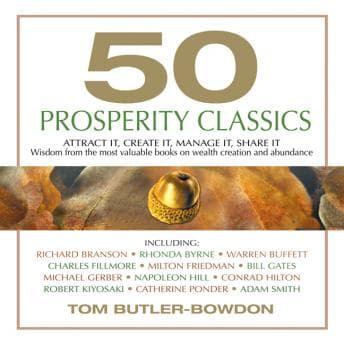
I listened to this during a week of back-to-back client calls, filling the gaps between meetings where my brain was too fried for original thought but too wired to sit still. Perfect use case. Butler-Bowdon takes 50 books spanning entrepreneurship, personal finance, investing, and philanthropy, and distills each one down to roughly 15 minutes of core ideas. Think of it as a tasting menu for wealth literature.
The selection is genuinely interesting. You get the expected heavy hitters - "Think and Grow Rich," "The Millionaire Next Door," Kiyosaki's stuff - but also pulls from Adam Smith, Ayn Rand, and Muhammad Yunus on microfinance. That range matters. Most "prosperity" compilations lean hard into the law-of-attraction crowd or the hustle-porn crowd. Butler-Bowdon actually covers the spectrum from "visualize your abundance" (eye roll) to "here's how compound interest actually works" (useful) to "here's how to give it away responsibly" (rare).
The key takeaway is worth the listen. The other 7 hours? Well, actually, this one earns more of its runtime than most. Each summary follows a clean structure: what the book argues, who wrote it and why, and what you should actually take from it. Butler-Bowdon's background from the London School of Economics shows - he's not just summarizing, he's contextualizing. When he covers Napoleon Hill alongside Benjamin Graham, he's letting you see how the mystical and the mathematical have always coexisted in wealth thinking.
What My Parents Knew Without Reading 50 Books
Here's where I get personal. About a third of these books preach some version of "change your money mindset" or "abundance is a frequency." And look - I watched two immigrants build a business from nothing in Koreatown with zero mindset coaching and a whole lot of 5 AM alarm clocks. The prosperity gospel of positive thinking has always felt thin to me when measured against people who just... worked.
But Butler-Bowdon - and credit where it's due - doesn't swallow any of it uncritically. He'll summarize a book like "The Science of Getting Rich" by Wallace Wattles and then quietly note its limitations. He treats each book as a data point, not a doctrine. That intellectual honesty is what separates this from the usual "here are 50 books that will change your life!!!" listicle energy.
The sections on actual financial mechanics - covering Peter Lynch, Warren Buffett's shareholder letters, George Clason's "Richest Man in Babylon" - are where the book earns its keep. Practical. Testable. The kind of stuff I've seen actually move the needle for the startups I advise. That same 'here's what actually works' energy is why I keep recommending The Making of a Manager to the founders I work with. Skip to those chapters if the manifestation stuff makes you twitchy.
Sean Pratt Does the Heavy Lifting
Sean Pratt narrates like a business school professor who's had exactly the right amount of coffee. Clear, measured, no vocal fireworks. For a 12-hour listen that's essentially a lecture series, that's exactly what you want. He doesn't try to dramatize Adam Smith or make Napoleon Hill sound exciting - he just delivers the material cleanly and lets you decide what's worth your time.
At 2.0x he's perfectly intelligible, which is my baseline test for any nonfiction narrator. Smooth transitions between book summaries. No weird audio artifacts. It's workmanlike in the best possible way - this isn't a performance, it's a delivery system, and the system works.
Who Gets the ROI
If you're early in your financial education and want a map of the territory before committing to any single book - this is genuinely useful. It's like a consultant's landscape analysis of the wealth literature. (I've literally charged people for less comprehensive overviews than this.)
If you've already read 20+ of these 50 books? You'll find the summaries too shallow and the familiar material tedious. You're not the target audience. Move on.
If you're looking for a single actionable framework to build wealth? This isn't it. It's 50 frameworks in miniature, which means none of them gets deep enough to actually change your behavior. It's a menu, not a meal.
The Billing Rate on This One
Bottom line: Butler-Bowdon is gifted at getting to the heart of things - that's not my line, that's a listener quote I agree with completely. This is a solid reference listen, best consumed in chunks rather than straight through. It won't replace reading the actual books that grab you, but it'll save you from buying the 30 that wouldn't have. At 12 hours it's still too long for what it is - this could've been 8 hours and lost nothing. But for a book about books about money, it delivers surprisingly honest returns. Jenny would say I'm being generous. Jenny might be right this time.