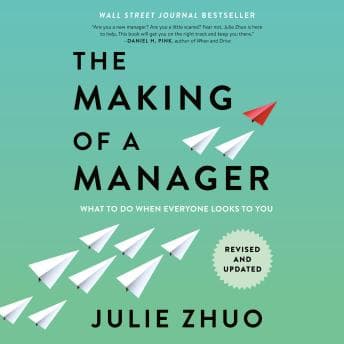

I expected this to be another business book that could've been a blog post. You know the type - one decent insight stretched across 8 hours with enough filler to make you question your life choices. But somewhere around hour 3, stuck on a delayed Caltrain watching the fog roll over the peninsula, I realized I was actually... learning things?
Julie Zhuo became a manager at Facebook at 25. I became a manager at 27 and spent the first six months convinced everyone knew I was faking it. This book basically reads like someone reached into my imposter syndrome and said "yeah, that's normal, here's what to do about it."
The Debugging Guide I Needed Three Years Ago
Zhuo structures this like a troubleshooting manual, which - as someone who spends half her life reading runbooks - I deeply appreciate. She breaks down management into components: running meetings, giving feedback, hiring, firing. Each section has specific frameworks without being annoyingly prescriptive.
Her bit about the "Task-Relationship-Self" framework for understanding why something feels off with a report actually changed how I think about 1:1s. When someone's underperforming, is it the task (wrong role?), the relationship (trust broken?), or self (personal stuff happening?). Simple, but I'd never explicitly categorized it that way.
She also gets refreshingly honest about her own failures. There's a section where she talks about a hire she made despite red flags because she was desperate to fill the role. Watched it blow up. Learned the hard way. That kind of vulnerability is rare in business books, which usually read like "I was always brilliant, here's proof."
Author-Narrated: A Double-Edged Sword
So here's the thing about author narration - it's either incredibly authentic or painfully awkward. Zhuo lands somewhere in the middle, leaning toward authentic. Her delivery is clear and conversational, like she's explaining this stuff over coffee. But she's not a professional narrator, and occasionally you can tell.
Karissa Vacker handles some portions (she's won Earphones Awards, which tracks), and the contrast is noticeable. Vacker's sections flow more smoothly. But honestly? I kind of preferred Zhuo's slightly imperfect delivery for this content. It felt less like being lectured and more like getting advice from a senior engineer who's been through it.
The production is clean - no weird audio artifacts or volume inconsistencies. At 7.5 hours, it's the perfect length. Dense enough to be useful, short enough that you don't zone out.
Who Should Listen (And Who Should Skip)
Perfect for: New managers (obviously), ICs considering the management track, anyone who just got promoted and is quietly panicking. Also good for experienced managers who learned through trial and error and want to fill in gaps.
Skip if: You're looking for high-level leadership philosophy or CEO-level strategy. This is tactical, ground-level stuff. Running your first skip-level meeting, not running a company. Also skip if you need heavy entertainment value - this is a practical guide, not a story. I listened during commutes and while meal prepping on Sundays - contexts where I could focus but didn't need to be riveted.
The ROI Calculation
Look, I've read (listened to?) probably a dozen management books at this point. Most of them blur together into a generic soup of "be authentic" and "give feedback." This one actually stuck. Driven to Distraction had that same sticky quality—frameworks that actually changed how I approached problems instead of just sounding good in theory. I've already applied the Task-Relationship-Self thing twice this week.
Is it groundbreaking? No. But it's genuinely useful in a way that most business books aren't. Zhuo writes like an engineer who became a manager, which - surprise - is exactly what she is and exactly what I needed.
The ROI on this audiobook is solid. Three commutes to finish, probably saved me three months of learning the same lessons the hard way. That's a trade I'll take every time.
Bottom Line
I'm giving this one credit. Not because it's revolutionary, but because it's practical in a genre that's usually all theory. If you're a new manager or about to become one, this is the audiobook equivalent of a good senior mentor - someone who's made the mistakes so you don't have to.
Just don't expect Ray Porter. (Nobody's Ray Porter.)









