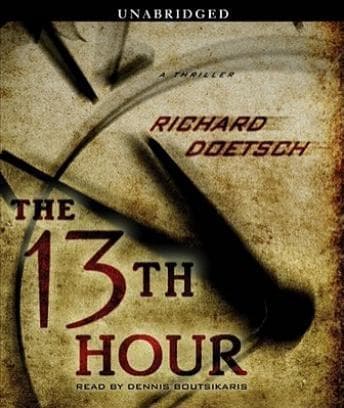

What happens when you build a thriller where the plot literally runs backwards? Like, not Memento-style where the audience is confused and that's the point - but structurally, each chapter moves one hour earlier, peeling back layers of what actually happened to Nick Quinn's murdered wife.
I started this one on a Wednesday morning, 6:12 AM, barely functional, wedged into a window seat on a packed southbound Caltrain. And honestly? The reverse chronology was the perfect antidote to my pre-coffee brain fog. Every chapter is a new hour going backward, which means every hour is essentially a fresh mini-mystery. You don't need to remember where you left off three days ago because the structure resets constantly. That's a huge win for commute listening.
Memento Meets Groundhog Day (But Make It a Thriller)
Here's the setup: Nick Quinn is in jail at 9 PM, accused of murdering his wife Mary. A mysterious stranger hands him a talisman that lets him jump back one hour at a time - twelve jumps total. Each jump lands him earlier in the day, and he has to figure out who killed Mary and prevent it before he runs out of hours.
The reverse structure is genuinely clever. At 9 PM you know almost nothing. By the time you're listening to the events at noon, you've accumulated enough context that details from earlier chapters suddenly click into place. It's basically a git blame on a murder - you're tracing the commits backward to find where the bug was introduced. I kept catching myself going "oh THAT'S why that happened" which is a satisfying dopamine hit when you're half-awake.
But - and this is a real but - the time travel mechanics are handled inconsistently. The rules for what Nick can and can't change feel like they shift based on what the plot needs rather than any internal logic. As someone who debugs distributed systems for a living, inconsistent state management drives me up the wall. If you're the type who needs your sci-fi mechanisms to be airtight, this will bug you. If you can treat the time travel as a narrative device rather than hard sci-fi, you'll have a much better time.
Dennis Boutsikaris Does the Heavy Lifting
Boutsikaris isn't Ray Porter (nobody is), but he's solid. His performance carries a lot of emotional weight in the scenes where Nick is dealing with the reality of Mary's death - there's a rawness to how he voices Nick's desperation that keeps the stakes feeling real even when the plot mechanics get wobbly. He won an OBIE for stage work and you can tell; his pacing and emotional timing are theatrical in the best way.
Where I noticed some flatness: the supporting cast. Nick's emotional arc is well-served, but secondary characters tend to blend together vocally. In a book where you're jumping between time periods and encountering people in different contexts, a bit more vocal differentiation would've helped. Not a dealbreaker, but I did occasionally lose track of who was talking during dialogue-heavy sections - especially at 1.5x speed on a noisy train.
The Character Problem Nobody Wants to Talk About
So here's where my enthusiasm cools. The reverse structure is the star. Nick's love for Mary is the emotional engine. But the actual people in this book? Pretty thin. Mary herself is more concept than character - she's The Wife Who Must Be Saved. Nick is driven and sympathetic but not particularly complex. The supporting cast exists to deliver plot information.
This is basically a puzzle box with a heart - and the puzzle box is excellent, but the heart needed more muscle. I finished it in roughly 3 commutes (10 hours at 1.5x goes fast), and while I was engaged the whole time, I wasn't emotionally wrecked at the end. Compare that to something like Dark Matter by Blake Crouch, which has a similar "man trying to get back to his wife" premise but hits way harder emotionally because both leads feel like real people. Skeleton Crew is another case where short, punchy structure does a lot of the heavy lifting — King's best stories in that collection work because the characters feel lived-in even when the page count is tight, which is exactly what 13th Hour needed more of.
Who Gets On This Train and Who Waits for the Next One
Perfect for: train, gym, roadtrip. The chapter-per-hour structure means natural stopping points everywhere, and the reverse chronology keeps your brain just engaged enough to stay focused without requiring deep concentration.
Skip for: anyone who needs rigorous time-travel logic. Also skip if weak characterization is a dealbreaker for you - the plot carries this, not the people.
The ROI on this audiobook is solid for a credit. Ten hours, genuinely original structure, competent narration, and enough twists to keep you off your phone during the commute. It was named one of AudioFile's Ten Best Audiobooks of 2010, and I get why - the concept alone deserves recognition. But it's not quite in the "I need to text Kevin about this immediately" tier. It's a really good airplane read in audio form. Enjoy it, appreciate the structural ambition, and don't poke too hard at the time travel rules.