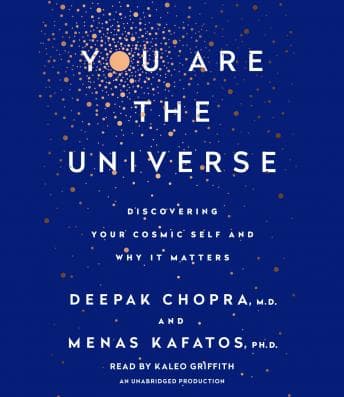

It was 2:47 AM, two nights after the production outage, and I still couldn't sleep. Kevin was out cold. I had ten hours of Deepak Chopra and a physicist arguing that I am, literally, the universe sitting in my queue. Sure. Why not. Let's do cosmic consciousness at 3 AM.
Here's the thing: I went in skeptical. Like, deeply skeptical. I debug distributed systems for a living. I think in latency and fault tolerance. "You are the universe" sounds like the kind of thing printed on a tote bag at a farmer's market. But Menas Kafatos is an actual physicist, and the questions the book tackles - why the physical constants of the universe are tuned so precisely for life to exist, what consciousness even is at a quantum level, what came before the Big Bang - these are real open problems in physics. Not woo. Real gaps in the literature.
The authors' core argument is something like: the observer problem in quantum mechanics isn't a bug we'll eventually patch, it's a fundamental feature of reality. Consciousness isn't a late-arriving emergent property sitting on top of matter - it might be load-bearing all the way down. They walk through the hard problem of consciousness, the fine-tuning problem, the measurement problem, and argue that mainstream physics has been quietly avoiding the implications of its own findings for decades. That part? Genuinely interesting. The science actually holds up - or at least, the parts where Kafatos is clearly driving. When Chopra takes the wheel and steers toward "you can co-create your reality," the rigor gets... spottier. It's like watching a well-architected system gradually accumulate tech debt.
When the Physics Is Good, It's Really Good
The section on the fine-tuning problem alone is worth the listen - the idea that if the gravitational constant were off by one part in 10^60, no stars form, no carbon, no us. They're not claiming God did it. They're claiming we don't have a satisfying answer and that's a problem we should sit with. Same with the quantum measurement problem: they do a decent job explaining why the Copenhagen interpretation requires an observer and why that's philosophically uncomfortable in ways most pop-science books gloss over. Kafatos keeps things grounded enough that I didn't feel like I was being sold something.
The leap from "consciousness might be fundamental" to "therefore you are a co-creator of the universe" is where I started mentally filing bug reports. The logical jump is... significant. It's not that the conclusion is impossible, it's that the connective tissue between the physics and the self-help payoff is thin. This is basically quantum mechanics but used as a warranty card for manifestation, and that's a familiar move. The pivot from interesting ideas to lifestyle prescription reminded me of how Automatic Millionaire does something similar — the underlying framework is genuinely solid until the book decides you need a 5-step action plan bolted onto it.
The Narrator Is Narrating a Washing Machine Commercial
Kaleo Griffith has won awards. I looked this up because I needed to understand what happened. His voice is technically competent - clear, well-paced, no audio issues. But for a book that's asking you to reconsider the fundamental nature of reality and your place in it? He sounds like he's reading terms and conditions. The clinical flatness that might work fine for a legal thriller becomes actively counterproductive here. When the text is building toward something genuinely wild - the universe as a self-aware system, time as emergent rather than fundamental - Griffith delivers it with the energy of someone announcing a gate change at SFO. The mismatch between the content's ambition and the narration's affect is real and it costs the book something.
I kept bumping it to 1.75x just to inject some momentum, which is a speed I usually reserve for startup books that could've been blog posts. That felt unfair to the actual physics sections, but the alternative was losing the thread entirely at 3 AM.
Should You Spend a Commute on This?
If you're already interested in the hard problem of consciousness, the anthropic principle, or why quantum mechanics is philosophically weirder than most people realize - yes, there's real value here. The ROI on the physics content is solid. If you're hoping Chopra will give you actionable steps for co-creating your reality, you'll get some of that in the back half, but it feels like a different book bolted onto the first one.
Not a commute book. The physics sections need actual attention, not 6 AM zombie-brain. This is a dedicated-listening situation - headphones, no distractions, probably not standing in a packed train car. Borrow it before you buy it. The ideas are worth engaging with. The narration will not help you engage with them.