
This is the audiobook that made me miss my exit twice in one week.
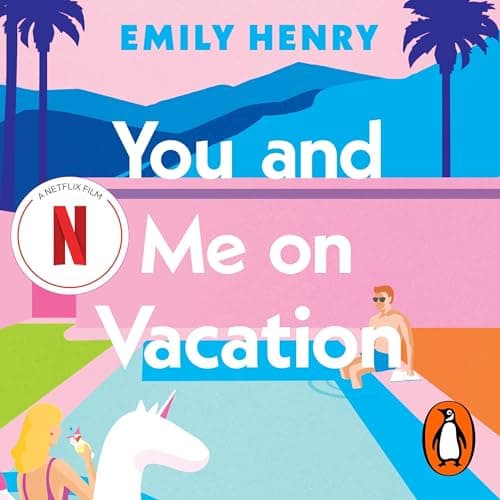
Emily Henry's You and Me on Vacation does something deceptively difficult: it makes you fall in love with two people falling in love, across twelve summers, without ever letting you forget that the thing keeping them apart is also the thing that makes them beautiful together. Poppy is loud, impulsive, color-saturated chaos. Alex is buttoned-up, careful, quietly intense. They shouldn't work as friends. They definitely shouldn't work as anything more. And yet the whole book is powered by the electric certainty that they already do — they're just the last ones to figure it out.
Whelan Knows Poppy's Brain
Here's what surprised me most: Julia Whelan doesn't just narrate this book. She thinks like Poppy. The entire story is told from Poppy's perspective, which means we're living inside a mind that's funny, self-deprecating, and absolutely terrified of examining her own feelings too closely. Whelan captures that specific brand of emotional avoidance — the way Poppy cracks a joke exactly when she should be honest, the way her internal monologue speeds up when she's near Alex and slows down when she's trying not to think about him. It's not a performance you notice. It's one you feel.
The dual-timeline structure is where Whelan really earns her reputation. The book jumps between this summer — where Poppy is trying to repair a two-year silence — and flashbacks to all those annual vacations: Vancouver, New Orleans, the drunken almost-tattoos, Alex gripping the armrest on his first flight while Poppy holds his hand like it's the most natural thing in the world. In print, those jumps could blur together. In Whelan's voice, each timeline has its own emotional temperature. Present-day Poppy sounds a little more guarded, a little more careful. Flashback Poppy is brighter, looser, unaware of what's coming. It's subtle work, and it's the reason this audiobook lands harder than the page version for me.
She gives Alex a quieter, drier register that makes his rare moments of openness hit like a gut punch. You know the feeling when someone who never says how they feel finally says it? Whelan makes you hear the weight of that silence breaking.
The Slow Burn Is the Whole Point
I need to be honest about something: this book takes its time. If you want your romance to ignite fast and burn hot, you're going to spend a lot of this audiobook waiting. Henry milks the friends-to-lovers tension across a full decade of shared history, and the payoff doesn't arrive until late. I found that rewarding — each flashback adds a layer, and by the time Poppy and Alex finally confront what's between them, you feel the accumulated weight of ten summers of almost-moments. But I can see how listeners who prefer quicker escalation might find themselves restless around the midpoint.
The flashback structure also means you're essentially following two emotional arcs that don't converge until the final stretch. You have to trust that Henry knows where she's going. She does. But the trust takes patience.
Compared to Beach Read, Henry's debut, this feels like a more confident book — less reliant on its premise, more willing to sit in the uncomfortable space where friendship and desire coexist and neither person wants to name it. Henry showed flashes of that same restraint in Beach Read, but there she still leaned on the opposites-attract conceit as a crutch — here she trusts the characters to carry the weight entirely. Happy Place has similar DNA with its friend-group dynamics and vacation-as-pressure-cooker setup, but You and Me on Vacation keeps the lens tighter on two people, and that focus gives it more emotional precision.
The Netflix Factor
If you've seen the adaptation, the audiobook is still worth your time. The show condenses the timeline and changes the ending. The book gives you the full sweep — all twelve summers, all the small moments that don't make it to screen but build the foundation for everything that matters. You get to live inside the slow accumulation of intimacy rather than watching it summarized. The book's ending is more satisfying, and Whelan's delivery of the final chapters is the kind of thing that makes you sit in your parked car staring at nothing. She does the same thing to me in Great Big Beautiful Life — there's something about the way she paces an ending that turns a parked car into a feelings-processing zone.
Speed and Listening Notes
Whelan's diction is so clean that this one handles a speed bump well. At 1.25x, the pacing feels snappier without sacrificing the emotional beats. A few of the travel-montage sections feel slightly leisurely at standard speed, so I'd nudge it up if you're the type who listens during commutes. That said, this isn't a background listen. The timeline shifts require enough attention that you'll want to actually be present for it — save the housework playlist for something else.
Who Should Listen (And Who Should Skip)
If you love a slow-burn friends-to-lovers story that earns every single almost-kiss over a decade of shared history, this is your audiobook. If you need your romance to heat up fast or you get impatient with dual timelines, you might want to skip ahead to something with a shorter fuse.
At just under eleven hours, it's a perfect week-of-commutes book or a lazy Saturday devour. It left me with that specific post-book glow where you're unreasonably kind to strangers and slightly devastated that fictional people don't exist. Whelan and Henry together are the rom-com audiobook pairing I keep coming back to, and this might be their best work — funny, warm, and emotionally precise in the moments that count.