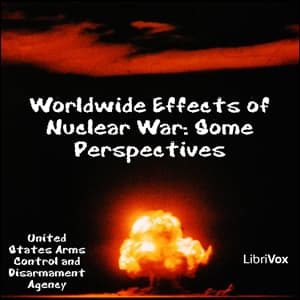

Bottom Line: A 55-minute Cold War government report that delivers maximum information density on nuclear war consequences. The narration is clear but monotonous—bump to 1.25x speed for better ROI on your attention. Essential listening for policy wonks and anyone who wants hard data instead of drama.
I was stuck in traffic on a Tuesday morning, coffee getting cold, when I decided to queue up a 1970s government document about nuclear annihilation. As you do. By the time I pulled into the parking lot, I'd sat through the entire thing and needed an extra five minutes just staring at my steering wheel, recalibrating my sense of existential dread.
Here's what surprised me: the clinical tone actually amplifies the horror. The U.S. Arms Control and Disarmament Agency wrote this thing like a technical manual, and that flat, bureaucratic delivery makes the content land harder. When you're hearing about thermal radiation effects described with the same energy as a quarterly budget report, something clicks differently in your brain. The data becomes impossible to dismiss as dramatization.
The efficiency here is remarkable. At 55 minutes, this report covers immediate blast effects, long-term environmental devastation, global agricultural collapse, and the cascading consequences for nations that never launched a single warhead. No padding, no filler—just information stacked like compressed files. If you're the type who appreciates a high signal-to-noise ratio, this delivers.
Now, the narration situation. Allyson Hester's delivery is technically competent—clear enunciation, clean audio, no production issues. The problem is her approach to emphasis. She treats every line like it deserves equal weight, which creates a uniformity that flattens the listening experience. One listener nailed it: "She was a bit slow and sounded like she was trying to put emphasis and stress in every line." Another was blunter: "The narrator sounded like a robot."
I noticed my attention drifting around the midpoint, needing to rewind sections because the consistent pacing had lulled my focus. The fix? Speed adjustment. At 1.25x, the narration hits a more natural rhythm, and the information actually sticks better. This is one of those audiobooks where the speed dial is your friend.
Why This 1975 Report Still Compiles
What kept pulling me back into the material was the realization of how little has changed. This report dropped in the mid-1970s, but the science hasn't been invalidated. The discussions of nuclear winter scenarios, ozone layer destruction, and worldwide famine conditions remain accurate frameworks for understanding modern arsenals. The same unsettling relevance applies to Permanent Record—Snowden's 2019 warnings about surveillance infrastructure haven't aged, they've just become more obvious. If anything, current weapons capabilities make some of these projections conservative.
The structure moves logically—blast effects first, then radiation, then the global ripple effects that justify the "worldwide" in the title. The sections on agricultural disruption hit particularly hard. We're not just talking about cities burning; we're talking about growing seasons disrupted across hemispheres, food chains collapsing, populations starving who never saw a mushroom cloud.
This isn't an audiobook you enjoy. You process it. You absorb data that probably should be required listening for anyone who discusses nuclear policy without understanding the actual stakes. The return on your 55-minute investment is a concrete, factual foundation that cuts through the abstraction most people maintain around these weapons.
Data Transfer vs. Emotional Impact
Compared to Annie Jacobsen's recent "Nuclear War: A Scenario," this lacks narrative drive and human stories. Jacobsen's work is designed to engage emotionally; this report is designed to inform technically. Both have value, but they're solving different problems. Radium Girls splits that difference—it delivers hard science about radiation exposure while making you care deeply about the women who suffered through it. If you want to feel the terror, go with Jacobsen. If you want to understand the mechanics, start here.
The LibriVox production is clean—no background noise, no audio artifacts, perfectly serviceable for a volunteer recording of public domain material. You're not getting Audible-tier polish, but you're also not paying for it. The trade-off is fair.
Who Gets Value Here (And Who Won't)
Best deployment: commute listening, study sessions, or any context where you want dense information without entertainment obligations. Skip if you need dynamic narration to maintain focus, or if you're looking for storytelling rather than data transfer.
End of Transmission
I keep thinking about that parking lot moment. Under an hour, and this audiobook had fundamentally shifted my frame on nuclear weapons discourse. Most podcasts can't accomplish that in a full season.






![Steve Jobs [unabridged audiobook] audiobook cover](/_next/image?url=https%3A%2F%2Fcovers.audiobooks.com%2Fimages%2Fcovers%2Ffull%2F9788499923406.jpg&w=1920&q=75)