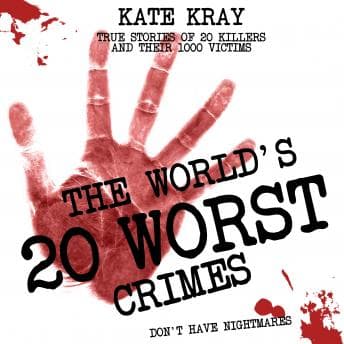

This book is a mess. Let me cut to the chase — I wanted to like it. Kate Kray married into one of Britain's most notorious crime families, so you'd think she'd bring some genuine insider perspective to a survey of history's worst killers. And for about the first hour, driving back from a client site in San Antonio at dusk, I was cautiously optimistic. But by hour three, I knew this was a reconnaissance mission that came back with bad intel.
More Opinion Than Evidence
Here's what killed it for me. When I'm reading about serial killers — people who actually destroyed hundreds of lives — I want facts. Crime scene details. Investigative timelines. Courtroom testimony. What I got instead was Kate Kray's editorial commentary layered over surface-level Wikipedia summaries. Each killer gets roughly 25-30 minutes, which sounds reasonable until you realize she's spending half that time on philosophical musings about evil versus nurture, and the other half rushing through victim details so fast you can barely process them.
I've briefed generals with tighter time constraints and still managed to include more actionable intelligence than this book delivers per chapter. The victims — allegedly a thousand of them across twenty killers — deserve better than a speed-read through their suffering. Some chapters felt like she was checking boxes rather than actually investigating. "Seemed thrown together quickly" is how other listeners have described it, and that's being generous.
Geoff Barham's English Accent Can't Save Bad Research
Now, Barham's narration is an interesting case. His English accent does lend a certain cold, clinical quality to the material that works for true crime. There's a detachment in his delivery that, when the writing is doing its job, actually enhances the horror of what you're hearing. He hits emphasis points well enough — you can tell he understood the assignment.
But here's the problem that drove me up the wall: he gets names wrong. Not different names for different chapters — he'll swap a killer's name with a victim's name within the same sentence. In a book about real people who were really murdered, that's not a minor production hiccup. That's a failure of basic quality control. It happened enough times that I'd catch myself rewinding to figure out who he was actually talking about. In my line of work, mixing up the principal with the threat actor gets people hurt. In audiobook narration, it just destroys your credibility.
I listen at 1.25x normally, but I actually slowed this one down to 1x a couple times trying to parse whether he'd said the right name. That's never a good sign.
The Kate Kray Factor
Look, her connection to Ronnie Kray is the whole marketing hook here, and I respect that she's carved out a career in true crime writing. But being adjacent to criminality doesn't automatically make you a good crime researcher. The book reads more like a sensationalist survey than serious analysis. She asks whether these killers are victims of their troubled pasts or "exponents of pure evil" — and then doesn't really answer the question with anything beyond her gut feeling.
I've interviewed people who've done terrible things. In debriefings, in holding facilities, in places I can't name. And the one thing I've learned is that armchair psychology without rigorous sourcing is just speculation with a dust jacket. Kray needed a research team, or at least a fact-checker. What she delivered instead is a cocktail party summary of cases that true crime fans already know — Dahmer, Bundy, the usual suspects — without enough depth to justify the listen for anyone who's already read a single decent true crime book.
Who Gets Something Out of This
If you're brand new to true crime and want a sampler platter — twenty killers, light on details, heavy on atmosphere thanks to Barham's accent — you might find value here. It's background listening, nothing more. Put it on while you're doing yard work and you'll absorb enough to hold a conversation at a dinner party.
But if you want serious true crime analysis? Skip this and pick up "I'll Be Gone in the Dark" or anything by Ann Rule. Those authors did the work. Kray coasted on her name and her proximity to darkness. I gave We Are All the Same in the Dark a shot around the same time — different genre, but the darkness there felt earned, not borrowed.
Ranger fell asleep during chapter four. He usually at least perks up for the violent parts. Even my dog knew this was phoning it in.
Not Worth the Ammunition
Worth your time? Here's the debrief: nine hours I won't get back, a narrator who can't keep his names straight, and an author who brought opinions to a facts fight. The concept had potential — twenty deep dives into criminal psychology from someone who married into London's underworld. The execution was a swing and a miss. Save your credit for something with actual substance behind it.