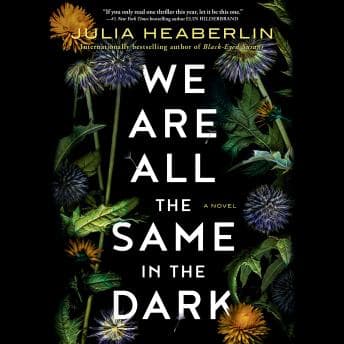
"What's coming is always unimaginable."
That line hit me around hour seven, and I had to pause. I was sitting in the dark corner of the library after closing—just me, the emergency exit signs casting their red glow, and Shirley Jackson (the cat, not the author) judging me from across the room. Perfect conditions for a Texas gothic about missing girls and the violence we bury in small-town soil.
Julia Heaberlin understands something fundamental about horror that most thriller writers miss entirely: the monster isn't what lurks in the dark. All the King's Men operates on that same principle—the real horror is what we've been complicit in all along. It's what we already know is there but refuse to look at.
Four Voices for Four Wounds
The production choice here is ambitious—four narrators trading off perspectives. Catherine Taber handles Odette, our cop protagonist, with this controlled tension that cracks at exactly the right moments. Jenna Lamia takes on Angel, the silent, one-eyed girl found in a dandelion field, and somehow makes a mute character's sections feel urgent rather than passive. Kirby Heyborne and MacLeod Andrews round out the male perspectives, including Wyatt, the town pariah who found Angel and can't stop seeing his missing sister in her.
The Texas accents? Spot on without tipping into caricature. Tears of the Moon nails this too—regional authenticity without the performance. I've listened to too many audiobooks where Southern settings become vocal performances of "y'all" and nothing else. This isn't that. The drawls here are lived-in, the kind of accent that comes from actually existing in a place rather than imitating it.
But here's where I'll be honest with my podcast listeners: the multi-narrator approach creates a slight dissonance when the book jumps timelines. You're following Odette in present-day, then suddenly you're in someone else's head from a decade ago, and the transition can feel abrupt. Not the narrators' fault—it's structural. The performances themselves commit fully.
The Dandelion Field and What It Hides
Heaberlin does something I rarely see executed well: she makes disability central without making it exploitative. Angel's missing eye, Odette's prosthetic leg—these aren't metaphors. They're facts of these women's bodies, and the book treats them as such. The audiobook format actually enhances this because you're not staring at cover art or imagining Hollywood casting. You're just... listening to these women exist.
The cold case structure is classic—missing girl, suspicious brother, town that won't let go—but Heaberlin layers it with genuine psychological complexity. Odette isn't just investigating Trumanell's disappearance. She's excavating her own guilt, her friendship with Tru, the night that made her become a cop in the first place. The narration carries this weight without melodrama.
Around hour four, there's a scene involving the documentary crew that's been making a true-crime series about Trumanell. It's brief but devastating—the way Heaberlin skewers our cultural obsession with missing white women while also participating in the genre. Self-aware horror. I live for it.
Where the Darkness Stutters
I won't pretend this is flawless. The pacing in the middle third drags. There are subplots that feel like they're building to something that never quite arrives—threads that get picked up and then set down without resolution. Some listeners will find this anti-climactic. I found it frustrating in the moment but more realistic in retrospect. Real investigations don't wrap up neatly. Real trauma doesn't resolve in a twist.
The actual twist, though? Devastating. Heaberlin earns it. The narrators—particularly Taber—sell the emotional gut-punch without overselling it. No screaming, no theatrical gasps. Just the quiet horror of understanding.
Who Should Walk Into This Dark
If you need your thrillers to sprint from chapter to chapter, this might test your patience. The book breathes. It lingers on character psychology in ways that feel more literary than genre.
But if you're the type who thinks Shirley Jackson walked so modern gothic writers could run—if you want Texas heat and buried secrets and women who survive things they shouldn't have to survive—this delivers.
Skip if: you want a procedural. This isn't Law & Order.
Listen if: you understand that the best horror lives in the spaces between what happened and what we remember.
Shirley (The Cat) Was Unimpressed. I Was Unsettled.
I finished this at 1 AM with all the library lights off, which was either the best or worst decision I've made this month. The final hour is quiet in a way that feels intentional—the narrators pulling back, letting the weight of the story settle.
My podcast listeners are going to have opinions about the ending. It's not tidy. It's not triumphant. But it's honest about what violence does to a community, to a family, to the girls who disappear and the ones who don't.
Horror that respects the genre. Even when it's wearing a thriller's clothes.