
"They took everything. The house. The jewels. The life we knew."
Somewhere around hour six, Kathleen Gati delivered that line as Sofya with such quiet devastation that I had to pause my work and just... sit there. Frida jumped on my desk, probably sensing the shift in my energy. I was designing wedding invitations—all champagne colors and delicate fonts—while listening to Russian aristocrats lose everything they'd ever known. The contrast hit different.
This book wrecked me in ways I wasn't prepared for.
When Your Best Friend Disappears Into Revolution
Martha Hall Kelly understands something fundamental about female friendship: it's not just about brunches and gossip. It's about showing up when empires fall. Eliza Ferriday, safe in New York, spends years trying to find out what happened to Sofya after the Russian Revolution swallowed her whole. And that ache—that specific terror of not knowing if your person is alive or dead—felt so visceral I found myself checking my phone to text my best friend. Just because.
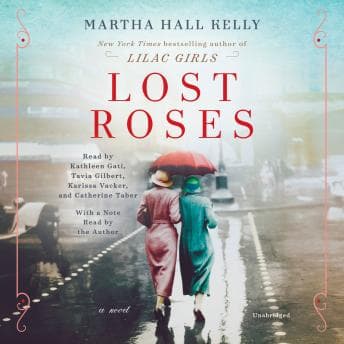
The four-narrator setup is genuinely spectacular here. Tavia Gilbert gives Eliza this passionate, sometimes strident energy that made me want to shake her and hug her simultaneously. She's privileged and occasionally oblivious, but her love for Sofya is bone-deep real. Meanwhile, Kathleen Gati as Sofya... listen. This woman understood the assignment. Her soft, sophisticated Russian aristocrat voice carries such dignity even as Sofya's world crumbles around her. The contrast between her refined delivery in the early St. Petersburg scenes versus the desperate survival chapters later? My heart. MY HEART. That kind of vocal transformation—watching a character's entire world shift through narration alone—reminded me of the emotional arc in Lost Girl, though this one cuts deeper.
Varinka Made Me Uncomfortable (In the Best Way)
Karissa Vacker voices Varinka with these harsh consonants that immediately set her apart from the aristocratic women. She's the fortune-teller's daughter hired as domestic help, and from the moment she enters the Streshnayva household, you feel the danger. Vacker doesn't play her as a cartoon villain—there's hunger there, resentment that feels earned even when her choices become monstrous. I found myself understanding her even while hating what she does. That's good writing AND good narration working together.
And then there's Catherine Taber as young Luba, Sofya's little sister. Her voice is so hopeful, so naive, that every time she spoke I wanted to reach through my headphones and protect her. (I couldn't. Obviously. This is historical fiction about the Russian Revolution. Nobody gets protected.)
Fifteen Hours of Emotional Devastation at 1.0x Speed
Look, 15+ hours is a lot. I listened over almost two weeks of design projects—logos, social media graphics, one very complicated restaurant rebrand. Some audiobooks I speed through because the story demands urgency. This one? I stayed at 1.0x the whole time. The vibes are immaculate but heavy. This is not a background listen. This is a rainy Sunday book stretched across many rainy Sundays.
The pacing does slow in the middle sections when we're jumping between New York society functions and Russian countryside survival. But Kelly earns those slower moments by making the emotional payoffs absolutely devastating. When Eliza finally gets news about Sofya's fate, I was in my kitchen making coffee at 7 AM and had to grip the counter. Heartburn made me do something similar—stop everything mid-task because the emotional punch landed so precisely.
Abuela would have loved this one. She had this thing about stories where women survive impossible circumstances—probably because she lived through a few herself. The telenovela energy is here, but elevated. Refined. Still plenty of moments where she would've gasped and clutched her rosary, though.
Who Needs This Story (And Who Should Wait)
It felt like finding old letters in your grandmother's jewelry box. Beautiful and painful and impossible to put down even when it hurts.
If you loved Lilac Girls, this prequel delivers the same emotional gut-punches with the added bonus of watching the Romanov era collapse in real-time. If you're coming in fresh, you don't need the first book—this stands completely alone.
Skip this if: You need fast pacing to stay engaged, or if you're in a season of life where stories about separated friends and lost children will be too much. (No shame. I've been there. Some books need to wait for the right moment.)
Listen if: You want historical fiction that makes you feel the weight of what women survived. If you want narrators who understand that aristocratic Russian and strident New Yorker and desperate peasant all require completely different vocal approaches. If you want to ugly-cry at least twice.
I cried three times. Didn't make the spreadsheet this year but this one would've earned multiple entries.
Worth Every Tear, Every Hour, Every Pause to Collect Myself
The four-narrator production elevates what could have been a straightforward historical drama into something genuinely immersive. Each woman's story braids together with such care that by the end, you feel like you've lived through the revolution yourself—safe in your apartment with your cats, but emotionally devastated nonetheless.
Worth every hour. Worth every tear. Worth clearing your schedule so you can listen without interruption when it matters most.