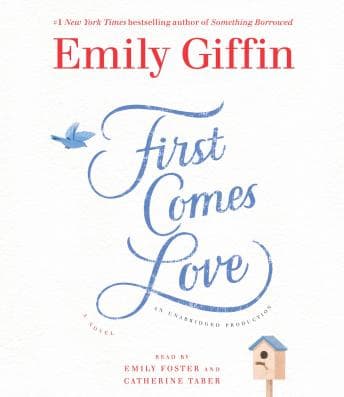

Sisters are the people who know exactly which buttons to push because they installed them. Emily Giffin gets this. Really gets it.
I listened to First Comes Love over two weeks of late-night grading sessions, and honestly? It was the only thing keeping me from throwing my red pen across the room. There's something almost therapeutic about listening to two fictional sisters tear each other apart while you're marking up essays about The Great Gatsby for the hundredth time.
The Two Voices in Your Head
Here's where this audiobook makes a smart choice: two narrators for two sisters. Catherine Taber takes Josie—all high energy and impulsive warmth—while Emily Foster handles Meredith with this lower, more measured delivery. It works. You know immediately whose head you're in without any "Chapter 12: Meredith" announcements.
Taber's Josie is exactly the kind of person who'd corner you at a faculty meeting to tell you about her dating life. (I know this type. I avoid eye contact with this type.) Foster's Meredith sounds like every type-A attorney I've ever met—controlled on the surface, barely holding it together underneath. The contrast isn't subtle, but neither is sibling rivalry.
I'll be honest: some listeners apparently preferred one narrator over the other, and I get it. Josie's sections can feel a bit... much. But that's the character, right? Giffin wrote her that way. Taber's just doing her job.
The one thing that pulled me out occasionally was the voice used for Meredith's four-year-old daughter. Something about it didn't quite land. Minor complaint in twelve hours of otherwise solid narration, but it's there.
What Giffin's Really Saying
Look, on the surface this is a book about two sisters dealing with old grief and present-day life choices. Josie wants to become a mother. Meredith has the picture-perfect life and secretly wonders if she chose it or if it chose her. Standard women's fiction territory.
But here's what makes it worth your twelve hours: Giffin doesn't let either sister be right. Or wrong. They're both frustrating and sympathetic in equal measure. Meredith's resentment is exhausting but earned. Josie's impulsiveness is maddening but understandable.
This is the kind of emotional honesty that reminds me why I still teach literature. Characters who aren't heroes or villains—just people making choices they'll have to live with. My students would probably find it "slow." (They find everything slow. They think The Great Gatsby is too long.) But for anyone who's ever had a complicated relationship with a sibling, this hits different.
The tragedy that fractured these sisters fifteen years ago—I won't spoil it—hangs over everything. Giffin handles grief the way grief actually works: not as a neat arc with closure, but as this thing that keeps reshaping itself, keeps demanding attention at the worst moments.
The Pacing Question
At twelve hours, this isn't a quick listen. And there are stretches in the middle where I felt the narrative spinning its wheels a bit. Both sisters circling the same emotional territory, having similar internal debates. I found myself grading a little faster during those sections.
But when it works—when the sisters finally confront each other, when the secrets surface—it earns every minute of setup. The slow burn pays off. I just wish Giffin had trusted her readers enough to trim some of the repetition.
I listened at 1.0x because—and my students mock me for this—the rhythm of good prose matters. But honestly? 1.15x wouldn't hurt here. The narrators are clear enough to handle it.
Who This Is (and Isn't) For
If you're a fan of Giffin's other work—Something Borrowed, Where We Belong—you know what you're getting. This is her wheelhouse: smart women, complicated relationships, emotional stakes that feel real rather than manufactured. That same focus on genuine emotional complexity shows up in Secret Garden, though the family dynamics there are quieter, more rooted in place than conflict.
Best for: Long commutes. Grading sessions. Walks along the lakefront when you want something engaging but not demanding. Denise and I listened to parts of this together, and she kept pausing to say "that's exactly what my sister would do." (She meant it as criticism. I think.)
Maybe skip if: You need action to stay engaged. Or if family conflict as entertainment isn't your thing—there's a lot of it here, and it can feel heavy.
Class Dismissed
The dual narration won an AudioFile Earphones Award, and I can see why. Taber and Foster don't just read the book—they interpret it. They understand that these sisters are performing for each other, hiding behind carefully constructed versions of themselves. The narration captures that performance.
Giffin's thesis seems to be that love—real love, family love—requires seeing people as they actually are, not as you need them to be. It's not a revolutionary idea, but she earns it through twelve hours of messy, honest storytelling.
Worth pausing the faculty meeting for. (Sorry, Principal Martinez.)