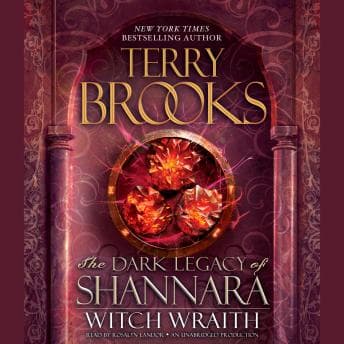
Look, I need to rant about something before we get into this. I've been a fantasy reader since I was sneaking Dragonlance novels into my bedroom past my parents' "no secular fiction" policy, and I have opinions about legacy fantasy series that refuse to end. Terry Brooks has been writing Shannara books since 1977. That's nearly five decades of Elves and Druids and magical MacGuffins. And yet here I am, finishing the third book in The Dark Legacy of Shannara trilogy at 1 AM on a Tuesday, sitting in the dark corner of my library branch after hours because I was shelving returns and got sucked in and forgot to leave. So clearly the man is doing something right.
The Forbidding Breaks Open and So Does Brooks's Formula
Here's what surprised me about Witch Wraith: it's darker than I expected from Brooks. Not horror-dark — let's be clear, this isn't Shirley Jackson territory and it never pretends to be — but there's a genuine sense of dread woven through the Forbidding sequences that I wasn't anticipating from someone whose earlier work reads more like a Tolkien tribute band. The demon hordes spilling through collapsing wards, Arling Elessedil's captivity under the Federation's Prime Minister, the growing desperation as every plan falls apart — Brooks is working with a ticking clock structure here, and at fifteen hours and forty-one minutes, he lets that clock tick slowly.
Railing Ohmsford's storyline — the kid chasing down his ancestor Grianne in a move that's either heroic or catastrophically stupid — carries the emotional weight of the book. Brooks doesn't shy away from the consequences of obsession, and Railing's willingness to burn everything down for his brother gives the narrative a moral complexity that the earlier Shannara books sometimes lacked. The question of whether Grianne is savior or something far worse? That's the engine driving the back half, and it works.
But I'll be honest: the Aphen/Arling sister dynamic, which should be the emotional core, occasionally gets lost in the machinery of the plot. Brooks has so many chess pieces moving — Federation politics, Druid conflicts, demon armies, Elfstone magic — that the human relationships sometimes feel like they're being squeezed into the gaps between action set pieces. For a trilogy closer, I wanted more quiet moments between these sisters. I got efficient plot resolution instead.
Rosalyn Landor Knows What She's Doing (And She Knows These Characters)
This is book three. Rosalyn Landor has been living with these characters for three full novels now, and you can hear it. There's a familiarity in her voice when she slips into Railing's desperate determination versus the measured, almost weary authority she brings to the Druid characters. She doesn't do vocal gymnastics — this isn't a performance that screams "look at me" — but her pacing through the descriptive passages is genuinely skilled. Brooks writes dense world-building paragraphs that could easily become monotonous, and Landor keeps them moving without rushing.
The action sequences are where she really earns her keep. There's a propulsive energy she brings to the battle scenes that made me forget I was sitting alone in a dark library surrounded by children's picture books. (Shirley Jackson would appreciate the contrast. Shirley my cat would not care.) The narrator commits. That's rare, especially in epic fantasy where the temptation to go full "ye olde" theatrical is strong. Landor stays grounded.
What I can't tell you is whether she creates radically distinct voices for every character — with this many players on the board, some blending is inevitable, and I occasionally lost track of who was speaking in group dialogue scenes. But her tone shifts are reliable enough that the major characters stay identifiable.
Who This Is Actually For (And Who Should Walk Away)
If you haven't read the first two books in this trilogy — Wards of Faerie and Bloodfire Quest — do not start here. You will be lost immediately, and Brooks doesn't hold your hand. This is a payoff book, not an entry point.
If you're a longtime Shannara reader, this is Brooks working at a level of narrative ambition that goes beyond his earlier trilogies. It's not perfect — the pacing sags in the middle hours and some character arcs resolve too neatly — but the Grianne Ohmsford storyline alone justifies the listen.
If you scare easily... well, this isn't that kind of dark. But the Forbidding sequences have a creeping wrongness to them that scratched my horror itch just enough to keep me interested.
And if you're new to Brooks entirely? Start with The Sword of Shannara or don't start at all. Context matters with this author. The same patience-rewarding quality shows up in Fourth Wing, another sprawling fantasy that expects you to trust the build before the payoff lands.
Shelving This One in the "Glad I Stayed After Hours" Section
Fifteen hours is a commitment, and Witch Wraith earns about thirteen of them. Landor's narration carries the slower stretches, the final act delivers genuine stakes, and Brooks proves that even after forty-plus years in the Four Lands, he can still surprise you. Not a perfect listen, but a satisfying one — the kind of trilogy closer that respects the investment you've already made. My podcast listeners who've been asking me to cover more fantasy? This is the one I'll point them to when they want epic scope without sacrificing character consequence.