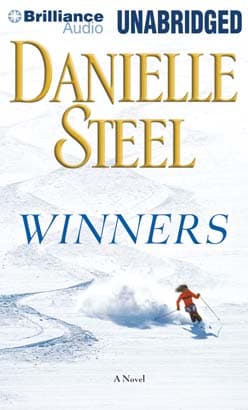

Is it possible to read a Danielle Steel novel and NOT know exactly how it's going to end within the first twenty pages? And does it even matter?
I'm asking because I just finished Winners during a truly heroic stretch of Sophie's nap times this week, and the answer to both questions is: no. And honestly? I'm fine with it.
Six Characters, One Rehab Facility, and All the Feelings
Here's the setup: Lily Thomas is training for the Olympics when a ski accident leaves her with a spinal cord injury. Her wealthy father Bill channels his grief into building a state-of-the-art rehab center. And then Steel does what Steel does best — she populates that center with a handful of people whose lives have been wrecked in various ways and lets them slowly, predictably, inevitably put themselves back together.
You've got Dr. Jessie Matthews, a neurosurgeon suddenly raising four kids alone. Joe, the financial manager betrayed by his business partner. Carole, a psychologist carrying the scars of breast cancer. Teddy, a young artist with a spinal cord injury even worse than Lily's. Steel rotates through all six storylines with the efficiency of someone who has written — what, 190 books? The woman does not waste time. That same juggling-multiple-lives energy is something Nine Perfect Strangers does too, though Moriarty lets her ensemble breathe a little longer before pulling everything together.
And that's both the strength and the weakness here. At 9 hours, it moves. Nobody gets bogged down. But six major characters in nine hours means nobody gets particularly deep either. Lily's journey from Olympic hopeful to Paralympic competitor is genuinely satisfying, and Teddy's quiet determination to get to college despite his injury hit me harder than I expected. But Joe's financial scandal subplot? Carole's romance? They felt like Steel was checking boxes on a whiteboard rather than letting these people breathe.
I kept wanting to spend more time with Lily and Teddy and less time with the characters who felt like they wandered in from a different, blander novel.
Dan John Miller Brings the Warmth (But Maybe Not the Women)
Okay, so Dan John Miller. The man has a genuinely warm voice — the kind of narrator who makes you feel like everything's going to be okay, which is exactly right for a book about resilience and recovery. His delivery during the emotional beats is sincere without being manipulative. When Bill is processing what happened to his daughter, Miller's voice gets this quiet, restrained quality that works so much better than big dramatic swings would have.
But — and this is the thing — his female voices all kind of... blend together? Lily, Jessie, Carole. They all have this slightly higher, slightly softer version of his regular voice, and when two women are in conversation, I sometimes had to rewind to figure out who was talking. For a book where four of the six main characters are women, that's a real problem. It's not terrible, but it kept pulling me out at moments when I should've been locked in.
I listened at my usual 1.25x and it worked perfectly. Steel's prose is straightforward — she's not writing sentences you need to sit with — and Miller's pacing at that speed felt natural, not rushed.
The Comfort Food Question
Look, I know what some of you are thinking. Danielle Steel. Predictable. Not "real literature." And sure, if you're looking for moral ambiguity or prose that makes you underline passages, this isn't it. The rehab facility gets built improbably fast. Everyone finds love or purpose or both. Lily gets back on skis. You can see every beat coming from about three chapters away.
But here's what I'll say: I listened to this during a week where Lucas had a stomach bug, Sophie refused to nap two days in a row, and I was running on coffee and spite. Honest moment: Butterfly Room scratched a similar itch for me a few months back — that same quiet reassurance that messy lives can find their way to something tender. And this book was exactly what I needed. It's warm. It's hopeful. It wraps up neatly. Sometimes you don't need to be challenged — you need to be reassured that things can get better, even when they're really, really bad.
The Lily-to-Paralympics arc genuinely moved me. Not ugly-cry-at-pickup moved me, but eyes-got-a-little-bright-at-a-red-light moved me. And Teddy painting from his wheelchair, refusing to let his injury define his future — that stayed with me after the book ended.
Who This Is For (and Who Should Skip)
If you already know you like Danielle Steel, this is solid mid-tier Steel. Not her best, not her worst. If you've never read her, this is actually a decent entry point — multiple storylines keep things moving and the disability representation, while a little idealized, comes from a genuine place.
Skip this if: you need complex characters, you can't handle a male narrator voicing multiple women without much differentiation, or the idea of a billionaire solving problems by throwing money at them makes you twitch.
Survived 47 pauses and still made sense. Not groundbreaking, but sometimes you don't need groundbreaking. You just need someone to tell you that broken things can be put back together. Car time approved — just barely.