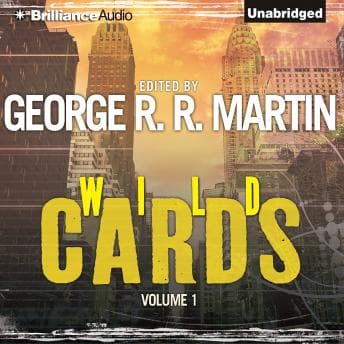

Okay, I need to rant about something before we get into this. Wild Cards I is a shared-world anthology — meaning like eight different authors wrote interconnected stories set in the same universe — and they handed ALL of it to one narrator. One guy. Luke Daniels. Doing voices for characters created by Roger Zelazny, Walter Jon Williams, Melinda Snodgrass, Howard Waldrop, and more. Each writer has a completely different style, different dialogue cadence, different everything. That's like asking one DM to run a campaign written by eight different people who never talked to each other about tone. (Actually, that sounds exactly like my old D&D group in high school. It went about as well as you'd expect.)
I was deep into a late-night coding session — allegedly working on my procedural generation thesis, actually refactoring the same function for the third time — when I figured I'd give this a spin. Nineteen hours is a commitment. Yes, it's worth it. Mostly.
The Superpower Lottery From Hell
So the premise: an alien virus called the Wild Card hits Earth in 1946. Draw an ace, you get superpowers. Draw a joker, you get grotesquely mutated. Draw the black queen — you die. Horribly. And most people draw the black queen. This isn't Marvel. This isn't even grimdark superheroes. It's alternate history where superpowered beings get tangled up in McCarthyism, the Cold War, gang violence, and government paranoia. The magic system is — well, it's not a magic system exactly, but the way the virus works? Chef's kiss. It's biological, it's random, and the consequences are genuinely horrifying for the jokers. Sanderson would appreciate the internal consistency even if it's not hard-magic in his style. The same itch for internally-consistent power systems with real political teeth got scratched when I reviewed Iron Flame — different setting entirely, but that same sense that the rules of the world were worked out by someone who actually cared about consequences.
The strongest stories here are the ones that lean into the alt-history. The Four Aces — these golden-age heroes who get dragged before HUAC and destroyed by the government they served — that's the emotional backbone of the book. It's doing what the best speculative fiction does: taking a what-if and following it to uncomfortable places. The weakest stories feel more like standard superhero origin tales that could've been in any anthology. The shared-world format means quality is uneven, and you feel the seams between authors. Some transitions between stories are jarring — you'll be deep in one character's arc and then suddenly you're in a completely different decade with a completely different protagonist.
But here's the thing: when it works, it WORKS. The sheer ambition of building this world across multiple perspectives, spanning decades of alternate American history — this is Sanderson-level world-building, just assembled by committee instead of one obsessive architect.
Luke Daniels vs. The Anthology Problem
Luke Daniels is a solid narrator. Good speed, clear differentiation between most characters, and he handles the tonal shifts between authors better than he has any right to. His male characters are distinct — you can tell who's talking without the "he said" tags, which is the baseline but you'd be surprised how many narrators can't manage it in an anthology format.
But — and this is the thing — some of his female voices veer into this slightly whiny register that pulled me out of the story. It's not constant, and it's not dealbreaking, but when you're nineteen hours deep and a female character shows up with that same thin, pinched quality, you notice. There's also this mechanical flatness that creeps in during some of the more expository passages, like he's reading the worldbuilding dumps on autopilot. And look, I'm the guy who will defend info-dumps with my dying breath — if you don't like info-dumps, this isn't for you (but you're wrong) — but even I need the narrator to sound like he cares about the geopolitical implications of an ace arms race.
Steven Pacey walked so other narrators could run, and Daniels is... jogging? He's competent and occasionally great, but this needed either a full cast (which the later Wild Cards audiobooks apparently got) or a narrator who could shift his entire vocal personality between stories the way the authors shift their prose styles.
Who Should Roll These Dice
If you're into alt-history, superhero deconstruction, or shared-world fiction — yeah, get in here. My D&D group would love this as campaign inspiration. The virus-as-random-mutation framework is basically a character creation system, and the political consequences of superpowers are way more interesting than "and then they fought the bad guy."
Skip it if: you need a single protagonist arc, you hate anthology formats, or you want your superhero fiction clean and optimistic. This has violence, sex, body horror (the joker transformations are rough), and a deeply cynical view of how America would actually treat people who are different. Which, you know. Tracks.
My Thesis Can Wait Another Week
I read this instead of writing my thesis, and I have mixed feelings about both decisions. Wild Cards I is ambitious, uneven, and genuinely unlike most superhero fiction out there. The anthology format is both its greatest strength and its biggest weakness — you get this incredible breadth of perspective but lose narrative momentum every time you jump authors. Daniels does a respectable job with an impossible task, but this is the kind of book that would sing with a full cast. At nineteen hours, it's asking a lot. But the world it builds is dense and real and worth the investment if you're the kind of person who wants to know what happens when you mix superpowers with real history.
Which I absolutely am. (Dr. Patel, if you're reading this — I was also working on Chapter 3. Probably.)