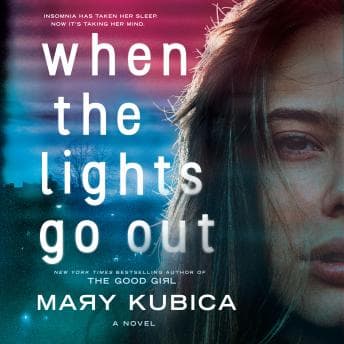

Three AM. The unit was eerily quiet — the kind of quiet that makes you check monitors twice because silence in a trauma center means either everything's fine or something terrible is about to happen. I was caught up on charting for once, so I popped in my earbuds and started this one. Bad idea. Not because it's scary, exactly, but because Mary Kubica wrote an insomnia narrative so convincing that by hour three I genuinely couldn't tell if I was tired because of my shift or because the book was doing something to my brain.
When Your Social Security Number Belongs to a Dead Girl
Here's the setup: Jessie Sloane has just lost her mother to cancer. She's grieving, she's exhausted, and she's trying to start over — applies for college, gets a new apartment. Then the college flags her social security number because it belongs to someone who died seventeen years ago. A death certificate. In her name. For someone who died as an infant.
And that's when Jessie stops sleeping. Like, completely.
Kubica does something clever here — she uses Jessie's insomnia as both a plot device and an unreliable narrator mechanism. As the days pile up without sleep, Jessie starts seeing things, questioning things, and we're right there with her, unable to separate what's real from what's hallucination. As someone who's actually worked a code on a patient in the middle of a psychotic break from sleep deprivation — yes, it happens, and yes, it's terrifying — I can tell you Kubica gets the disorientation mostly right. The way thoughts loop. The way you become convinced of things that don't make sense. The paranoia. It's not medically precise (the timeline is compressed in ways that wouldn't quite track clinically), but the feeling of it? Accurate enough that I was uncomfortable.
Meanwhile, twenty years earlier, we get Eden's story. Eden is desperate for a baby. Her marriage is crumbling under the weight of infertility, and she's making increasingly questionable decisions. You can see where these two timelines are going to collide, and honestly, that predictability is both a strength and a weakness.
Two Narrators, Two Very Different Energies
Julia Whelan handles Jessie. Jayme Mattler takes Eden. And the split works — mostly. Whelan is the heavy hitter here. She captures Jessie's spiral into delirium with this raw, ragged quality that made me genuinely anxious during my drive home one morning. There's a stretch where Jessie hasn't slept in days and Whelan's delivery gets this fragile, almost brittle edge to it. You can hear the character fraying. That's not easy to pull off without tipping into melodrama, and Whelan walks that line well.
Mattler's Eden sections are... fine. Competent. But there's a flatness to them that made me less invested in the past timeline. Eden's grief over her infertility should gut you — I know women who've lived that pain, my sister-in-law went through three rounds of IVF — but Mattler's delivery kept me at arm's length when it should have pulled me in. Not bad. Just not matching Whelan's intensity.
The dual narrator format does make it easy to track which timeline you're in, which matters because Kubica alternates frequently and without a lot of hand-holding.
The Ending Problem (No Spoilers, But Fair Warning)
Look. I'm not going to spoil it. But I need to be honest: the ending is divisive for a reason. You spend six hours building toward this revelation and when it comes, it's... it's one of those twists where half the audience goes "Oh wow" and the other half goes "Wait, that's it?" I was somewhere in between. I didn't yell at my dashboard, which for a thriller is actually not a great sign — it means I wasn't invested enough to be mad OR thrilled.
The pacing is the real issue. This is a 6-hour audiobook that feels longer than it is. The insomnia sequences, while effective early on, start to loop and repeat in ways that feel less like artistic choice and more like padding. By hour four I was checking my phone to see how much was left, which — when you're driving on the I-10 at 7 AM after a twelve-hour shift — is not ideal.
Kubica is better than this. The Good Girl had me white-knuckling my steering wheel. This one had me reaching for my coffee. Close to Home scratched that same itch for me — the dread builds the right way there, and I didn't once check my phone.
Who's Going to Love This (and Who Should Keep Driving)
If you're a Kubica completist, you'll want to hear it. If you're drawn to psychological thrillers about identity and motherhood and the ways grief can literally make you lose yourself — there's something here for you. The medical-adjacent stuff around insomnia is interesting even when the plot sags.
But if you need a thriller that actually thrills? If slow pacing makes you antsy? Skip ahead to Local Woman Missing instead. This one's more of a psychological character study wearing a thriller's clothes.
Carlos asked why I looked so tired when I got home that morning. I told him the audiobook gave me sympathy insomnia. He did not think that was funny.
Night Shift Prescription
Borrow it. Stream it on Libby. It's a decent listen that doesn't quite earn a credit, especially at only six hours. Whelan's performance is worth hearing, but the slow burn never fully catches fire. Perfect for that post-shift decompression if you're okay with a simmer instead of a boil — just maybe don't listen during an actual bout of insomnia. Trust me on that one.