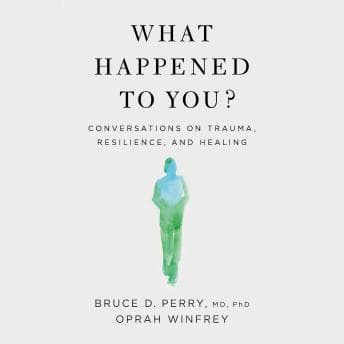

I Hate Admitting When I'm Wrong (But Here We Are)
I went into this ready to roll my eyes. Seriously. I had my chopping board out, a glass of Pinot Noir poured, and my "skeptical academic" face on. A celebrity talk show host and a psychiatrist? It sounded like the setup for a watered-down, made-for-TV special on feelings. I usually prefer my psychology dry, peer-reviewed, and cited in APA format.
But about twenty minutes in—somewhere between chopping onions and realizing I forgot the ginger—I stopped. I literally put the knife down.
Because Dr. Perry wasn't spewing generic self-help fluff. He was talking about the brainstem. He was explaining the hierarchy of brain organization and how early developmental trauma literally alters the architecture of a developing mind. And he was doing it accurately.
(My dissertation committee would probably frown at me enjoying this more than the latest issue of JAMA Psychiatry, but whatever.)
It's Not A Book, It's A Session
Most non-fiction audiobooks make the mistake of lecturing you. You get the "Voice of God" narrator reading statistics while you zone out. This isn't that.
The format is strictly conversational. It feels like you're sitting in the corner of a very comfortable, very expensive living room while Oprah and Bruce (we're on a first-name basis now, apparently) just talk. Oprah plays the role of the audience surrogate—she asks the questions, shares the vulnerable, messy stories from her own childhood (the whippings, the loneliness), and then Perry steps in to explain the neuroscience behind why those moments stuck.
It works. It really works.
Perry has this calm, rhythmic cadence that is almost hypnotic. He explains the concept of "regulation"—how you can't reason with someone who isn't regulated—in a way that made me look at my own research subjects differently. I spend my life analyzing why fictional characters do terrible things. This book lays out the mechanics. The villain isn't just "evil"; his stress response system is permanently stuck in fight-or-flight because of what happened when he was three.
The "Click" Moment
There was a specific moment where they discuss the difference between a "state" and a "trait." We tend to label people based on their states (angry, withdrawn) as if they are permanent traits (mean, anti-social).
I found myself staring at my half-finished curry, thinking about the paper I'm currently writing on anti-heroes. It's not just distinct character choices; it's biology. The way Perry explains the "dosing" of social interaction—how traumatized brains can only handle connection in small bits—is spot on. Clinically sound, but stripped of the jargon that makes my students fall asleep in Lecture Hall B. Similar to how Short History of Nearly Everything makes complex science accessible without dumbing it down, this translates neuroscience for humans who don't read journals for fun.
That said, it's not perfect. Sometimes Oprah interrupts right when Perry is getting to the good science bits, which triggers my own impatience. And if you're looking for a rigorous academic text, this is still "pop" science. It's the best version of pop science, but it's designed for the masses, not the lab.
A Warning Label
A serious heads-up: This is heavy. Like, "might need to sit in silence for ten minutes after" heavy. They discuss abuse, neglect, and systemic racism with a frankness that can be jarring. If you have your own history, don't listen to this while you're driving in heavy traffic. I had to pause twice just to process a few points that hit a little too close to home regarding my own family dynamics.
(Yes, Maa, I'm analyzing us again. Sorry.)
Who This Is (And Isn't) For
If you work with people—therapists, teachers, parents, anyone trying to understand difficult behavior—this belongs in your ears. Same goes if you're doing your own healing work and want the science behind why certain approaches actually help. Skip it if you need peer-reviewed citations and controlled studies; this is accessible neuroscience, not a literature review.
The Verdict
I finished the audiobook and immediately ordered a physical copy to highlight. My therapist is going to be incredibly smug when I tell her I actually got something out of an Oprah book.
It's not a magic pill. It won't fix your life overnight. But it gives you a different lens to look at the people who annoy you—and the parts of yourself you don't understand. Instead of asking "Why am I like this?", you start looking at the timeline. And scientifically speaking? That tracks.









![Steve Jobs [unabridged audiobook] audiobook cover](/_next/image?url=https%3A%2F%2Fcovers.audiobooks.com%2Fimages%2Fcovers%2Ffull%2F9788499923406.jpg&w=1920&q=75)