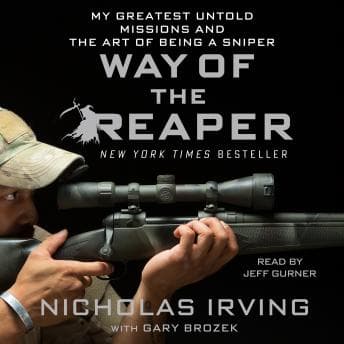

Everyone compares this to American Sniper. I get it - military memoir, elite shooter, combat in the Middle East. But here's the thing: Chris Kyle's book was a war story with sniping in it. Way of the Reaper is a sniper manual with war stories wrapped around it. That's a meaningful distinction, and it's why I finished this one instead of letting it rot in my 70% graveyard.
I started this on a late-night drive back from a client site in Orange County - Jenny was asleep in the passenger seat, and I needed something to keep me sharp on the 405. Within twenty minutes I was white-knuckling the steering wheel during Irving's account of engaging a Taliban suicide bomber mid-firefight. Not because I was scared. Because the man breaks down the decision-making process in real time - wind calculation, distance estimation, the split-second go/no-go on a target wearing a vest full of explosives. That's operational decision-making under pressure that would make most C-suite executives soil their Hermès ties.
The 10-Kill Framework Is Actually Brilliant Structure
Here's what surprised me: the book is organized around Irving's 10 most significant kills, and each one teaches a different element of the craft. Intel gathering. Recon. Weaponry selection. Patience. Luck. It's basically a case study format - and I don't say that lightly, because I've written more McKinsey case studies than I care to remember. Each chapter isolates a variable, shows you the setup, walks you through execution, then unpacks what went right or sideways.
The longest shot chapter - over half a mile on a human target - is where the book hits its stride. Irving doesn't just tell you he made the shot. He walks you through the sub-sonic ammo selection, the environmental factors, the math. There's a discipline here that my parents would've recognized from running their dry cleaning business. Not the killing, obviously. The preparation. The obsessive attention to detail. The understanding that the margin between success and catastrophe is measured in millimeters.
At 7 hours and 8 minutes, this is tight for a military memoir. Most of these books bloat past 10 hours with childhood backstory and political editorializing. Irving keeps it lean. Finally, a book that respects your time.
Jeff Gurner Does the Heavy Lifting - Mostly
Gurner's voice has this deep, controlled quality that works perfectly for the material. He reads it like a briefing, not a bedtime story. There's weight behind the combat sequences without dipping into melodrama. Where Kyle's audiobook sometimes felt like a guy at a bar telling you war stories (which has its own charm), Gurner keeps Irving's account clinical and grounded.
But - and this is worth noting - Irving reads his own preface, and there's a jarring tonal shift when Gurner takes over. Irving's voice is more casual, a bit rougher around the edges. Gurner is polished. It's like watching a documentary that switches directors mid-scene. Not a dealbreaker, but you feel the seam.
The narration can also flatten out during the more technical passages about weapon specs and ballistics tables. Gurner's steady cadence, which is an asset during firefights, becomes almost monotone when the material goes instructional. I bumped down to 1.75x for those sections, which - if you know me - is basically admitting defeat.
Where the Book Flinches
The subtitle promises "the art of being a sniper" and the description mentions examining "the personal ramifications of taking another life." The first promise? Delivered. The second? Barely touched. Irving gestures toward the psychological cost a few times but never really sits in it. I wanted the emotional P&L, not just the operational one.
This is where American Sniper, for all its flaws, had more guts. Kyle was messier about what the work did to him. Irving keeps his armor on. I respect that as a person. As a reader, it left me wanting. Jeannette Walls had no such armor in Glass Castle — that book goes places emotionally that Irving simply refuses to go, and the contrast is stark once you've read both.
Also, Gary Brozek's co-writing is competent but occasionally gives the prose a ghostwriter sheen - you can feel when Irving's authentic voice gets smoothed out into something more publishable. The audiobook format actually helps here because Gurner's delivery papers over the unevenness.
Who Gets Value Here (And Who Doesn't)
If you're into military history, this is a strong listen - more educational than most combat memoirs, less padded than almost all of them. If you want to understand elite decision-making under impossible constraints, there's genuine insight here that translates beyond the battlefield. I've seen startup founders make worse decisions with better information and zero incoming fire.
If you're looking for deep emotional processing of war's aftermath, this isn't it. If you've already read The Reaper (Irving's first book), some of the background will feel redundant.
Skip if you want philosophy. Listen if you want process.
The Consulting Equivalent of a Clean Kill
Bottom line: Way of the Reaper is a tight, efficient military memoir that delivers exactly what it promises on the operational side and underdelivers on the human side. At 7 hours, the ROI is solid. Gurner's narration is reliable if occasionally flat. Irving's framework of building each chapter around a specific kill and skill is genuinely clever structure that more nonfiction authors should steal. Jenny would say I'm being harsh about the emotional depth. Jenny is right. But the craft stuff alone earns the credit.







![Steve Jobs [unabridged audiobook] audiobook cover](/_next/image?url=https%3A%2F%2Fcovers.audiobooks.com%2Fimages%2Fcovers%2Ffull%2F9788499923406.jpg&w=1920&q=75)