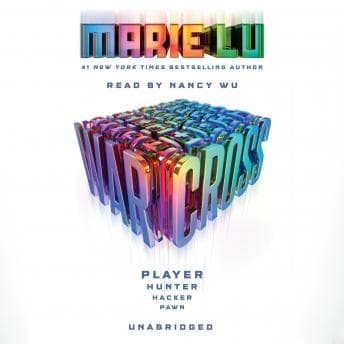

Okay, I need to rant about something. Warcross is basically a book about a VR esports tournament with high stakes, hacking, and a billionaire tech genius love interest — and somehow people are calling this boring? I've seen the complaints. "Formulaic." "Predictable." And look, I get it. If you've consumed enough Ready Player One-adjacent media, you might see the beats coming. But here's the thing those reviewers are missing: Marie Lu actually builds out how her game world works. The Warcross arenas, the power-ups, the team drafts, the way the NeuroLink overlays digital information onto the real world — this is the kind of tech-integrated world-building that makes my procedural generation thesis brain light up. (Not that I'm working on my thesis. I was listening to this instead of writing my thesis. Dr. Patel, if you're reading Audiobooks4soul.com reviews, I promise I'm being productive.)
I binged most of this during a late-night board game reorganization — I'd pulled everything off the shelves to sort by BGG rating (don't judge me) — and Warcross kept me company for the full eleven hours and change. Pretty good pairing, actually. Sorting cardboard while someone describes virtual reality tournaments.
The LitRPG That Doesn't Know It's LitRPG
Here's what I wish more people talked about with Warcross: it's basically YA LitRPG without the stat blocks. Emika gets drafted into a tournament team, there are clearly defined game mechanics with different player roles (Architects, Thieves, Fighters, etc.), power-ups function like items in an MMO, and the progression from scrappy bounty hunter to tournament competitor is satisfying. If Marie Lu had slapped some XP counters and skill trees into the narrative, the LitRPG community would've claimed this book years ago. The magic system — well, the tech system — is internally consistent and the rules of Warcross matches actually matter to the plot. That's more than a lot of VR-themed books can say.
The world outside the game is solid too. The NeuroLink glasses that basically everyone wears, the way digital bounties work, the economy built around Warcross gambling — Lu thought about how this technology would reshape daily life, not just combat arenas. It's not Sanderson-level world-building, but for a YA sci-fi thriller clocking in under 12 hours? She does real work here.
Where it stumbles is the romance. Emika and Hideo have that classic YA insta-attraction thing going, and while I don't hate it, it does eat into time that could've been spent on the tournament matches or the hacking investigation. The twist at the end genuinely caught me off guard though — I'll give Lu that. I was mid-alphabetizing my Wingspan expansions and actually stopped what I was doing.
Nancy Wu's Emika Problem
Nancy Wu does solid work here, but it's uneven in ways that bugged me. Her Emika voice is strong — she nails the first-person narration with the right mix of confidence and vulnerability for a teenage hacker who's been sleeping on friends' couches. Where things get weird is Hideo. He's supposed to be Japanese-British, and Wu gives him this British accent that... comes and goes. Like, one scene he sounds distinctly British, and two chapters later the accent's just gone. It's distracting once you notice it, and you will notice it.
Some folks have said the narration sounds too hyperactive during serious moments, and yeah, I can hear that. There's a mismatch sometimes between the weight of what's happening — corporate conspiracies, surveillance ethics, real danger — and the peppy delivery. It works for the tournament scenes, where that energy is appropriate. Less so when the story's trying to land emotional punches about Emika's past or Hideo's family trauma.
That said, Wu handles the ensemble cast well enough. The different Warcross teammates get distinct enough voices that I could track who was talking during team strategy scenes without getting lost. She's no Steven Pacey — Steven Pacey walked so other narrators could run — but she's competent. On the subject of narrators who can't quite stick the landing on accents, I ran into a similar gripe with To Murder a King: Struggle for the Crown Book 2, where the historical voice work is ambitious but inconsistent in ways that pulled me out of otherwise solid material.
Who Rolls Initiative on This One
If you're a YA reader who likes sci-fi premises, or if you've been wanting to dip into something that feels like LitRPG without fully committing to the genre, this is a great entry point. My D&D group would love this — the tournament structure basically plays out like a campaign arc. If you're coming from adult sci-fi expecting hard technology or deep philosophical exploration of VR... temper those expectations. This is popcorn sci-fi. Fun, fast, satisfying in the moment.
Speed recommendation: bumping to 1.25x helped with some of the slower middle sections without losing Wu's character work.
Worth Burning a Long Rest On?
Warcross is a fun listen that doesn't overstay its welcome. The world-building is genuinely creative, the tournament scenes are exciting, and the ending twist recontextualizes enough to make me want the sequel. Wu's narration has some rough edges — that flickering Hideo accent, the tonal inconsistency during heavy scenes — but she carries Emika's voice well. It's not going to change your life, but it'll make a board game reorganization fly by. Three and a half stars, rounded up for the world-building and that ending.