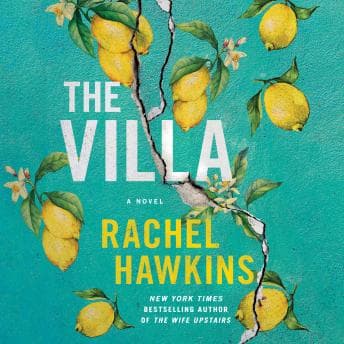

Rachel Hawkins wants to be Shirley Jackson so badly it hurts. And look - I say that with genuine affection, because the bones of The Villa are good bones. The dual-timeline structure, the creative women trapped in toxic dynamics, the Italian gothic setting dripping with heat and decay. It's giving Mary Shelley at Villa Diodani, it's giving Fleetwood Mac imploding in the studio, it's giving... well, it's giving a lot of things, and that might be part of the problem.
Let me back up. I was shelving returns at the library on a Saturday afternoon - the quiet kind of Saturday where the rain's doing all the talking - and I had this queued up for my shift. Earbuds in, processing holds, letting the story unspool while I alphabetized. Which turned out to be the right energy for this one, because The Villa rewards a certain kind of distracted attention. It's not demanding your full nervous system the way the best horror does. But it is sly.
The Ghost of Mary Shelley Is Doing a Lot of Heavy Lifting
So here's the setup: Emily, a woman whose identity has been slowly consumed by her best friend Chess's gravitational pull, joins said friend at an Italian villa with a bloody past. In 1974, a rock star named Noel Gordon rented the same place, brought along musician Pierce Sheldon, Pierce's girlfriend Mari, and Mari's stepsister Lara. Drugs, music, creative jealousy, and eventually murder. Mari wrote a legendary horror novel out of it. Lara wrote a platinum album. Pierce ended up dead.
The parallels between timelines are where Hawkins does her sharpest work - the way Emily mirrors Mari, the way Chess mirrors the charismatic figures who devour the people around them. The 1974 timeline is genuinely unsettling in places, this slow simmer of a woman realizing that the people she loves might be capable of something monstrous. The present-day timeline? Less so. Emily's investigation into the villa's history reads more like a true-crime podcast binge than a descent into real danger, and the friendship tension between her and Chess, while well-drawn early on, starts hitting the same notes over and over.
Hawkins clearly studied the Shelley-Byron summer, the Manson cultural fallout, the way art born from violence gets mythologized. I respect the research. But the book sometimes feels like it's checking off influences rather than metabolizing them. Shirley Jackson walked so this author could run - but the running feels a little breathless in the wrong way, like someone trying to cover too much ground.
Three Narrators, Three Timelines, One Smart Decision
Here's where the audiobook earns its keep. Julia Whelan handles Emily's sections, and she does something clever with Chess that I genuinely appreciated - she gives her this folksy Southern drawl that sounds warm and inviting on the surface but carries an edge underneath, like sweet tea with something bitter dissolved in it. That vocal choice tells you everything you need to know about how Emily perceives Chess before the text even gets there. The narrator commits. That's rare.
Shiromi Arserio takes the 1974 timeline, and she's the one doing the real horror work here. There are these longing sighs she uses for Mari - not overdone, just enough to convey a woman who's slowly losing her grip on what's real - and then these sharp, intense moments where she raises her voice and the shift is genuinely jarring. She understands that gothic suspense lives in the contrast between whisper and scream.
Kimberly M. Wetherell gets the podcast excerpts and article sections - the meta-textual framing devices - and her steady, almost clinical delivery actually works perfectly as counterbalance. It grounds you. Reminds you that this is a story being told about a story, which is very much the point.
The production includes some music cues that I noticed but didn't find distracting. Smart choice for the 1974 sections especially.
Where the Foundation Cracks
The mystery itself is... fine. I figured out the present-day twist before the halfway mark, which for an eight-hour listen means I spent about four hours waiting for the book to catch up with me. The 1974 reveal lands harder, but even that feels slightly telegraphed if you've spent any time with gothic fiction (and hi, I've spent my entire adult life with gothic fiction). Hawkins writes engaging sentences and her pacing moves well - this never drags exactly - but the suspense relies more on withholding information than on building genuine dread.
And that's the distinction, right? This understands that horror isn't about gore - it's about dread. The book knows this intellectually. But it doesn't always feel it in its bones.
Who Gets the Key to the Villa
If you love Lucy Foley, Ruth Ware, that whole school of atmospheric thriller with a literary bent - you'll eat this up. The audiobook production genuinely elevates the material, and the three-narrator approach keeps you oriented in a story that could easily get tangled. If you're coming at this as a horror listener expecting to feel genuinely afraid? Temper those expectations. This is thriller-with-gothic-wallpaper, not horror that's going to follow you to bed. All the Tranquil Dead is what I reach for when I want something that actually delivers on the gothic dread this book keeps promising.
Shirley (my cat) was unimpressed. I was entertained. Not terrified, not transformed, but entertained - and sometimes that's enough for a rainy Saturday at the library.
My podcast listeners are going to have opinions about this one. The Shelley parallels alone will fuel a forty-minute episode.