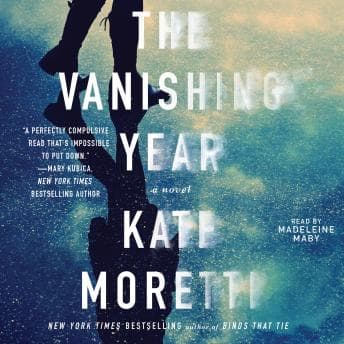

"Who she is" — that's the question Moretti keeps twisting like a knife for nearly ten hours, and somewhere around the midpoint I realized I'd stopped grading the stack of sophomore essays in front of me entirely. Just sat there at my kitchen table at 11:30 PM, red pen frozen in hand, because Zoe Whittaker — or whoever she actually is — had pulled me so completely into her Tribeca penthouse that a sixteen-year-old's take on The Great Gatsby could wait.
Let me back up. The Vanishing Year operates on a premise that's deceptively simple: beautiful young wife of Wall Street money discovers her carefully constructed new identity is crumbling. We've seen this skeleton before — the woman-in-the-gilded-cage thriller. But Moretti does something clever with the architecture. She doesn't just give you Zoe's present tense unraveling. She gives you the before, the version of this woman who needed to vanish in the first place, and she lets you hold both versions simultaneously until you're not sure which one is the real person. Which, of course, is exactly the point.
The Smoke in Her Voice Tells You Everything
Madeleine Maby has this smoky quality to her delivery — not affected, not noir-cosplay, just this low, steady register that makes you feel like Zoe is confiding in you from a corner booth at some dimly lit bar. And here's what makes her performance smart rather than just atmospheric: as Zoe's facade starts cracking, Maby doesn't go big. She goes quieter. The shifts are so subtle you almost don't catch them — a slight tightness when Zoe talks about Henry's controlling tendencies, a flatness that creeps in when she's performing for Manhattan society. It's the vocal equivalent of watching someone's hands tremble while their face stays perfectly composed.
She doesn't do wildly different voices for the supporting cast, and honestly, for this book, that's the right call. This is Zoe's show. The subtle tone shifts — slightly warmer for Zoe's friend Cash, cooler and more measured for Henry — keep you grounded in Zoe's perspective without breaking the spell. The narrator understands that pause is punctuation, and Maby uses silence the way Moretti uses paragraph breaks: to let dread settle in.
Moretti Knows What You Think You Know
Here's what Moretti is really doing with this structure, and it took me a few hours to see it clearly. She's writing about the performance of identity — not just Zoe's assumed name and backstory, but the performance every woman in Zoe's world is doing. The philanthropy board meetings, the perfect dinner parties, the way Zoe catalogs her own wardrobe like stage costumes. If you loved Rebecca, this is its spiritual successor — not in plot, exactly, but in the way it examines how a house and a husband and a name can become a prison you helped build.
The thriller mechanics work. I won't spoil the specific reveals, but Moretti plays fair. The clues are there if you're paying attention, scattered through Zoe's memories and her present-day paranoia. There's a stretch in the middle — maybe hours five through seven — where you're holding about four different threads and the pacing slows just enough that I did briefly return to grading. But that deceleration is doing something. It's mimicking Zoe's own uncertainty, that awful waiting-room feeling of knowing something terrible is coming but not being able to identify it.
My one real frustration: some of the secondary characters feel like they exist primarily as plot machinery. Henry in particular could've been more dimensionally drawn — he hovers between controlling husband and genuine partner in a way that sometimes feels less like ambiguity and more like the book hasn't decided what it needs him to be yet. My students would say he's "giving red flag energy." They'd be right, but I wanted to understand the why behind those flags a bit more.
Who Needs This in Their Ears
If you're a fan of A.S.A. Harrison's The Silent Wife or anything by Megan Abbott — books where the danger lives inside domestic spaces — this one's for you. It's a focused listen; don't put this on while doing dishes or you'll miss the quiet details Moretti buries in Zoe's narration. The same kind of attention Capote demands in In Cold Blood — where the details doing the real work are always the ones buried in the quieter passages. And if you're the kind of reader who likes to play detective alongside the protagonist, Moretti gives you just enough rope.
Skip it if you want a propulsive, every-chapter-cliffhanger thriller. This burns slower than that. The prose deserves to be savored, and Maby's performance rewards patience.
Worth Pausing the Faculty Meeting For
The Vanishing Year isn't reinventing the domestic thriller. But it's doing the genre with real literary care — the kind of book where the sentences matter as much as the twists. Maby's narration matches that energy perfectly: controlled, intelligent, with just enough smoke to keep you leaning in. I finished it at 1 AM, essay pile untouched, and I regret nothing. Principal Martinez, those grades will be in by Friday. Probably.