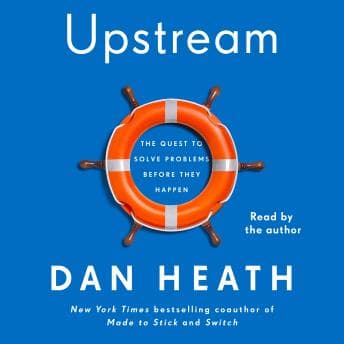

Everyone keeps recommending this book like it's going to change your life. "Read Upstream! It'll transform how you think!" And honestly? They're mostly right, but not in the way I expected.
I finished this in about 5 commutes—pretty standard for a ~8 hour business book. But here's the thing: I kept pausing it. Not because it was boring, but because my brain needed processing time. That's actually a compliment.
The "Could've Been a Blog Post" Test
Let me be direct: this book passes the test, but just barely. The core thesis—we spend too much time reacting to problems instead of preventing them—is something you could tweet. But Heath earns his page count with examples that genuinely surprised me.
The Expedia case study stuck with me for days. They were getting 20 million customer service calls per year, and someone finally asked "wait, why are people calling?" Turns out a huge chunk were customers who never received their itinerary email. The fix was embarrassingly simple. That's the whole book in miniature: problems we've normalized that are actually fixable.
The Chicago Public Schools dropout prediction system is the other example I kept thinking about on my morning commute. They figured out they could identify at-risk students in ninth grade—not with fancy AI, just by looking at attendance and course failures. The intervention wasn't revolutionary either. Just... attention. Someone noticing.
Dan Heath Narrating Dan Heath
Author-narrated business books are usually a coin flip. Either they're great (the author knows exactly where the emphasis belongs) or they're terrible (the author has zero vocal training and sounds like they're reading a grocery list).
Heath lands on the good side. His delivery is confident without being smug—which is harder than it sounds when you're essentially saying "here's how to be smarter about problems." He's got this smooth, self-assured thing going that matches his writing style. When he's setting up a case study, you can hear him building to the insight. He's clearly done the TED talk circuit enough to know how to hold attention.
No production bells and whistles here—just Heath talking for 7+ hours. That's fine. This isn't the kind of content that needs sound effects. (Can you imagine? "And then they prevented the problem" triumphant horn sound)
Where It Gets Frustrating
Here's my honest take: if you've read Heath's other books—Made to Stick, Switch, The Power of Moments—you know the formula. Counterintuitive insight + memorable story + framework = chapter. Repeat.
It works. It's effective. But by hour 5, I was kind of like "okay, I get it, upstream good, downstream bad, can we move on?" The Iceland teenage drinking case study is fascinating (they basically engineered a cultural shift), but by that point I was already converted. The neuroscience angle in Brainstorm actually adds some depth to why that intervention worked—understanding teenage brain development makes the Iceland approach feel less like magic. You're preaching to the choir, Dan.
Also—and this is a minor gripe—the book is better at diagnosing why we get stuck downstream than at giving you tactical tools to move upstream. Heath identifies three barriers: problem blindness, lack of ownership, and tunneling (being so overwhelmed you can't think long-term). Great. If you're looking for more tactical ownership frameworks, Extreme Ownership goes harder on the execution side—though it's definitely more intense than Heath's style. But the "how to fix it" sections feel thinner than the "here's the problem" sections.
The ROI Calculation
At 7h 48m, this is a reasonable time investment for business/self-help. I'd bump it to 1.5x—Heath's pacing is deliberate and you won't miss anything important at higher speed. The concepts aren't complex; they just need good examples to land.
Perfect for: commute, gym, housework—anything where you want to feel productive but don't need to take notes.
Who should listen: Anyone in operations, product, or systems roles—this is basically required reading. It gives you vocabulary for conversations you're probably already trying to have. "We need to go upstream on this" is now something I say in meetings, and people actually know what I mean. Who should skip: If you've already read two or more Heath books, the marginal insight drops significantly. You'll enjoy it, but you won't be surprised.
Worth Your Commute?
Bottom Line: Worth your commute if you've never read a Dan Heath book. If you've read his others, you'll still enjoy it, but expect diminishing returns. The examples alone are worth the listen—I've already stolen the Expedia story for two different work presentations.
It's not his best work (that's still Switch for me), but it's solid. The kind of book that makes you feel smarter without actually being that hard to get through. And honestly? After debugging distributed systems all day, sometimes that's exactly what I need.