
"Imaginary time is not imaginary — it's the only time that's real."
That line hit me somewhere around the Millbrae stop on a Wednesday morning, and I actually looked up from my phone like Hawking had personally insulted my understanding of physics. Which, honestly, he kind of did.
Your Brain on Theoretical Physics at 6:47 AM
TL;DR: Worth your commute — barely. Not because it's bad, but because this is genuinely hard material compressed into 3.5 hours, and your half-asleep commuter brain might not be ready for p-branes and eleven-dimensional supergravity before your first coffee. I listened to this twice. First pass was at my usual 1.5x on the train, and I retained maybe 60% of it. Second pass was at 1x, sitting at my desk with noise-canceling headphones during a quiet on-call shift, and suddenly the pieces clicked together like a well-structured dependency graph.
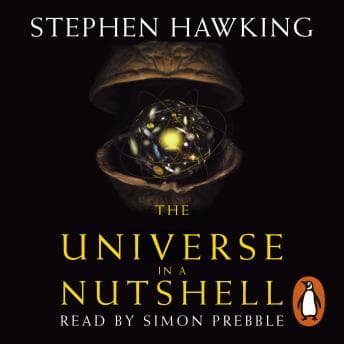
Here's the thing about this book: it's basically A Brief History of Time but for the 2001 state of string theory and M-theory. Hawking picks up where that earlier book left off and goes harder into the speculative physics — imaginary time, brane worlds, the holographic principle. If Brief History was the API documentation, Universe in a Nutshell is the deep-dive architecture doc. Shorter, denser, and assumes you've at least skimmed the README.
At 3 hours and 28 minutes, the ROI on this audiobook is actually pretty solid if you're into cosmology. No filler. No "let me tell you a story about my morning routine before I get to the point." Hawking just... explains the universe. Efficiently. Like a function with zero unnecessary allocations.
Simon Prebble Is Not Stephen Hawking (And That's Fine)
So here's the elephant in the room: you're listening to a book by one of the most recognizably-voiced humans in history, and it's narrated by someone else. Simon Prebble brings a crisp British delivery that works well for the material — clear enunciation on terms like "Kaluza-Klein" and "anti-de Sitter space," which is honestly the minimum bar for a physics audiobook narrator. His pacing is measured, almost professorial, which helps when Hawking is explaining why the universe might have no boundary in imaginary time.
Prebble handles the occasional dry Hawking humor with the right touch of understatement. There's a bit where Hawking riffs on betting against his own theories — the man literally placed bets on whether information gets destroyed in black holes — and Prebble delivers it with just enough wryness that you catch the joke without it being oversold. It's not Ray Porter (nothing is Ray Porter), but it's solid, reliable narration. Think of it as a well-maintained codebase: nothing flashy, no bugs, gets the job done.
The production is clean and straightforward. No music, no sound effects, no dramatization. Just voice and physics. For a book this dense, that's the right call.
The Science Actually Holds Up (Mostly)
Okay, caveat: this was published in 2001, so some of the speculative stuff about string theory being close to a Theory of Everything is... optimistic, let's say. We're still waiting on that one. But the foundational explanations of general relativity, quantum mechanics, and how they refuse to play nice together? Still excellent. Hawking had a genuine gift for analogy — the way he describes curved spacetime using the rubber sheet model, or explains the uncertainty principle through particle behavior, is clearer than most physics professors I had at UW.
The big loss in audio format is the diagrams. The original book is heavily illustrated, and there are moments where Prebble is essentially describing a visual concept and you're building the mental model from scratch. The chapter on brane worlds was the hardest for me — trying to visualize a three-brane moving through higher-dimensional space while standing in a crowded train car is... an experience. I actually pulled up diagrams on my phone for that section during my second listen.
Who Should Queue This Up
Perfect for: Anyone who read A Brief History of Time and wanted more. Engineers and science folks who want to understand the theoretical physics landscape circa early 2000s. People who listen to Sean Carroll's podcast and want the Hawking original source material.
Skip for: Complete physics beginners — start with Astrophysics for People in a Hurry or A Short History of Nearly Everything instead. (Though honestly, if you want zero cognitive load and maximum commute entertainment, something like Postmortal is a more reliable train companion — propulsive, weird, and you won't need diagrams.). Also skip if you need your audiobooks to be purely commute-friendly with zero cognitive load. This requires attention.
The 1x speed recommendation is real. I know, I know — it physically pains me to say that. But trust me, 1.5x through the chapter on imaginary time and the no-boundary proposal is how you end up thinking Hawking said the universe is shaped like a donut. (It's not. I think.)
Worth a Credit? Run the Cost-Benefit
At 3.5 hours, this is on the short side for a credit spend, and that's what keeps it from a full "buy it now" recommendation. If you can grab it on a sale or through your library app, do that. The content is A-tier Hawking — accessible, witty, genuinely illuminating about the state of theoretical physics. But the audio format loses something without those diagrams, and the brevity means you're paying premium per hour.
I finished this in 2 commutes (well, 2 commutes plus one late-night re-listen), and I came away feeling like I'd just had the universe's architecture explained by the world's most patient senior engineer. Not a bad way to spend a train ride. Just maybe grab a coffee first.