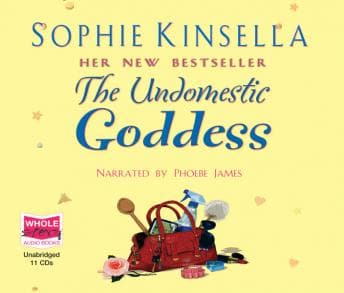

I was grading sophomore essays on The Great Gatsby - the ones where they all discover that the green light is a symbol, bless their hearts - when I needed something to keep me from writing increasingly sarcastic margin notes. Sophie Kinsella's Undomestic Goddess seemed like the antidote. Light. Funny. No one analyzing the eyes of Doctor T.J. Eckleburg.
And you know what? It worked. Mostly.
The Cambridge-Educated Disaster We Didn't Know We Needed
Samantha Sweeting is the kind of protagonist who makes you feel simultaneously better and worse about your own life choices. She's a high-powered London lawyer with an IQ of 158 who can't operate a washing machine. The premise is pure farce - she makes a catastrophic professional error, has a complete breakdown, and somehow ends up as a housekeeper in the Cotswolds for a couple who think she's qualified because she showed up at their door looking desperate.
Kinsella understands something about modern professional anxiety that feels almost too real. Samantha's obsessive checking of emails, her inability to exist outside of billable hours, her complete disconnection from anything resembling domestic competence - it's exaggerated for comedy, but there's a kernel of truth that made me wince. (I once forgot to eat for an entire day during finals week. Denise found me at midnight eating crackers over the sink like a raccoon.)
The fish-out-of-water comedy writes itself. Samantha trying to make bread. Samantha Googling "how to iron." Samantha discovering that yes, you do have to actually clean toilets, they don't just... stay clean. It's predictable in the best way - you know where it's going, but the journey is genuinely funny.
Phoebe James: Comedic Genius or Chaos Agent?
Here's where things get complicated. Phoebe James' narration is divisive, and I understand both camps.
Her comedic timing is excellent. Samantha's inner dialogue - the panicked stream of consciousness when she's pretending to know what a "julienne" is - lands perfectly. James captures that specific flavor of British middle-class anxiety that makes Kinsella's humor work. She gets the rhythm of the jokes.
But. And this is a significant but.
Her voice for Trish, the lady of the house, is... a choice. It's this exaggerated posh accent that's clearly meant to be satirical, but after twelve hours, it starts to feel like someone doing a parody of a parody. Like she's performing for the back row of a very large theater. I found myself bracing slightly whenever Trish appeared.
There are also moments where the vocal emphasis lands wrong - stress on the unexpected syllable, beats that don't quite sync with the comedy. It's not constant, but it's noticeable. Like a musician who's technically proficient but occasionally rushes the tempo.
Denise, who was listening alongside me during our Saturday morning walk, said it reminded her of watching a community theater production - everyone's trying hard, and most of it works, but you're aware of the effort.
What Kinsella Actually Does Well
Beneath the frothy premise, there's a genuinely interesting meditation on identity and competence. Samantha has built her entire sense of self around being excellent at one thing. When that thing is taken away, she has to confront the terrifying question: who am I if I'm not my job? Nick and Charlie explores that same question of identity outside of labels, though in a completely different context.
This reminds me of what Hemingway said about stripping away everything that isn't essential to find what remains. Samantha, stripped of her law career, discovers she's... not nothing. She's someone who can learn. Someone who can find satisfaction in making a perfect loaf of bread. Someone who can fall in love when she's not checking her BlackBerry every thirty seconds.
(My students would hate this book, by the way. They'd call it "basic" and ask why she didn't just quit her job earlier. They're seventeen. They don't understand yet how identity gets tangled up with profession. Give them a decade.)
The romance is exactly what you'd expect - there's a handsome gardener, there are misunderstandings, there's a moment where everything seems ruined before it all works out. Kinsella doesn't subvert the formula because she doesn't need to. She executes it with warmth and genuine affection for her characters.
Who This Is For (And Who Should Skip It)
If you love British chick lit and don't mind narration that occasionally veers into theatrical territory, this is a delightful listen. Perfect for housework, walks, or - ironically - grading papers. It's comfort food. Not challenging, not profound, but genuinely enjoyable.
Skip it if you're sensitive to exaggerated character voices, or if you prefer narrators who stay subtle - Phoebe James might grate on you over twelve hours. Consider sampling first.
And if you're a burned-out professional who's forgotten what it feels like to have hobbies? This might hit closer to home than you'd expect from a book about a woman who doesn't know how to turn on a vacuum.
Worth Pausing the Faculty Meeting For
The Undomestic Goddess isn't going to change your life. It's not trying to. It's a well-crafted escape that understands exactly what it is and delivers on that promise. The narration has its quirks - some charming, some less so - but the core experience is warm, funny, and surprisingly relatable.
I finished it during a particularly tedious budget presentation. Principal Martinez was discussing copier allocation. Samantha was learning to make hollandaise sauce. I know which one I'd rather revisit.