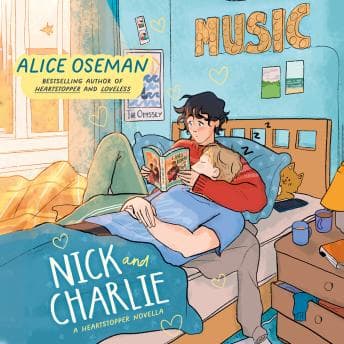

Look, I'll admit it. I was skeptical. A novella about a couple worried about surviving long-distance? At my age? With my research background in attachment theory? I figured I'd spend the whole 1 hour 45 minutes mentally annotating every unrealistic beat.
I was wrong. Mostly.
The Psychology of First Love (And Why Oseman Gets It)
Here's the thing about Nick and Charlie that most YA romances get catastrophically wrong: the anxiety isn't performative. Charlie's spiraling thoughts about whether Nick will outgrow him at university - that's textbook anxious attachment. And Nick's desperate need to reassure while also feeling suffocated by the pressure to be the stable one? Classic avoidant-anxious dynamic under stress. My therapist would have thoughts about both of them, honestly.
What makes this work is that Oseman doesn't pretend these patterns are romantic. They're messy. They're a little exhausting. Charlie knows he's being irrational and can't stop anyway. Nick knows he should communicate better and keeps freezing up. The research actually shows that this is exactly how secure attachment gets tested - not by dramatic betrayals, but by the slow pressure of uncertainty and change.
Now. The two-week silence thing. Some listeners found it unbelievable for a "mature couple." And okay, fair. But I'd argue that's the point? They're seventeen and eighteen. They think they're mature. They're not. That gap between self-perception and reality is what makes adolescent psychology so fascinating to study. (Don't tell my students I said that.)
The Voice in My Head - Times Two
Huw Parmenter and Sam Newton. I couldn't find much about their previous work online, but based on this? They understand something crucial about dual narration: it's not just about different voices. It's about different internal worlds.
Parmenter's Charlie is all tight anxiety and barely-contained spirals. You can hear the overthinking in his pacing - the way certain sentences speed up when Charlie's catastrophizing, then slow down when he's trying to convince himself everything's fine. Newton's Nick is warmer, steadier, but there's this undercurrent of someone trying very hard to hold it together. The contrast works because it mirrors how these two actually relate to each other.
The alternating first-person structure is smart. You get Charlie's version of a conversation, then Nick's, and suddenly you realize they're both missing what the other actually meant. It's a clinic in perspective-taking - or the failure of it. Which, again, is what makes this a fascinating case study in how intimacy doesn't guarantee understanding.
The swoony moments are swoony. The tense moments are genuinely tense. I was jogging through Cambridge when the big confrontation hit and I actually stopped on the path like an idiot because I needed to hear how it resolved.
Where It Dragged (Just a Little)
At under two hours, there's not much room for filler. But some of the middle section - the will-they-won't-they-talk-about-the-actual-problem phase - felt like it was spinning its wheels. I get that avoidance is the point. I study avoidance. But watching (listening to?) two people not communicate while you're waiting for them to communicate is... a specific kind of frustration.
Also, and this is minor, but the supporting characters are basically furniture. Which is fine for a novella. But I found myself wanting more context for Nick and Charlie's world. Who are their friends? What do those friends think? The isolation of their relationship is part of the problem, but the narrative doesn't really interrogate that. The Midnight Library explores that same kind of self-imposed isolation—different context, but the same psychological pattern of cutting yourself off from perspective.
Would I Listen Again?
Probably not. But that's not a criticism - it's the nature of short, emotionally intense stories. You experience them once, they hit you, you move on. What I would do is recommend this to anyone studying adolescent attachment patterns who wants a case study that actually feels authentic. Or, you know, anyone who just wants to feel things for an hour and a half.
The ending is hopeful without being naive. It acknowledges that first love is hard, that growing up together and growing apart are both real possibilities, and that choosing to try anyway is its own kind of courage. The protagonist exhibits classic anxious-preoccupied attachment, but the resolution suggests he's learning. That's more than most romance narratives give us.
Who Should Listen (And Who Should Skip)
If you're a Heartstopper fan, you already know what you're getting. If you're not, this works as a standalone study in young love under pressure. Skip it if you need plot-heavy action or can't stomach watching two people avoid a conversation for forty minutes. But if you want character psychology, pure and distilled? This delivers.
And honestly? Sometimes that's exactly what you need.









