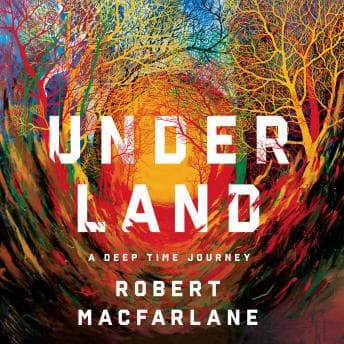

What would you bury underground if you wanted someone to find it in 100,000 years?
That's the kind of question that rattled around my head for three straight days of commutes after finishing Underland. But I'm getting ahead of myself. I actually started this one on a Sunday afternoon - Kevin was watching football, I was allegedly "meal prepping" but really just standing in the kitchen with a cutting board and my earbuds in, completely forgetting about the onions because Robert Macfarlane was describing how trees talk to each other through underground fungal networks. Like... distributed systems. Beneath our feet. Nature literally invented mesh networking before we did. The gut microbiome chapter in Fiber Fueled hit me with the same vertigo — another hidden biological network doing staggering work completely beneath our notice.
Geology as Architecture, Language as Spelunking
TL;DR: Worth your commute - but with caveats (pun intended).
Macfarlane structures this book as a series of descents. Literal descents - into the Mendip Hills cave systems, the Paris catacombs, a moulin inside a Greenland glacier, a Finnish nuclear waste repository designed to last longer than any human civilization. Each chapter takes you underground in a different location, and the connecting tissue is this concept of "deep time" - the idea that geological timescales make our entire species look like a rounding error.
The thing that surprised me? The science actually holds up. Macfarlane isn't a scientist, he's a literary nature writer, and I went in braced for hand-wavy metaphors dressed up as explanation. But no. When he talks about the mycorrhizal networks connecting tree root systems - what scientists literally call the "Wood Wide Web" - he's pulling from real research. When he describes how the Onkalo nuclear waste facility in Finland is engineered to communicate danger to beings that might not share our language or even our biology, it's genuinely fascinating systems thinking. This is basically infrastructure engineering but for deep time horizons.
The Paris catacombs section hit different than I expected. He's not just doing spooky underground tourism. He's crawling through illegal passages with urban explorers, and Macfarlane captures that specific claustrophobic dread - the moment where you're belly-crawling through a passage and you realize you can't turn around, you can only go forward. My heart rate actually spiked on the Caltrain at like 6:15 AM, surrounded by sleeping engineers. That's a weird experience.
Matthew Waterson is Not Ray Porter (But He's Pretty Good)
Ray Porter narrates this. Need I say more?
Just kidding. He doesn't. Matthew Waterson does, and honestly? His soft British accent is exactly right for this material. There's something about a measured, slightly reverent English voice describing prehistoric sea caves in Norway that just... works. The pacing is deliberate - almost meditative - which matches the book's whole vibe of slowing down to geological time.
The catch: a few mispronunciations scattered throughout. I noticed at least a couple with place names (which, fair, this book covers locations from Scandinavia to the Karst Plateau to Greenland). It's not deal-breaking, but it dinged my experience. Also, this is a solo narrator reading a book with very little dialogue, so don't expect character work. It's essentially 12 hours of someone reading beautifully written essays to you. Waterson keeps it engaging enough that I never zoned out during the denser passages, and that's saying something for a book about limestone geology.
The Structure Problem (It's a Feature, Not a Bug - Mostly)
Here's where I got stuck: the book meanders. Each chapter is its own descent, its own location, its own set of themes. And Macfarlane connects them through recurring motifs - darkness, burial, hidden knowledge - but sometimes it feels more like a linked short story collection than a unified argument. I've seen other listeners call the structure confusing, and I get it. Around hour 7, during the Karst section, I briefly lost the thread of what we were building toward.
But then he hits you with the Onkalo nuclear repository chapter near the end, and suddenly all those hours of mythological descents and underground fungal networks and Bronze Age burial chambers click into focus. The whole book is asking: what do we hide underground, and why? Bodies. Art. Waste. Secrets. Infrastructure. Memory.
Perfect for: long commutes, roadtrips, contemplative walks. Skip for: gym sessions or anything requiring divided attention. This demands more focus than your average nonfiction listen - it's dense, lyrical prose, not bullet-point science.
Speed note: I listened at 1.25x instead of my usual 1.5x. Macfarlane's sentences are architectural; they need a beat to land. Speeding through them felt wrong, like fast-forwarding through a time-lapse of the northern lights.
The ROI on 12 Hours Underground
The ROI on this audiobook is high but specific. If you're the kind of person who gets excited about the intersection of science, philosophy, and landscape - if you've ever stared at a rock face and wondered what stories it holds - this is your book. If you want narrative drive, plot, characters with arcs? Wrong genre. This is lyrical nonfiction at its most ambitious.
I finished this in about 5.5 commutes plus that Sunday kitchen session, and I'm still thinking about the Finnish nuclear repository. They're trying to build warning systems that will communicate "DO NOT DIG HERE" to civilizations that might exist 100,000 years from now. How do you design a message for a user you can't even imagine? As someone who writes documentation that's confusing to people who share my language and my century, this broke my brain in the best way.
Kevin asked me why I was muttering about fungal networks over dinner. I told him trees have better distributed systems than most startups. He didn't ask again.






![Steve Jobs [unabridged audiobook] audiobook cover](/_next/image?url=https%3A%2F%2Fcovers.audiobooks.com%2Fimages%2Fcovers%2Ffull%2F9788499923406.jpg&w=1920&q=75)

