
Look, I'm going to say something that might get me kicked out of certain LA wellness circles: I'm tired of diet books that promise to fix everything by eliminating food groups. My parents didn't build a business working 14-hour days on keto. They ate rice. Lots of rice. And vegetables. And they're healthier at 70 than most of my former McKinsey colleagues at 45.
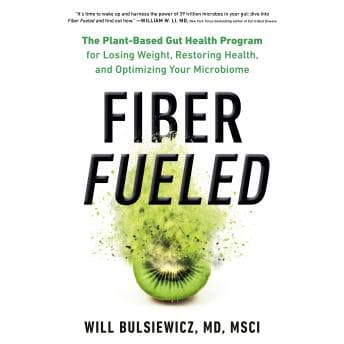
So when Dr. Will Bulsiewicz opens Fiber Fueled by essentially calling out the elimination diet industrial complex, I was ready to listen. At 2.0x, naturally.
The Science That Actually Holds Up
Here's what separates this from the usual health book noise: Dr. B is a board-certified gastroenterologist who actually treats patients. Not a wellness influencer. Not someone who read a study once. A guy who looks at colons professionally and has opinions about your short-chain fatty acids.
The core argument is elegant in its simplicity - your gut microbiome needs fiber diversity to produce SCFAs (those short-chain fatty acids I mentioned), which then do basically everything good in your body. Weight regulation, inflammation control, immune function, the works. And when you eliminate entire food groups - grains, legumes, whatever the latest fad demonizes - you're essentially starving the bacteria that keep you healthy.
I've seen this play out in real life. Three different startup founders I've consulted for went hardcore keto, lost weight fast, then crashed harder. Digestive issues, brain fog, the whole package. Dr. B explains the mechanism behind that crash in a way that actually makes sense. Your gut microbiome adapts to what you feed it. Stop feeding it variety, and you lose the bacteria that process variety. It's like downsizing your team and then wondering why you can't scale.
Where My 2.0x Speed Couldn't Save Me
At 7 hours and 11 minutes, this is reasonably efficient for a health book. But there's still padding. The early chapters on microbiome basics could've been tighter - if you've read anything about gut health in the last five years, you can probably skip to chapter 5. (Thank me later.)
Dr. B also spends considerable time on his personal transformation from "junk food junkie" to plant-based advocate. It's relatable, I guess, but I'm here for the data, not the origin story. Jenny would say I'm being harsh. Jenny is right.
Barrett Leddy's narration is solid - friendly without being condescending, which is rarer than you'd think in the health audiobook space. He doesn't do that thing where narrators slow down for "important" points like you're a child. The pacing matches the conversational tone Dr. B apparently uses with his patients.
The 28-Day Program Reality Check
The back half includes a 28-day jumpstart with menus and 65+ recipes. Here's the thing about recipe sections in audiobooks: they're basically useless in audio format. Yes, there's a PDF included. But if you're buying this primarily for the meal plans, get the physical book.
What IS useful in audio is Dr. B's framework for building fiber tolerance gradually. He acknowledges something most plant-based advocates ignore - if you go from eating 10 grams of fiber daily to 50 overnight, you're going to have a bad time. The "train your gut" approach is practical. It's what my parents did instinctively. Now it has a TED talk.
Who Should Listen (And Who Should Skip)
This is for you if: you've tried elimination diets and felt worse long-term, you want actual science instead of Instagram nutrition, or you're curious why your gut seems angry all the time.
Skip it if: you're looking for a quick fix (there isn't one), you want a pure recipe book (get the print version), or you're deeply committed to carnivore/keto and don't want your worldview challenged.
Bottom Line
The key takeaway is worth the listen. The other 7 hours? Not so much - maybe 5 hours of genuine value here. But those 5 hours are legitimately useful, backed by real clinical experience, and delivered without the usual wellness industry condescension.
I finished this during a late-night meal prep session - chopping vegetables while learning why I should chop more vegetables. There's a certain poetry to that, I suppose. Dr. B makes a compelling case that the fiber your grandmother took for granted wasn't boring - we just weren't paying attention to the science yet. For a different angle on listening to what your body's actually telling you, It's Not Always Depression covers similar ground from a mental health perspective.
New York Times bestseller status is usually meaningless to me, but this one earned it. Finally, a health book that respects both your time and your intelligence.