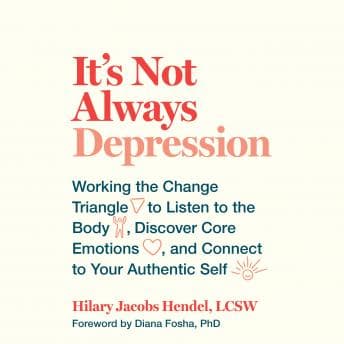

Bottom line: This is one of those rare self-help books that actually delivers a usable framework instead of just repackaging common sense into 8 hours of fluff.
I picked this up expecting another "feel your feelings" book that would tell me what my therapist already tells me, just slower. And look, there's some of that here. But Hilary Jacobs Hendel does something most psychology books don't—she gives you an actual tool. The Change Triangle isn't revolutionary if you've studied any emotion-focused therapy, but the way she breaks it down makes it stick. Defense mechanisms at the top, inhibitory emotions (shame, guilt, anxiety) in the middle, core emotions at the bottom. Simple. Actionable. My parents would've called this "stop overthinking and feel what you feel," but hey, now it has a diagram.
The Framework That Actually Earns Its Runtime
Here's what got me: Hendel's core argument is that a lot of what gets diagnosed as depression is actually blocked emotions wearing a depression costume. I've seen this play out with founders I've worked with. The guy who can't make decisions isn't depressed—he's terrified of failure and calling it "burnout." The woman who can't stop working isn't a workaholic—she's running from grief she never processed. Hendel's patient stories (Sara, Spencer, Bonnie) aren't just filler. They're case studies that show how the triangle works in real time.
The AEDP approach she uses—accelerated experiential dynamic psychotherapy—sounds like consultant jargon, but it's basically "stop talking around your feelings and actually feel them in your body." Which, okay, I'm a 2.0x speed guy who optimizes everything. This book made me slow down. Not because Campbell's narration required it (she's solid, warm, doesn't get in the way), but because the exercises actually demand you pause and check in with yourself. I did a few of them on a flight to Denver. Probably looked weird. Don't care.
Where It Drags (And Where to Skip)
Not gonna pretend this is perfect. There are stretches where Hendel gets a little too into her own therapy sessions and personal anecdotes. Some of it feels like she's processing her own stuff on my time. Jenny would say I'm being harsh. Jenny is right. But also—I've got limited hours, and about 90 minutes of this could've been cut without losing anything essential.
Skip to chapter 5 if you want to get straight to the practical application. The early chapters set up the theory, which is fine, but if you've read any Bessel van der Kolk or even Brené Brown, you've heard the "emotions live in the body" pitch before. Untethered Soul covers similar territory but leans harder into the spiritual angle—less clinical, more "observer consciousness." The real value is in the second half where she walks you through working the triangle yourself.
Cassandra Campbell handles the narration with exactly the right energy—empathetic without being saccharine, clear without being clinical. She makes the patient stories feel like you're eavesdropping on actual sessions rather than reading case files. Hendel pops in occasionally too, which adds authenticity. The bonus PDF with exercises is actually useful if you're serious about applying this stuff (rare for bonus content to not be garbage).
Who Should Listen (And Who Should Skip)
If you're a high-achiever who's been white-knuckling your way through anxiety and calling it "just how I'm wired"—this might hit different. I recognized way too much of myself in the defense mechanism descriptions. Brainstorm breaks down similar patterns from a developmental angle—turns out a lot of adult defense mechanisms are just teenage coping strategies we never outgrew. The workaholism, the intellectualizing, the "I'm fine, everything's fine" while your chest is tight and you haven't slept well in months. Skip this if you want quick tips or you're already deep into emotion-focused therapy—you've probably covered this ground.
This isn't going to replace therapy. But it's a solid companion piece, and honestly, it's more actionable than a lot of sessions I've paid $300/hour for. The seven core emotions framework (anger, sadness, fear, disgust, joy, excitement, sexual excitement) is simple enough to remember and apply when you're spiraling at 2 AM.
My 2.0x speed couldn't save the slower sections, but the key takeaways are worth the listen. The other 3 hours? Acceptable padding. For a psychology book, that's actually a decent ratio.
Would I recommend it? Yes, with caveats. If you want quick tips, this isn't it. If you want to understand why you feel stuck and actually do something about it, download the PDF, grab a notebook, and commit to the exercises. That's where the ROI lives.