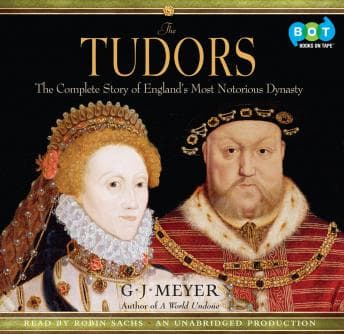

Everyone tells you they're obsessed with the Tudors. They've watched the Showtime series, they've read Hilary Mantel, they've got opinions about Anne Boleyn's guilt or innocence like it's some kind of sixteenth-century true crime podcast. And I was one of those people - confident I knew the broad strokes, figured Meyer's book would just fill in a few gaps around the edges.
Twenty-five hours later, walking the lakefront with Denise in early December, the wind off Lake Michigan cutting through my jacket, I realized I'd been wrong about almost everything. Not the facts, necessarily, but the framing. The story I thought I knew was the Hollywood version, and Meyer had just handed me the historian's cut.
Henry VII Was the Real Villain and Nobody Talks About It
Here's what surprised me most: Meyer doesn't start with Henry VIII and his wives. He starts with Henry VII - the father, the founder, the man who took the throne with essentially no legitimate claim and then spent his entire reign paranoid about losing it. And Meyer makes the case, pretty convincingly, that everything people love to be horrified by in Henry VIII was seeded in Henry VII's reign. The surveillance state, the financial extortion of the nobility, the willingness to destroy anyone who might be a rival. The son didn't invent tyranny; he inherited a template for it.
What I appreciate about Meyer's approach is the "Background" sections - these interchapter essays that step outside the chronological narrative to explain things like how Parliament actually functioned, what the English economy looked like, why the monasteries mattered beyond just religion. In a classroom, I'd call these context-building exercises. Here, they're the difference between watching a period drama and actually understanding the period. My students would hate this. I love it.
The book's argument about the English Reformation is particularly sharp. Meyer doesn't treat it as some inevitable triumph of reason over superstition. He treats it as what it largely was: a political power grab justified after the fact by theology. Henry VIII didn't break with Rome because he had deep Protestant convictions. He broke with Rome because the Pope wouldn't give him a divorce, and once he realized he could seize church property and redistribute it to buy loyalty - well, suddenly he was very interested in reform. Meyer lays this out with a kind of wry clarity that reminds me of what Hemingway said about the importance of knowing what to leave out. Meyer knows what to leave in - the money trail, the coercion, the bodies.
Robin Sachs and the Art of Making 25 Hours Feel Like a Semester You Actually Enjoyed
Robin Sachs narrates this with a crisp British accent and a delivery that I can only describe as authoritative without being stuffy. The narrator understands that pause is punctuation - and in a 25-hour book packed with genealogical detail, political maneuvering, and the occasional beheading, that pacing matters enormously. Sachs doesn't rush through the dense passages about land distribution or parliamentary procedure, but he doesn't linger on them either. He treats them with the same measured attention he gives the dramatic moments, which is exactly right. This isn't a thriller; it's a history. The drama comes from the facts, not from vocal theatrics.
I will say - and this is a minor thing - that with a solo narrator covering this many historical figures across five monarchs and roughly 120 years, you're not getting distinct character voices. Sachs isn't doing a different accent for Thomas More versus Thomas Cromwell. But honestly, for a work of nonfiction this scholarly, that would've been distracting. What he does well is modulate tone. When Meyer's prose turns sardonic (and it does, frequently - this is a man who clearly finds the Tudors both fascinating and appalling), Sachs catches that register perfectly.
I listened at 1.0x, because the prose deserves to be savored, and because Meyer's sentences sometimes carry three or four clauses of historical context that you need to process before the payoff lands. Speed this up and you'll miss the structural irony - like when Meyer describes Elizabeth I's carefully constructed public image and then, almost casually, reveals the private desperation behind it.
Who Should Commit 25 Hours (And Who Should Run)
Let's be honest about the commitment here. Twenty-five hours. That's longer than most audiobooks I assign myself in a year, and it's roughly the equivalent of reading a 700-page hardcover. If you want a quick Tudor overview, this isn't it. If you want to understand why the Tudor period still shapes English-speaking culture - the relationship between church and state, the nature of royal authority, the origins of Protestant identity - this is the book.
If you loved Meyer's A World Undone (his history of World War I), this is its spiritual successor in approach if not subject. Same willingness to challenge received wisdom, same balance of narrative and analysis, same refusal to treat historical figures as heroes or villains when the truth is messier and more interesting.
Skip this if you're looking for pure entertainment. Skip this if you want Anne Boleyn as a romantic figure. Skip this if you don't have the patience for a chapter about Tudor-era taxation. But if you teach history - or English, for that matter, since half the literature I assign was written in the shadow of these people - this is essential listening.
Worth pausing the faculty meeting for. And I did. Multiple times.
The Annotation in the Margin
I finished this at 11 PM on a Tuesday, grading papers with one earbud in, and I immediately texted my buddy Jerome who teaches AP European History down the hall. Three words: "You need this." That's about the highest compliment I can give a history audiobook. It made me want to teach differently, read differently, and reconsider a dynasty I thought I already understood. That same feeling — of a book quietly rearranging how you think about a life you didn't live — hit me just as hard with Narrative of the Life and Adventures of Henry Bibb, an American Slave, which is also, at its core, about power and the stories people construct to survive it. Five centuries of distance, and these people still have something to say about power, faith, and the stories we tell ourselves about both.





![Steve Jobs [unabridged audiobook] audiobook cover](/_next/image?url=https%3A%2F%2Fcovers.audiobooks.com%2Fimages%2Fcovers%2Ffull%2F9788499923406.jpg&w=1920&q=75)