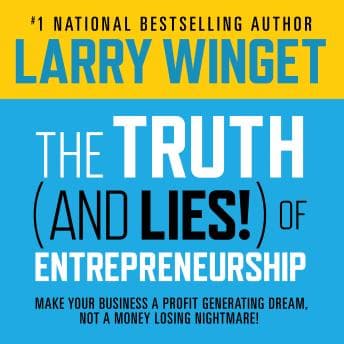

Everyone's been telling me Larry Winget is the "anti-guru guru" - the guy who'll slap the motivational poster right off your wall. So I went in expecting either a breath of fresh air or another contrarian shtick dressed up as tough love. Turns out it's somewhere in between, and that's actually more interesting than either extreme.
My Parents Didn't Need a TED Talk. They Needed a Nap.
Here's where Winget got me. About two hours in, he goes on this extended tear about how "follow your passion" is the most dangerous advice in business. How passion doesn't pay rent. How nobody cares about your dream - they care about whether you solve their problem. And I'm sitting in my home office at 10 PM, prepping a deck for a founder who's burning through runway because he "loves the product," and I literally said out loud: "This is what my parents did instinctively. Now it has a TED talk."
My folks ran a dry cleaning business. They didn't follow their passion for removing stains. They found a neighborhood that needed clean clothes, and they showed up at 6 AM every day for twenty years. Winget would've loved them. He hammers this point - is your business necessary? What problem does it solve? What pain does it alleviate? - with the subtlety of a brick through a window. And honestly, after sitting through hundreds of pitch meetings where founders can't answer those questions, the brick feels appropriate.
The section on hiring and firing is surprisingly practical. He talks about building around core values - honesty, integrity - and then actually firing people who violate them, which sounds obvious until you realize 90% of small business owners I've worked with would rather chew glass than terminate someone. I've seen this fail at three different companies where the founder kept a toxic employee because "they're like family." Winget's take: family doesn't steal from you, and if they do, you still fire them.
Dan Strutzel Is Not Larry Winget (And That's Fine, I Think)
Here's where it gets a little weird. Larry Winget calls himself "The Pit Bull of Personal Development." He's built an entire brand on being abrasive, confrontational, the guy who'll tell you your business plan is garbage to your face. Dan Strutzel narrates this book, and Dan Strutzel is... pleasant. Clear. Well-paced. Professional. He reads Winget's lines about being brutally honest with the energy of a competent corporate trainer delivering a webinar.
Is it bad narration? No. Strutzel's articulation is clean, his pacing is solid, and he handles the conversational tone well enough. But there's a disconnect between the content - which is essentially a business owner grabbing you by the collar and shaking you - and the delivery, which is more like a calm HR representative reading you the policy manual. You feel the gap. A Winget-narrated version of this would've been a different animal entirely. Jenny would say I'm being harsh. Jenny is right. Strutzel does a competent job. He just doesn't do a Larry Winget job.
45 Minutes of Real Talk in a 6-Hour Wrapper
At 6 hours and 38 minutes, this is mercifully shorter than most business books, and at 2.0x speed I was through it in a single evening. But even at that length, The key takeaway is worth the listen. The other 7 hours? Not so much. (Yes, I know that math doesn't work. The point stands.)
Winget repeats himself. A lot. The "passion is a lie" argument gets made about four different ways across multiple chapters. The sales chapter - which is actually one of the stronger sections, with practical advice on creating value in the customer's mind rather than just lowering prices - could've been the anchor of the whole book if he'd gone deeper instead of wider. The "circle the wagons" section on defending your business when things go south has some genuinely useful frameworks, but it's sandwiched between extended rants about social media gurus that felt dated even as I was listening.
Here's what I kept thinking: this book is at war with itself. It wants to be a practical business toolkit AND a polemic against the self-help industry. The toolkit parts are genuinely useful - the questions about whether your business is necessary, the framework for pricing, the blunt truth about what selling actually requires. The polemic parts are entertaining but repetitive. Skip to the chapters on selling and customer service. Thank me later. The economic ecosystem storytelling in Start-Up Nation does the opposite of Winget's approach—it shows you why certain cultures build necessary businesses by default, which honestly made Winget's "solve a real problem" thesis land even harder in retrospect.
Who Gets the ROI
If you're a first-time entrepreneur who's been mainlining Gary Vee content and thinks hustle culture is a business plan - listen to this book. It might save you $50K and a marriage. If you've actually run a business for more than three years, you already know most of this. You lived it. My parents lived it without the audiobook.
Bottom line: Winget's substance is real, his experience is legitimate, and about 60% of this book earns its runtime. The other 40% is him telling you how honest he is, which is the business book equivalent of someone telling you they're funny. Solid pickup on sale, but I wouldn't burn a full credit on it.