
Can you actually change who you are by changing how you see yourself?
I've spent years studying this exact question in academic settings, so when I came across Zig Ziglar's take on Maxwell Maltz's self-image psychology, I was genuinely curious. Would this be pop psychology fluff, or would it actually track with what the research shows? Spoiler: it's somewhere in between, and that's not necessarily a bad thing.
The Psychology Behind the Hype
Here's the thing about self-image work—Maltz's original research from the 1960s was groundbreaking, and modern neuroscience has largely validated the core premise. Your brain really does create neural pathways that reinforce your self-concept. Ziglar gets this right. The six-step framework he presents isn't revolutionary if you've read the primary literature, but it's accessible in a way that academic papers definitely are not. (Trust me, I've written those papers. Nobody's listening to them on their morning commute.)
What I appreciate is that Ziglar doesn't oversimplify the mechanism. He acknowledges that self-sabotage isn't just weakness or lack of willpower—it's a protective function of the brain keeping you in familiar territory. That's psychologically sound. The comfort zone isn't a character flaw; it's a feature of human cognition that evolved for survival.
But—and this is where my academic brain gets a little twitchy—the book sometimes conflates correlation with causation. Positive self-image correlates with success, sure. But the relationship is bidirectional and way more complex than "think better thoughts, get better results." Still, for a five-hour audiobook aimed at general audiences, I'm willing to let some nuance slide.
Dan Strutzel Does the Heavy Lifting
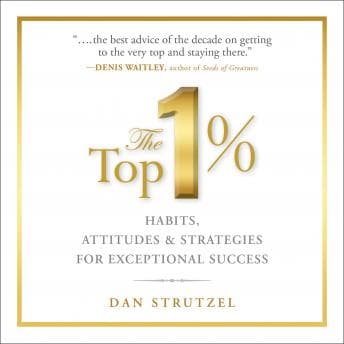
I'll be honest, I didn't know much about Dan Strutzel before this, and I couldn't find a ton about his background beyond his extensive work in personal development narration. But based on this performance? The man knows how to deliver motivational content without making you want to throw your headphones across the room.
His pacing is genuinely good. He gives you space to absorb concepts without dragging, and he emphasizes the right phrases without that performative intensity that makes so much self-help audio feel like an infomercial. It's clean, professional, and—this matters—he sounds like he actually believes what he's reading. That authenticity (or convincing performance of it) makes a difference when you're asking someone to reconsider their entire self-concept.
I listened to most of this while cooking last week—made a pretty ambitious dal makhani that required a lot of stirring—and the audio worked well for that kind of half-attention listening. The structure is clear enough that you can zone out for a minute and still pick up the thread.
Who This Works For (And Who It Won't)
Here's my honest assessment as someone who studies why people change (and more often, why they don't).
This book is going to work best for people who haven't encountered self-image psychology before. If you've never read Maltz, never done cognitive behavioral work, never really examined the stories you tell yourself about yourself—this is a solid introduction. Ziglar's framework gives you concrete steps, which matters because vague inspiration doesn't create behavior change. Structure does. 12 Rules for Life takes a similar approach—concrete, structured guidance that gives you something to actually implement rather than just feel inspired by for twenty minutes.
If you've already done this work through therapy or extensive reading, you might find it basic. I caught myself thinking "yes, I know" more than a few times. But I also caught myself reconsidering some concepts I'd filed away as "understood." Sometimes hearing familiar ideas in a new voice—literally—shakes something loose.
The relationship chapter is probably the weakest link, psychologically speaking. The connection between self-image and interpersonal dynamics is real, but it's also where pop psychology tends to get sloppy. Ziglar doesn't get sloppy exactly, but he doesn't go as deep as I'd want. (My therapist would probably say I always want to go deeper. She's not wrong.)
Skip this if: you've already done serious cognitive behavioral work or read Maltz's original Psycho-Cybernetics—you'll spend five hours nodding along to things you already know. Queue it up if: you're just starting to suspect your self-concept might be the thing holding you back and want a structured entry point.
The Academic's Reluctant Endorsement
Look, I'm not the target audience for most self-help. I read the studies these books are based on. I analyze the mechanisms. I'm professionally skeptical.
But I think there's genuine value here for someone at the right moment in their life—that moment when you're starting to suspect that the way you see yourself might be the thing holding you back. The research actually shows that insight alone doesn't create change, but it's a necessary precursor. This book provides that insight in an accessible, well-structured package.
At just under five hours, it's not asking for a huge time investment. The production is clean, Strutzel's narration is engaging without being exhausting, and the framework is sound enough that I'm not cringing at the psychology.
Is it going to transform your life? That depends entirely on what you do after you finish listening. But as a starting point for examining your self-concept? Pretty solid.