
What happens when the person you trust most — your spouse — might be planning something you can't even fathom? That question burrowed into my brain somewhere around hour three of this audiobook and wouldn't let go, which is saying something because I was awake on hour nineteen of being conscious and folding laundry at my kitchen table while Carlos and the kids slept.
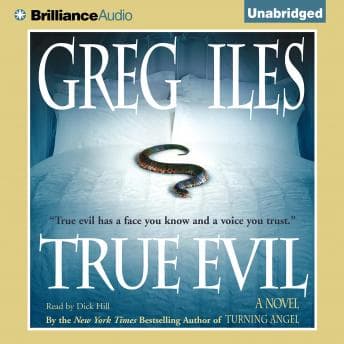
Greg Iles knows Mississippi the way I know the layout of a trauma bay — intimately, instinctively, with the kind of authority that only comes from having lived it. And True Evil runs on that authority. The setup is nasty in the best way: Dr. Chris Shepard gets ambushed in his own office by an undercover FBI agent named Alex Morse who tells him his wife may have consulted a divorce attorney whose clients' spouses keep dying. Not divorcing. Dying. And his wife never mentioned it. That hook alone had me wide awake despite having worked a twelve-hour night shift.
When the Medicine Doesn't Make Me Scream at My Dashboard
Iles is a thriller writer who actually does his homework. The medical details are accurate. Finally. Chris Shepard is a family physician, and the way Iles writes his diagnostic thinking and his interactions with patients feels right — not Hollywood-right, but actually right. There's a subplot involving a bioweapons angle and cancer research that stretches into ambitious territory, and while I won't spoil where it goes, I'll say the science is plausible enough that I didn't once yell at my steering wheel. That's rare. I have yelled at Greg Iles before (Blood Memory, chapter twelve, you know what you did), but this one? The medical framework holds up.
The psychological tension is where this book earns its keep. Chris and Alex are thrown together in a way that makes you squirm — not because of cheap romance beats, but because Iles makes you feel the paranoia of not knowing if your own spouse is capable of something monstrous. Every interaction Chris has with his wife after learning about the lawyer visit is loaded. You're second-guessing everything. Is she innocent? Is Alex Morse manipulating him? Is Chris just a pawn? At seventeen hours, Iles has the space to let that paranoia build slowly, and he uses it.
Dick Hill and the Southern Accent Problem
Okay. Here's where I have to be honest. Dick Hill is a Golden Voice narrator for a reason — the man can inhabit a character. His read on Chris Shepard's growing dread is genuinely good. You can hear the shift when Chris goes from skeptical to terrified, and Hill handles the quieter emotional moments with real skill.
But the Southern accent. Lord. I grew up in a Filipino household in Arizona, and even I know that's not how folks in Natchez talk. Hill's drawl sounds like someone who learned Southern from a movie about Southern people. It's inconsistent — sometimes it's there, sometimes it vanishes mid-sentence, and sometimes it gets so thick it pulls you right out of the scene. For a book set so specifically in Mississippi, written by an author who grew up there, the accent mismatch is frustrating. It's like watching a medical drama where they hold the stethoscope backwards. You can still follow the story. But you notice.
He also has this habit of dropping to a near-whisper at the end of passages. During daytime listening, fine. At 4 AM in my car with road noise? I was jabbing the volume button constantly. If you're a night driver or listen with any ambient noise, bump it up a few notches from the start.
The 17-Hour Commitment — Is It Worth It?
Seventeen hours is a real investment. And around the middle stretch — maybe hours eight through eleven — the pacing softens. There's a lot of maneuvering, a lot of characters positioning themselves, and some courtroom-adjacent scenes that drag compared to the knife-edge tension of the first act. But the back third picks up hard. Iles knows how to close a book. The final twists aren't cheap — they're earned by everything that came before, and I was genuinely unsure who to trust right up to the end.
The supporting cast is solid. The divorce attorney, Andrew Rusk, is written with the kind of slimy charm that makes your skin crawl. And Alex Morse is a complicated character — damaged but not defined by it, competent but making choices you want to argue with. As someone who works with people in crisis every single shift, I appreciated that Iles let his characters be messy and still functional. That's real.
Who Gets This Prescription
If you're a Greg Iles fan already — especially the Penn Cage world — this is solid, though it's a standalone that predates the Natchez Burning trilogy. If you're a medical thriller person who's tired of authors Googling "how does epinephrine work" five minutes before deadline, you'll appreciate the research here. If a shaky Southern accent is a dealbreaker for you in audio, honestly consider reading the print version instead. The story deserves better than the accent it got. That earned-paranoia feeling, where you're questioning everyone right up to the last chapter, is something We Begin at the End pulls off just as ruthlessly — and with a narrator whose voice actually matches the world on the page.
Perfect for that post-shift decompression, but you'll need to be awake enough to follow the plot threads. This is not a background listen.
Night Shift Prescription: Take With Caffeine
Carlos asked why I was so quiet at breakfast. I told him I was just thinking about whether I'd know — really know — if someone close to me was hiding something that dark. He looked at me funny and handed me more coffee. Fair enough. The book does that to you. It plants a seed of doubt about the ordinary, and that's harder to shake than any jump scare. Iles earned seventeen hours of my time. Dick Hill earned about thirteen of them. The accent owes me the other four.