
"We're not going back to the way things were. Not ever."
Somewhere around hour twelve, that line hit me like a nat 20 to the chest. I was supposed to be working on my thesis—procedural generation algorithms wait for no man—but instead I'm white-knuckling my desk chair while Bronson Pinchot calmly describes the systematic collapse of American infrastructure. Dr. Patel would be so disappointed. Worth it.
The Sandbox Apocalypse
Nicholas Sansbury Smith does something clever here that scratches my world-builder brain in all the right places: he treats the EMP aftermath like a tabletop campaign with multiple party viewpoints. You've got your sheriff (classic lawful good), your retired marine (the guy who actually read the survival handbook), a nurse dealing with medical collapse, and a senator-turned-SecDef watching the macro picture crumble. It's basically four different campaigns running simultaneously, and Smith—being a former Homeland Security Disaster Mitigation Officer—brings the kind of procedural authenticity that makes you believe this could actually happen.
The magic system here is chef's kiss. And yes, I know it's not technically magic, but the rules of EMP survival function the same way Sanderson's systems do: clear limitations, logical consequences, escalating stakes based on established parameters. Cars don't work. Hospitals can't function. Supply chains collapse in predictable patterns. Smith doesn't cheat his own rules, which means every victory feels earned and every loss feels inevitable.
Pinchot's 34-Hour Marathon
Let's talk about the man carrying this monster. Bronson Pinchot—yes, that Bronson Pinchot—delivers 34 hours of post-apocalyptic tension without ever sounding tired. One listener put it perfectly: "I could listen to Pinchot for hours and never tire of his voice." And honestly? Same. His pacing matches the survival thriller energy—measured during the quiet planning moments, urgent when everything goes sideways.
Here's the thing though: with this many characters across four books, you're not getting wildly distinct voices for everyone. It's more about consistency than theatrical range. Pinchot keeps the narrative clear, which matters when you're juggling multiple POVs across what amounts to a full campaign arc. No production issues, no weird audio artifacts—just clean, professional narration that lets the story do the heavy lifting.
Where the Armor Gets Dented
I'm not gonna pretend this is perfect. Some readers bounced off the character depth—or lack thereof. One complaint that stuck with me: "Many of the characters lacked the type of depth I look for, and the one I liked the most didn't live past the first book." Ouch. And yeah, I felt that. Smith writes survival fiction, not character studies. These are archetypes navigating impossible situations, not complex NPCs with tragic backstories and hidden motivations.
The later books apparently lose some steam too. It's the classic series problem—Book 1 has the novelty of collapse, Book 4 is dealing with the grind of reconstruction. If you're coming from Hell Divers (Smith's other big series), some folks found this less compelling. Me? I think it's apples and oranges. This is grounded military thriller energy, not sci-fi spectacle.
Also: if you don't like info-dumps, this isn't for you (but you're wrong). Smith's Homeland Security background means you're getting detailed breakdowns of infrastructure failure, survival protocols, and tactical decision-making. Confessor had a similar density of world-building detail, though in a fantasy context instead of realistic collapse scenarios. My D&D group would love this—it's basically a sourcebook for running a modern apocalypse campaign.
Your Survival Party Composition
This is for the preparedness nerds, the tactical fiction fans, the people who watched The Road and thought "but what about the logistics?" If you want deep emotional arcs and literary prose, look elsewhere. If you want to spend 34 hours learning exactly how society collapses and what ordinary people do about it, welcome to the party.
Skip if: you need complex character development, hate military fiction tropes, or get frustrated when your favorite character dies early. (Apparently that's a thing here. Consider yourself warned.)
Roll for Initiative on Your Credit
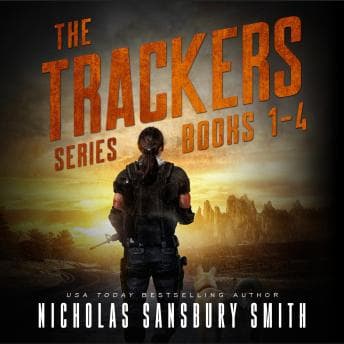
Yes, it's 40 hours. Yes, it's worth it. The Trackers box set is a commitment—the kind of audiobook that becomes your companion for a couple weeks of commutes, coding sessions, and thesis procrastination. Pinchot delivers consistent quality across the full runtime, and Smith's procedural authenticity elevates what could've been generic EMP fiction into something that feels researched and real.
It won't win awards for literary depth. But as a survival sandbox with clear rules and escalating stakes? This is Sanderson-level world-building applied to realistic disaster fiction. I went in expecting background noise and came out genuinely invested in whether these people would make it.
Now if you'll excuse me, I have a thesis to ignore and a Stormlight reread calling my name.