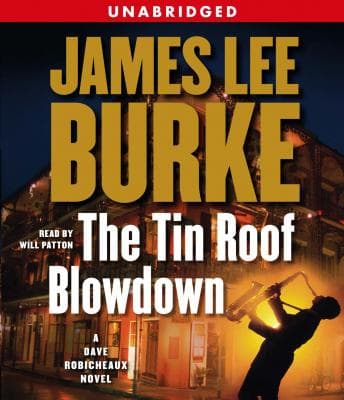

I was running along the Charles River when Will Patton's voice first described bodies floating through the streets of New Orleans, and I nearly tripped over my own feet. Not because I wasn't paying attention—because I was paying too much attention. That's the thing about this audiobook. It grabs you by the throat and doesn't let go, even when you're desperately trying to maintain a respectable pace on a Tuesday morning jog.
James Lee Burke's The Tin Roof Blowdown is, at its core, a psychological study of what happens when societal structures collapse. And I mean that literally. Hurricane Katrina didn't just destroy buildings—it stripped away the thin veneer of civilization and exposed the predators who'd been waiting for exactly this kind of chaos. As a researcher, I found myself treating this novel like a case study in collective trauma response. The protagonist exhibits classic hypervigilance patterns, but Burke never makes it feel clinical. It feels real. Uncomfortably real.
When Civilization Becomes Optional
Dave Robicheaux is the kind of protagonist I want to sit down with in a clinical interview. He's a recovering alcoholic, a man haunted by violence, and somehow still the moral center of a world that's lost its compass. Burke writes him with the kind of psychological complexity that most thriller authors only dream about. I found that same level of character depth in Vanishing Man, where the protagonist's fractured psyche becomes the entire framework of the mystery. His internal contradictions aren't plot devices—they're the actual architecture of a traumatized mind trying to function.
The research actually shows that people in disaster zones don't behave the way movies suggest. Some become heroes. Some become monsters. Most just... survive. Burke gets this. Firekeeper's Daughter explores that same moral complexity in a community under siege—how crisis reveals who people really are beneath the surface. He populates post-Katrina New Orleans with serial rapists and a morphine-addicted priest and vigilantes who might be worse than the criminals, and none of it feels exploitative. It feels like an honest accounting of human nature under extreme stress.
What makes Robicheaux compelling is that he never pretends he's above the darkness. He wades through it. Literally and figuratively. And you wade through it with him, whether you want to or not.
The Voice That Haunted My Commute
Will Patton. Look, here's the thing—I've listened to a lot of audiobooks where the narrator is fine. Competent. Professional. Patton is none of those adequate descriptors. He's something else entirely.
His voice has this warm, weathered quality that sounds exactly like a Louisiana detective who's seen too much and drunk too much and still gets up every morning to do the job anyway. When he shifts into the various criminals and victims and morally ambiguous priests, he doesn't do cartoon voices. He does something subtler—changes in rhythm, slight adjustments in register. It's the kind of performance that wins Audie Awards, which, well, it did.
I kept asking myself: why does this narration work so well when other skilled readers might have made this same material feel melodramatic? I think it's because Patton understands restraint. Burke's prose is already lyrical—sometimes almost too lyrical. A lesser narrator would lean into that, make it feel overwrought. Patton pulls back. He lets the horror speak for itself.
The pacing is impeccable. And I don't throw that word around. This is a 13-hour audiobook, and I never once reached for the speed controls. (My therapist would have thoughts about how invested I got in a fictional murder investigation, but that's a separate session.)
The Uncomfortable Parts
I should be honest about something. Burke has political opinions, and they're in this book. Some listeners find this irritating. Personally, I think it's impossible to write about Katrina without politics—the disaster response was political, the neglect was political, the recovery was political. But if you're someone who wants your crime fiction ideology-free, this might not be your book.
Also, it's dark. Really dark. Bodies on trees. Violence against the vulnerable. The kind of content that made me switch to a podcast about baking when I needed a mental break. This is not bedtime listening unless your dreams are already pretty grim.
Psychologically, everything tracks. The criminals have coherent motivations. The victims respond in ways that make sense given their circumstances. Burke understands human nature in a way that feels almost uncomfortable—like he's been taking notes on the worst of us for decades. Which, as a crime novelist, I suppose he has.
Who This Is (And Isn't) For
If you're a fan of character-driven crime fiction—the kind where the detective's internal landscape matters as much as the external mystery—this is your book. If you want to understand something about collective trauma and moral complexity wrapped in a genuinely gripping thriller, this is your book. Skip it if you need fast pacing and constant action. Burke meanders. He describes Louisiana landscapes like a poet and lets Robicheaux's internal monologue breathe. I loved it. You might not.
Still Thinking About That Priest
The audiobook won the 2008 Audie for Mystery, and honestly? Deserved. Patton's performance elevates already excellent source material into something that stays with you long after the final chapter. I finished it three days ago and I'm still thinking about that morphine-addicted priest—what he represents about faith under pressure, about the gap between what we believe and what we do when everything falls apart. That's the kind of psychological residue Burke leaves behind.