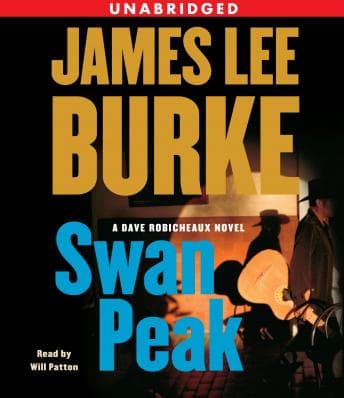

I was marinating lamb chops at 11 PM on a Tuesday—actively avoiding a revision on my 'Narrative Identity in Adolescents' paper—when Will Patton started describing a man trussed up to a tree and soaked in gasoline. My mother would say this is why I'm single. My therapist would say I'm sublimating anxiety through fictional trauma. I say: if you haven't heard Will Patton read James Lee Burke, you don't know what regret sounds like.
The Psychology of a Voice
We need to talk about Will Patton. In audiobook narration, there are performers, and then there's whatever alchemy Patton does with Dave Robicheaux. His voice sounds like it's been steeped in Tennessee whiskey and dragged through a gravel pit. It's not just 'gritty'; it's exhausted.
Psychologically, it's the perfect auditory match for Robicheaux—a man whose internal monologue runs 40% Catholic guilt, 40% PTSD, and 20% poetic rage. When Patton drops his register for Clete Purcell, Dave's best friend and chaotic id, you can practically see the neon bar signs reflecting off Clete's sweaty forehead. Most narrators do accents; Patton does pathologies. He understands that Clete isn't just 'the sidekick'; he's a walking, talking manifestation of impulse control disorder, and I love him for it.
Worth noting: Patton pulls off the same trick in Doctor Sleep, where he gives Danny Torrance an entirely different kind of damage—quieter, more internal, and somehow just as exhausting to inhabit.Montana: A Case Study in Displacement
Usually, we're in the Louisiana bayou. This time, Burke moves the whole dysfunctional circus to Montana. As a researcher, I find displacement fascinating—take a character out of their habitat, and their defense mechanisms usually crumble. Watching Dave and Clete try to fish in the pristine wilderness while their pasts inevitably catch up to them? That's a clinic in the inescapable nature of the self.
But here's the thing about Burke—and this is where I usually lose the 'plot-driven' readers. The man loves a description. He will describe the light hitting a trout stream for three paragraphs while a corpse cools in the background. Some listeners call this 'slow pacing.' I call it 'atmospheric immersion.' If you need a murder solved in ten minutes, go watch Law & Order. If you want to understand why a man looks at a mountain and sees his own mortality, you stay here.
The "Wait, What?" Moment
However—and I say this with love—the ending tested my patience. Burke has a tendency to get a little preachy, sliding from noir philosopher to Sunday school teacher when he needs to wrap things up. The resolution felt tacked on, a bit too neat for the psychological mess that preceded it. It's like when my students hand in a brilliant analysis and end it with "and everyone lived happily ever after." No, they didn't. That's not how trauma works.
Also, a warning: there are scenes involving chain lightning and wilderness violence visceral enough to make you put down your knife while cooking. I may have ruined the marinade during the Clete-gasoline scene. The sensory details were too much even for my desensitized brain.
Who This Is (and Isn't) For
If you want literature that hurts a little—prose that lingers like smoke in your clothes—this is yours. Skip it if you need tight plotting or can't tolerate a three-paragraph meditation on water while waiting for the next body to drop.
New Iberia Blues is where I'd send someone who needed to understand what Burke is actually doing structurally before committing to this one—the Louisiana setting makes the displacement mechanics in Swan Peak land harder if you've already felt what it costs Dave to belong somewhere.Case Closed (Sort Of)
Patton's performance is the gold standard for noir narration, elevating Burke's prose into something that feels less like a story and more like a confession. Just maybe don't listen while you're trying to relax. There is no relaxing in Dave Robicheaux's head.