
"Business is not something you do to people. It is something you do for people."
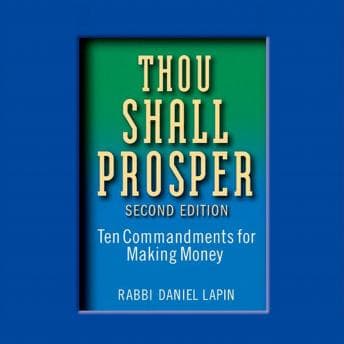
I heard that line somewhere around hour three, sitting in my car outside a client's office in Palo Alto, engine off, not moving. I'd blocked thirty minutes before a pitch meeting to review my notes. Instead I just... sat there. Because that sentence is the entire argument of this book, and Rabbi Lapin spends the next fifteen hours proving it from the Torah, the Talmud, and about four thousand years of economic history.
This is what my parents did instinctively. Now it has a TED talk. Except it's actually older than TED talks by roughly three millennia.
The Insight That Earns Its Runtime
Here's the core thesis, and I'll give it to you straight: Jewish culture has produced disproportionate economic success not because of secret handshakes or conspiracy theories, but because of a specific philosophical relationship with money, work, and other people. Lapin argues that viewing business as a moral act - as genuine service to others - isn't soft idealism. It's the actual engine of sustainable wealth.
That's not a new idea. But the way he builds it is. He goes deep into the Hebrew language itself - the word for "work" sharing roots with the word for "worship," the concept of earned money being spiritually cleaner than gifted money. He connects ancient Talmudic commercial law to modern contract theory. The Intelligent Investor does something structurally similar — Graham builds his entire framework on a philosophical premise about what markets actually are before he lets you near a single stock. He makes a serious, non-preachy case that the guilt many people feel about wanting money is culturally learned and economically destructive. Grant Sabatier makes a similar case from a purely secular angle in Financial Freedom — different tradition, same conclusion: the discomfort around money is the obstacle, not the money itself.
I've sat across the table from founders who are almost apologetic about charging for their product. I've watched that kill companies. Lapin gives you the philosophical framework to understand why that guilt is misplaced, not just the motivational-poster reassurance that it is.
This is worth the listen. The other 14 hours? Mostly worth it too, which is not something I say lightly about an 18-hour audiobook.
Where It Tests Your Patience
Let me be honest about the format. Seventeen hours and fifty-four minutes. At 2.0x, that's still nearly nine hours of content. And Lapin is thorough in the way that rabbinical scholars are thorough - which is to say, he will examine an idea from six angles when three would have closed the deal.
The chapters on reputation and networking run long. The action steps at the end of each chapter are genuinely useful but occasionally feel like a different book stapled onto the back of a better one. And the internet business examples - added for the second edition - haven't aged with the same grace as the ancient wisdom. When a rabbi tries to explain SEO strategy, you feel the seams.
A.C. Fellner's narration is competent and clear. Steady pace, no major accent drift, no audio artifacts that I caught. He handles the Hebrew terminology without stumbling, which matters more than you'd think given how much of the argument runs through specific words and their meanings. He's not a narrator who adds a layer to the material, but he doesn't subtract from it either. For a book this dense, that's the right call.
The Test My Parents Would Apply
My parents ran a dry cleaning business in Koreatown for decades. Fourteen-hour days. They never read a business book. But they did exactly what Lapin describes: they treated every customer's clothes like a trust, they built a reputation one interaction at a time, they felt genuine shame at the idea of doing shoddy work. They didn't have a philosophical framework for it. They just had the values.
Reading business books for twenty years, I've seen a lot of frameworks that dress up common sense in expensive language. Lapin does some of that. But he also does something rarer - he gives the common sense a foundation. He explains why the values my parents operated on actually work, economically and philosophically. That's useful. That's the kind of thing you can hand to a founder who grew up in a different context and say: here's why character isn't soft, it's structural.
Skip to chapter 5 if you're impatient. But honestly? Start from the beginning on this one. The setup matters.
Bottom line: long, occasionally repetitive, and more valuable than most business books that cost twice the time. The ancient wisdom holds. The internet business tips do not.