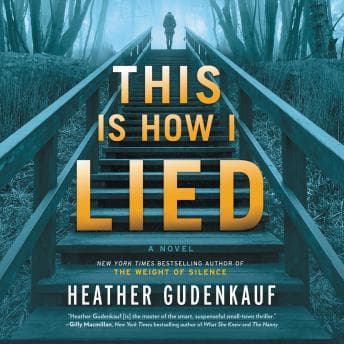

Heard a lot of praise for Gudenkauf's small-town thrillers, so I queued this one up expecting something sharp and propulsive. What I got was... competent. Solid, even. But I'd be lying if I said it kept me on the edge of my seat the way I wanted it to.
Let me cut to the chase: This Is How I Lied is a perfectly fine cold case mystery that plays it safe when it should've gone for the jugular.
Three Women, One Narrator, and the POV Shell Game
The book rotates between three perspectives — Maggie, the now-pregnant detective reopening her best friend's murder; Eve, the dead girl herself via flashbacks; and Nola, Eve's sister who's been carrying something heavy for twenty-five years. That's a lot of voices for one narrator to juggle, and Brittany Pressley handles it about as well as you can reasonably expect from a solo performance. She shifts her tone and cadence enough that I could usually track who was speaking without checking. Maggie gets this steady, controlled delivery — fits the cop persona. Eve's sections feel younger, a little more raw. Nola's the wildcard, and Pressley leans into that instability.
But here's the thing — with three distinct timelines and three women whose emotional registers overlap more than they diverge, there were stretches where I had to rewind and figure out whose head I was in. I was doing a late-night gear inventory in my home office (the consulting firm keeps odd hours), and every time I'd look down at a spreadsheet and back up, I'd lost the thread of who was narrating. A multi-narrator production would've solved that instantly. Not Pressley's fault — she's working within the format she was given — but the material was begging for it.
Grotto, Iowa: The Town That Remembers Everything
Gudenkauf knows small towns. I'll give her that. The claustrophobia of Grotto — everybody watching, everybody whispering, the way old grudges calcify into something permanent — that part rings true. I grew up in a town not much bigger before the Army got me out, and she nails that suffocating quality where your worst moment at sixteen follows you into middle age.
The caves where Eve's body was found serve as this recurring physical metaphor — dark, layered, hiding things in plain sight. And the way the investigation reopens because of a single new piece of evidence, pulling all these buried relationships back to the surface, that's structurally sound. Gudenkauf clearly did her homework on how cold cases actually get revisited. It's not some dramatic forensic breakthrough. It's quieter than that, more procedural, which I appreciated.
Where it lost me was the character work around Nick, Eve's boyfriend and prime suspect. He felt like a placeholder — the obvious red herring who exists to absorb suspicion while the real answer hides elsewhere. I've debriefed enough actual investigations through my consulting work to know that real suspects are messy, contradictory people. Nick just... wasn't interesting enough to carry his role in the story.
The Predictability Problem
I started piecing together the ending around the four-hour mark. Not the exact details, but the shape of it — who was hiding what, and why. And once that clicked into place, the last five hours became an exercise in confirmation rather than discovery. That's a problem for a mystery. The slow drip of revelations from Nola's perspective should've been the engine driving everything forward, but I was ahead of the plot, waiting for it to catch up.
Now — I should be fair. Gudenkauf isn't trying to write a military thriller or a Connelly-style procedural. This is domestic suspense, small-scale and character-driven. The emotional payoff matters more than the twist. And when she explores how trauma reshapes memory, how the stories we tell ourselves about the past are really just survival mechanisms, that lands. Maggie's pregnancy adds an interesting layer — she's literally creating new life while excavating an old death. That tension works.
But a mystery that doesn't surprise me by the end is a mystery that didn't quite accomplish its mission.
Worth Your Time? Here's the Debrief
At just under ten hours, this isn't a massive commitment. Pressley's narration is clean and professional — pleasant voice, good pacing, no audio issues that pulled me out. I listened at my usual 1.25x and it flowed fine. If you're doing yard work or folding laundry and want something that keeps your brain engaged without demanding your full attention, this'll do the job.
If you've read Gudenkauf before and loved Not a Sound, temper your expectations slightly. This one doesn't hit quite as hard. But if you're into small-town secrets, cold cases, and female-driven suspense, it's a decent addition to the rotation. Deal with the Devil scratched a similar itch for me — different setup, but that same female-driven momentum and the sense that everyone in the story is holding something back.
Ranger slept through the last three hours. Make of that what you will.