
"You can put that man in a suit, but he'll never be tame."
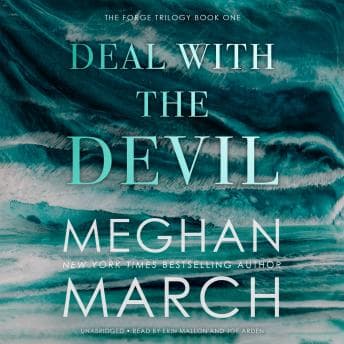
That line hit me about ten minutes in, and I thought - alright, March, you've got my attention. I was up past midnight finishing a threat assessment for a client, Ranger snoring at my feet, and I figured I'd knock out something short before bed. Five hours and fifty-three minutes later, the sun was coming up and I'd blown right through the whole thing. So much for sleep.
Let me cut to the chase: this is not my usual lane. I'm a thriller guy, a history guy. Romance with a capital R isn't typically in my rotation. I'm more comfortable with something like Blowback: A thriller, where the stakes are geopolitical instead of emotional. But Linda recommended Meghan March months ago, and I'd been dodging it. When I finally hit play, I was surprised at how much the suspense elements actually worked. Jericho Forge is basically what happens when you cross a Fortune 500 CEO with someone who's done very bad things in very dark rooms - and the book doesn't shy away from that tension. India isn't some damsel waiting to be rescued either. She's desperate, sure, but she's calculating. She walks into that deal with her eyes open, which I respect.
The Forge Effect - When the Villain Gets His Own Mic
Here's what caught me off guard: Joe Arden's narration for Jericho Forge is genuinely dangerous-sounding. Not cartoonish villain dangerous - the quiet kind. The kind where a guy lowers his voice instead of raising it and everyone in the room goes still. I've known men like that. Some of them wore stars on their shoulders. That quiet menace also runs through Crimson Shore, though in a completely different setting. Arden nails that controlled intensity, especially in the scenes where Forge is circling India during their early exchanges. There's a scene - the "Kraken" scene, listeners will know the one - where the humor and the heat collide, and Arden walks that line between funny and predatory without losing either thread. Pretty impressive for what could've been a one-note alpha-male performance.
Erin Mallon handles India well, giving her enough backbone that you believe she'd actually stand toe-to-toe with someone like Forge. The chemistry between the two narrators during their back-and-forth dialogue is real - you can feel the push-pull. That said, Mallon has this habit of stretching certain dramatic moments, drawing out inflections like she's trying to wring every drop of tension from a line that was already doing its job. It's not constant, but when it happens, it pulled me out of the scene. Like a sniper taking one extra second on the trigger - sometimes less is more.
Where the Intel Gets Thin
Here's my honest assessment of the story itself: it's a setup book. First in a trilogy, and it knows it. March builds the world of Forge's empire and India's desperation with real skill - the witty dialogue crackles, the power dynamics feel earned rather than forced. But around the midpoint, you can feel the architecture. You can see where she's laying pipe for books two and three, and some scenes exist more to establish future plot threads than to serve this particular story. The pacing wobbles there. Not fatally, but noticeably.
The book is under six hours, which works in its favor - there's not enough runway for things to drag badly. But it also means the ending hits fast and hard, and you're left hanging. If cliffhangers make you want to throw your phone, consider yourself warned. I immediately looked up book two, which I suppose means March did her job.
At 5 hours 53 minutes, this is a quick operation. No wasted movement for the most part. The dual narration gives it a full-cast feel without the production overhead, and the audio quality is clean throughout - no weird level changes between narrators, no background noise. Straightforward and professional.
Who Should Gear Up (And Who Should Stand Down)
If you like your romance with a side of genuine menace - not just "bad boy with a heart of gold" but actual moral ambiguity where you're not sure if Forge is the hero or the threat - this delivers. Thriller readers who don't mind steam will find enough suspense to stay engaged. Pure romance readers are probably already on board.
Skip it if: you need standalone stories (this is absolutely a trilogy commitment), you can't handle explicit content (and I mean explicit), or if cliffhangers genuinely ruin your day.
SITREP: I went in skeptical and came out buying book two at 5 AM. The narration - Arden especially - elevates material that could've been generic into something with real teeth. Mallon's occasional dramatic stretching keeps it from a perfect score, but the dual performance is strong. Not my usual mission, but I can see why March sells books by the truckload.
Ranger slept through the whole thing. But he's not the target audience.