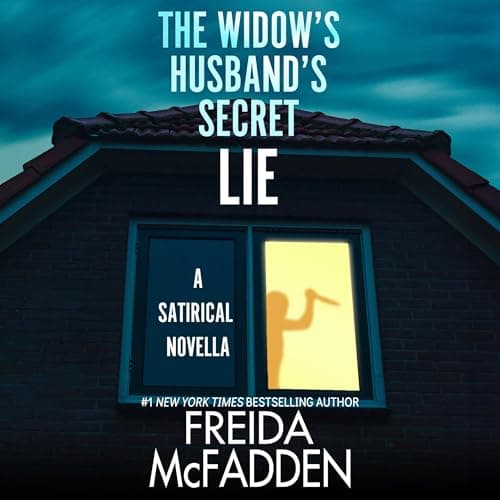

I started this on the downtown 6 after a brutal evening shift, half-hungry and still thinking about a family meeting that went sideways, and the opening funeral scene snapped me out of hospital brain almost immediately. Not because it was profound. Because it was mean in exactly the right way. A dead husband, a widow doing the math on grave depth, and finger sandwiches/deviled eggs/mini beef wellingtons getting just as much attention as grief? Yeah. That told me what kind of ride this was going to be.
This is Freida McFadden in a very specific mode: short, sharp, slightly ridiculous, and fully aware of its own ridiculousness.
What sold me first
The satire lands early. The funeral setup is the hook, but what kept me listening was the book's commitment to that dry, side-eye voice. The joke about the casket maybe being five feet down instead of six is such a good signal flare for the whole novella: grief is present, but the narrator's brain is busy doing petty little calculations and observations because denial wears a lot of costumes. And the LED lighting joke — small thing, but exactly the kind of detail that tells you this book knows how absurd modern tragedy can look when you tilt the camera just a little.
There's also a very particular Freida McFadden pleasure here, which is that you keep asking yourself, "Wait, is this book kidding right now?" And then five minutes later: "Nope. It's kidding and threatening me." That's fun. Especially in a 2-hour-39-minute package that never asks for a huge emotional investment up front.
I also need to mention Alice, because yes, she really is Something. Even without this being a deep character study, Alice adds that off-balance energy McFadden likes — the kind of presence that makes scenes feel a little socially dangerous even before the thriller machinery fully kicks in. Not everyone in this novella is built for complexity. But some of them are built to make you suspicious on sight, which honestly matters more here.
Marin Ireland understood the assignment
Marin Ireland is a big reason this works as audio instead of just "cute on the page." Her timing is dry without flattening the tension, which is harder than people think. Comedy in thrillers dies fast if the narrator winks too hard. She doesn't. She plays the lines straight enough that the humor slips in like a scalpel — clean cut, then you notice the damage.
And when the book pivots from snark to unease, she doesn't overperform it. No melodramatic gasping. No trying to convince you the twist is bigger than it is. Just controlled escalation. For a novella like this, that's smart. You need someone who can sell both the sarcasm and the paranoia without making either feel like a separate audiobook.
I listened at 1.25x for most of it and wouldn't push much faster unless you already know you like your thrillers zippy. At 1.5x, I think some of Ireland's comedic pauses would lose their sting. And those pauses matter here.
Where it absolutely works — and where it doesn't
This is the part where I stop people from spending a full credit blindly.
The book is entertaining. Very. I smiled more than I expected in a story about a dead husband and lurking secrets, which feels spiritually incorrect, but here we are. The funeral scene is memorable. The recurring sense of "why am I seeing his face everywhere?" gives the novella enough propulsion to keep you locked in. And the twist ending? It does what McFadden endings do: it wants a reaction. For a lot of listeners, that reaction is going to be a delighted "you've got to be kidding me." For others, it's going to be a side-eye and a shrug.
I'm in the middle.
I didn't hate the ending. I also didn't think it earned the jaw-on-the-floor marketing copy attached to it. I yelled at my phone on the subway during this one — but affectionately, not because I felt betrayed. More like, "Freida, be serious." Which, to be fair, is part of the fun with her books.
The bigger weakness is depth. At novella length, this was never going to become a layered study of marriage, deception, and identity. Fine. But a couple of moments feel more engineered than lived-in, and if you're the kind of thriller listener who needs airtight psychology, you may bounce. Some of the uneven pacing complaints make sense too. Not because it's slow — it isn't — but because short books like this can sprint through setup, pause for a joke, then lurch into revelation. If you want clean, relentless momentum, that stop-start rhythm may bug you.
Still, I respected that the book didn't overstay. There is real value in a thriller that knows it's a palate cleanser. Not every mystery needs to be a 14-hour trauma brick. Sometimes you want one weird widow, one dead husband, one suspiciously polished social scene, and a narrator who can make a line hit with just enough acid. We Have Always Been Here scratches a similar itch — tight, atmosphere-forward, with that same sense that the social surface is one bad moment away from caving in.
Who should listen (and who should skip)
Pick this if you want a quick, darkly funny psychological snack and you're okay sacrificing depth for punch. Pick it if you enjoy thrillers that are a little camp, a little catty, and aware that absurdity is part of the appeal. And pick it if good narration can carry a lightweight story further than the text alone might.
Skip it if you need rich character interiority or a twist that feels inevitable in hindsight instead of gleefully engineered. Skip it if satire around death and funerals feels off to you. And definitely skip the full-price purchase if you judge audiobook value by hours alone, because 2 hours and 39 minutes is subway-ride money, not automatic-credit money.
Prognosis
This is a solid little chaos capsule. Funny enough to justify the satire label, tense enough to qualify as a thriller, and elevated quite a bit by Marin Ireland's control and timing. Not top-tier McFadden for me. But for a post-shift listen when your brain wants danger without homework? It does the job.
Wait for a sale, borrow it, or stream it. Then enjoy the deviled eggs and bad decisions.