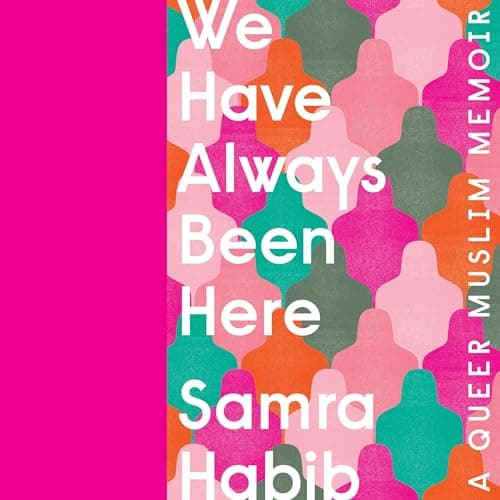

This is a five-hour memoir that will wreck your evening plans — in the best way. If you're looking for a reflective, emotionally dense listen and can give it undivided attention on a quiet night, buy it. If you need something you can half-listen to while cooking or commuting, this isn't your book. The emotional weight requires presence.
Samra Habib's We Have Always Been Here opens not with grand declarations but with the specific terror of being Ahmadi Muslim in Pakistan — a community targeted by extremists who consider the sect heretical. Habib describes bomb threats against their mosque and the casual, grinding fear of simply existing in public. There's no dramatic orchestration here. The danger is conveyed through small details: a parent's tight grip on a child's hand, the calculation of which routes are safe. That restraint hit me harder than any heightened prose would have.
What follows is a refugee story that refuses to become an uplift narrative. Habib's family arrives in Canada, and instead of finding safety, they find new varieties of hostility — schoolyard racism, grinding poverty, cultural isolation. Then comes the arranged marriage, which Habib enters as a teenager still silently processing their own queerness. I kept pausing during these sections, not because they're graphic but because the quiet suffocation of it — a kid being handed a life script they can't follow — is rendered with such specificity that it physically tightens your chest.
The memoir's second half catches fire when Habib starts actively seeking out queer Muslim communities around the world. They travel to Turkey, to Europe, to various corners of North America, meeting people who prove that the supposed contradiction between queerness and Islam is a fiction imposed by people with power. The title is a direct rebuttal: queer Muslims aren't new. They've always existed. Habib's photography work documenting these communities gets mentioned but never fully explored, which is one of the book's real missed opportunities — I wanted more about how their art practice informed their self-understanding.
Parmida Vand's narration is the reason this works as an audiobook rather than just a book you happen to listen to. Her voice carries a particular quality during the heavier passages — she slows down just slightly, lets silence do work, never pushes for emotional effect. During the Pakistan sections, her tone stays level and factual, which mirrors Habib's own refusal to sensationalize. When the material shifts to Habib falling in love for the first time on their own terms, Vand's delivery lifts noticeably — not into cheerfulness exactly, but into something looser, more open. You can hear the relief in the prose, and she catches it. The intimate, one-on-one quality of her performance makes the five-hour runtime feel like a long conversation rather than a reading.
Structurally, the book has some rough patches. Transitions between life phases sometimes feel like jump cuts — one chapter you're in suburban Canada dealing with a crumbling marriage, the next you're in Istanbul meeting queer activists, with very little connective tissue between the two. The globe-trotting later chapters cover so much ground so quickly that individual encounters start to blur. I found myself wanting Habib to slow down and sit with one community, one city, one relationship for longer. At five hours, the compression is understandable, but it costs the back half some of the visceral specificity that makes the front half so effective.
The passages about Habib's parents are where the writing is sharpest. There's genuine love and genuine fury, held together without resolution. Habib doesn't forgive their parents in some clean dramatic arc — they just keep showing up, keep trying to understand people who made impossible choices under impossible pressure. That complexity is the book's emotional core, and it's the thing that stayed with me longest after the final chapter. Reason to Believe left me with that same unsettled, still-processing feeling — the kind a book earns only when it refuses to wrap its contradictions into something tidy.
What impressed me most is that this never becomes a single-axis memoir. Habib's queerness doesn't exist in isolation from their faith, their immigration status, their poverty, their gender. These things don't alternate politely — they pile up, contradict each other, create pressures that can't be solved by addressing just one. That layered honesty is rare in memoir, and it's what separates this from books that treat identity as something you can untangle into neat categories.
Content note: there are passages dealing with sexual abuse, homophobia, and anti-Muslim hatred that are handled with care but are still difficult to sit with. Know that going in. Skip this one if you need clear resolution or if stacked trauma content isn't something you can absorb right now — the book doesn't offer catharsis, and it doesn't apologize for that.
For a short listen, this one punches well above its runtime. I finished it on a Tuesday night and didn't start another book until the weekend — I needed the space to let it settle.









