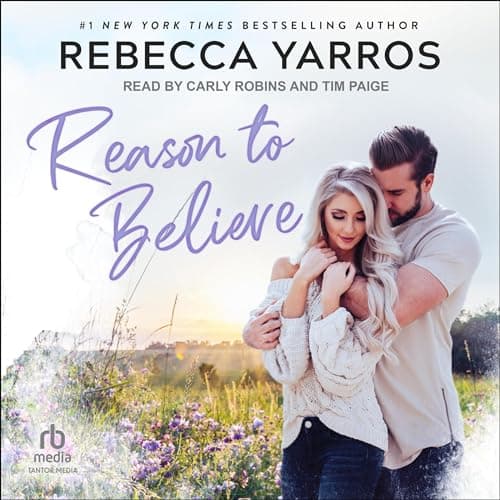

So everyone kept telling me Rebecca Yarros is basically emotional demolition in book form, and I kept putting her off because I figured the hype was all Fourth Wing dragon stuff and I'm not really a fantasy girl. Wrong Yarros, Elena. Wrong Yarros entirely.
I started Reason to Believe at 2 AM on a Tuesday because I couldn't sleep — Diego had knocked my water glass off the nightstand (again) and I was too wired to go back to bed. Figured I'd listen to something light while I cleaned up the mess. By 4 AM I was sitting on my bathroom floor with mascara from yesterday still on my face, crying into a towel because a fictional firefighter was reading a bedtime story to a foster baby.
Knox Daniels Made Me Forget He's Fictional and That's a Problem
Here's what got me: Knox doesn't do the typical romance hero thing where he's emotionally unavailable until the heroine unlocks him like some feelings puzzle box. He walks into his own house, sees Ember covered in baby puke with two kids who aren't hers, and just... steps up. No hesitation. No dramatic internal monologue about whether he's ready. He builds a crib. He does middle-of-the-night bottle feedings. And Tim Paige voices him with this low, steady warmth that makes you feel like someone actually reliable exists in the world — not breathy or performative, just solid. The kind of voice that makes "we can make this work" sound like a vow instead of a throwaway line.
And Ember — okay, Carly Robins gives her this slight crack in her voice during the scenes where she's fighting to keep those boys together. Not a full break, just enough fracture that you hear the fear underneath the determination. There's a specific stretch somewhere around hours three and four where Ember is navigating the foster care system's bureaucracy, and Robins delivers it with this exhausted, clipped frustration that felt so real I had to pause and take a breath. Because Yarros co-founded a nonprofit for foster kids, and you can FEEL that this isn't research — it's conviction.
The Fake Dating Setup Is the Least Interesting Part (And I Mean That as a Compliment)
Look, the premise sounds like standard romance scaffolding: fake relationship, brother's best friend, forced proximity. And yeah, it is. But the thing that makes this book hit different is that the fake relationship isn't really the engine — the kids are. The older boy, the pre-K student who's Ember's student before he's her foster kid, and his baby brother who could get separated from him by the system. Every decision Knox and Ember make circles back to those boys. The romance doesn't exist in some separate lane from the parenting stuff; it grows directly out of it. Knox falling for Ember while she's teaching a scared little kid that adults can be trusted? The chemistry is chef's kiss but it's also genuinely earned because you're watching two people build something real out of something terrifying.
And then there's the wildfire crew angle — hotshot firefighters rebuilding a fallen crew that belonged to Ember's father. Yarros threads the grief of losing a parent to the job they loved right alongside the foster care story, and the way those two currents kept catching me off guard was almost unfair. Loss begets loss begets someone deciding to stop the cycle. My heart. MY HEART. That exact ache — grief tangled up with chosen family and the stubborn decision to keep showing up anyway — is what made Giver of Stars wreck me in a completely different setting but with the same marrow-deep emotional logic.
Abuela would have loved this one. She would've been yelling at Ember's brother to mind his own business and let his best friend love his sister already.
The Dual Narration Earns Its Two Voices
With dual narrators you always risk one POV feeling like filler between the good parts. That doesn't happen here. Robins and Paige feel matched — like they recorded in conversation with each other's energy even though they obviously didn't. When Knox is being protective, Paige doesn't go growly alpha; he goes quiet and deliberate. When Ember is being stubborn, Robins doesn't go shrill; she goes still. It's a smart pairing. Not flashy, but consistent in a way that lets you sink into 11 hours without narrator whiplash pulling you out.
I do wish the pacing in the middle section — around hours six through eight — moved a little faster. There's some repetitive internal back-and-forth about "we shouldn't do this because my brother" that could've been trimmed. The conflict felt slightly manufactured when the real emotional stakes (the kids, the crew, the dead father's legacy) were already doing the heavy lifting. But honestly? Minor complaint. This book felt like wrapping yourself in a weighted blanket after the worst day of your year.
Who Gets to Cry Here (And Who Should Keep Walking)
Pick this up if you want romance that's built on caretaking rather than just attraction — if watching someone choose a family on purpose wrecks you the way it wrecks me. Skip it if you need your fake-dating trope played for comedy, or if the brother's-best-friend tension feels like a conflict you've outgrown. This is a rainy Sunday book, but the kind of rainy Sunday where you're also sorting through old photos and trying not to call your mom at midnight.
Cried twice. Added to the spreadsheet. Diego judged me from the nightstand. Frida didn't even wake up. Standard Tuesday.