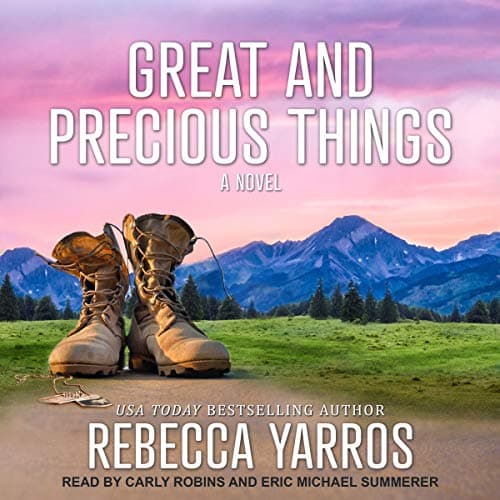

"How do you define yourself when others have already decided who you are?" That question hits you early in Great and Precious Things, and it stayed lodged in my chest through most of the twelve-hour listen. Rebecca Yarros doesn't just ask it rhetorically — she builds an entire town around the weight of that question, then drops a broken soldier right into the middle of it.
Camden Daniels comes home to Alba, Colorado, after six years away. He left carrying the worst kind of baggage: he went to war with his younger brother and came back alone. Nobody in this tiny mountain town has forgiven him for it. That particular wound — the soldier who survives when someone else didn't — gets under your skin in a different way in Night Patrol too, if you want another listen that doesn't let the homecoming feel easy. Not the neighbors, not the community, and especially not his father. When a desperate message pulls him back, Cam has to face down every ugly thing he ran from — the grief, the guilt, the whispered accusations — and the one person who never stopped loving him.
Willow is that person. And the romance between her and Cam is where Yarros does her best work. It's not a simple love story slapped onto a dramatic backdrop. These two have history threaded through every interaction. There's longing that feels earned rather than manufactured, and the slow unraveling of why they've stayed apart gives the story genuine tension. When Willow tells Cam she's always loved him, you believe it because Yarros has built the emotional architecture to support that confession. It's not a declaration — it's an exhale she's been holding for years.
The family dynamics here are brutal in the best way. Cam's relationship with his father is layered with resentment, obligation, and the kind of love that only shows itself through damage. There's a degenerative illness involved, secrets that the town would rather bury than confront, and a community that functions more like a jury than a support system. Yarros captures small-town claustrophobia perfectly — that particular suffocation of being judged by people who've known you since birth and decided they know all they need to.
Now, about the narration. Carly Robins and Eric Michael Summerer split duties, and this is one of those dual-narration setups that genuinely elevates the material. Summerer gives Cam a rough, restrained quality — you can hear the soldier in him, the guy who's trained himself not to feel too much because feeling anything might crack the whole dam open. Robins brings warmth and quiet stubbornness to Willow that keeps her from becoming the standard "woman who waits." Together, they create a rhythm that makes the alternating perspectives feel like a conversation rather than a ping-pong match. The emotional beats land harder because of how these two perform them — one listener called them out specifically for how many feelings they pulled out of a single scene, and honestly, same.
I listened to this during a stretch of early morning runs and quiet evening hours (the rare kind where both kids were actually asleep), and I'll say this: it's not background listening material. The emotional payoffs require your attention. There were moments — particularly around the family revelations and Cam confronting his past — where I had to stop what I was doing and just listen. The story earns its tears, and there were a couple of points where it got them from me.
That said, I understand the criticism some listeners have raised. The bones of the story — soldier returns home, forbidden love, small-town secrets — aren't exactly uncharted territory. If you've read enough contemporary romance, you'll see some structural beats coming. And the ending takes a sharp turn into thriller-adjacent territory that doesn't quite match the emotional intimacy of everything that preceded it. One reviewer compared the climax to a subpar Law and Order episode, and while I wouldn't go that far, the tonal shift did feel abrupt. The story is strongest when it stays in the uncomfortable silences between people who love each other badly.
But here's what separates this from a standard small-town romance: Yarros doesn't let anyone off the hook. Cam isn't just brooding — he's genuinely difficult, sometimes wrong, and the narrative doesn't excuse him just because he's suffered. Willow has her own agency and her own reasons for staying that go beyond waiting for a man to come back. The secondary characters in Alba feel like real people with real stakes, not cardboard villagers there to create obstacles.
At twelve hours, the pacing is solid. There's a slow burn to the romance that pays off well, and the mystery elements — what really happened, what's being hidden — provide enough propulsion to keep you moving through the quieter stretches. Yarros knows how to balance heartbreak with hope, and this might be one of her strongest examples of that skill.
Who should listen: If you love emotionally heavy romance with real family dysfunction and dual narration that actually earns the two-voice format, queue this up. If you need fast pacing or can't handle a slow burn that sits in the grief before it gets to the good stuff, this one might test your patience.
For fans of Yarros who maybe stepped away after a book that didn't click, this one is worth coming back for. It has the emotional weight of The Last Letter with the small-town pressure cooker energy that makes her best work stick with you after the final chapter ends.