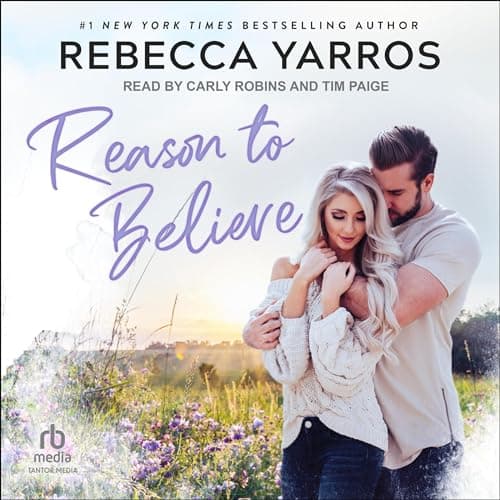

I have a complaint. Nobody warned me. Not the cover, not the blurb, not the cheerful Saturday morning I chose to start this book. I pressed play thinking I was getting a college romance with a hot hockey player next door, and within twenty minutes I was ambushed by the most visceral grief scene I've encountered in the romance genre. Soldiers at the door. A mother who won't open it because she already knows. And Ember, twenty years of being an army brat crystallized into one terrible moment of understanding. That's not how you're supposed to start a Saturday.
Here's the thing — listeners who've loved this book consistently say the same thing: the grief feels real. And they're right, but I want to be more specific about why. Rebecca Yarros, who draws from her own experience as a military spouse, doesn't render loss as a single dramatic event that gets processed and shelved. She renders it as a thousand small, ongoing destructions. Ember making breakfast for her younger siblings while falling apart inside. The way she talks to her father's memory like he might still answer. The scene where she finds one of his old jackets and can still smell him — that's the one that wrecked me enough to pause and stare at my ceiling for a while. Grief captured in physical, sensory detail is extraordinarily hard to write, and Yarros nails it.
What surprised me as the story unfolded is that the romance doesn't function as an escape from the grief. It's tangled up in it. Josh Walker shows up next door — hockey player, impossibly kind, with the patience of someone who understands loss even before we learn why — and Ember is torn between wanting to feel something good and believing she doesn't deserve to. Their dynamic has this push-and-pull tension that feels earned rather than manufactured. When Ember pushes Josh away, it's not because of a contrived misunderstanding. It's because she's terrified of needing someone who could also disappear. Yarros lets that fear breathe instead of rushing past it to the next steamy scene.
The steam is there, and it's well done. But what stayed with me were the quiet moments — the way the romance makes Ember feel guilty because joy seems like a betrayal of her grief, or how Josh's steady presence becomes both a comfort and a threat. That emotional complexity is what lifts this beyond standard new-adult fare.
Carly Robins narrates with restraint that serves the material perfectly. She doesn't oversell the emotional moments, which is exactly the right call for a book this heavy. When Ember's voice cracks, Robins lets it crack just enough — no melodrama, no vocal pyrotechnics. Her Josh voice works too, warm and steady in a way that makes you understand why Ember keeps gravitating toward him even when she's fighting it. Robins carries that same quiet steadiness into In the Likely Event, another book with serious emotional weight that she navigates without ever tipping into overwrought territory. The pacing of her delivery matches the book's rhythm: measured during the grief scenes, charged during the romance, devastating when those two collide.
Where the book wobbles is in its secondary characters. Ember's college friends feel thin — they provide contrast and occasional normalcy but lack the depth of the central relationship. Her mother's arc, while realistic in its portrayal of someone shutting down after devastating loss, could have used one or two more scenes showing her internal world rather than just filtering through Ember's frustration. And Josh's secret, when it finally lands, packs a punch but felt like it could have been seeded earlier so the reveal didn't arrive quite so abruptly.
But these are minor issues against what is a genuinely affecting story. Yarros does something rare: she makes the stakes feel real beyond the romance. The tension isn't just "will they get together" — it's "can Ember survive this, and will loving Josh make her stronger or break her completely?" That's a much harder question, and the book doesn't take the easy way out.
So let me be direct about who should and shouldn't spend a credit here. Buy this if you want romance wrapped tightly around family grief and you're okay with a heavy emotional load that doesn't let up for cheap laughs. Buy this if you want to feel something real and raw from your romance rather than just a dopamine hit. Skip this if you want banter-first romance, a lighter college vibe, or a more steam-forward experience. Skip this if grief narratives exhaust rather than engage you — there's no shame in that, but this book will drain you.
Listening context matters too. This worked for me on a solo weekend — housework, a long walk, dedicated listening stretches. I would not recommend it for bedtime if you're already feeling tender, and it's not background material. You need to be present for this one.
At nine hours, the pacing feels right. No bloat, no passages tempting you to skip ahead. If you've read Yarros's later work — The Things We Leave Unfinished or The Last Letter — you'll recognize her DNA here, but in a rawer, less polished form. I landed on Alas de sangre after this one specifically to track how her voice evolved — the emotional core is recognizably hers, but the craft around it has sharpened considerably. That rawness is part of the appeal. This feels like a book written from genuine emotion rather than formula, and Robins's narration honors that honesty. It's the kind of audiobook that lingers days after the last chapter, not because of plot twists, but because of how truthfully it handles what it means to keep living after the worst has already happened.