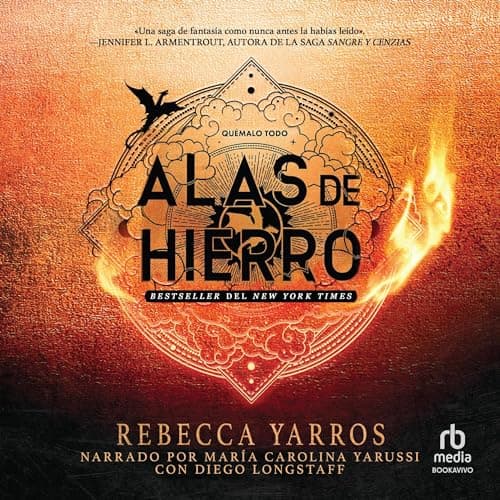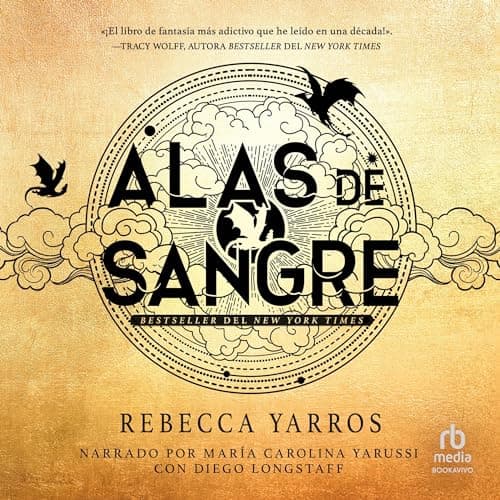

Fourth Wing is a D&D campaign your DM spent six months prepping and it absolutely shows.
Look, I'm going to be upfront: I listened to this in Spanish — Alas de sangre — because I've been halfheartedly trying to level up my Spanish since undergrad and figured dragons might motivate me more than Duolingo. I was sprawled across my apartment floor at 1 AM, surrounded by the aftermath of a Gloomhaven session my group abandoned halfway through, and María Carolina Yarussi's narration had me so locked in I forgot to clean up a single tile. Twenty-one hours later, my thesis has not progressed. Dr. Patel would not be pleased. I regret nothing.
The Magic System Is Chef's Kiss (No, Seriously)
Here's what Yarros gets right that a lot of romantasy doesn't even attempt: the dragon-rider bonding system has actual rules. Dragons choose based on perceived strength. They will literally incinerate you if you're not worth their time. There's no gentle Eragon-style egg-touching here — this is a system where the death rate during Conscription Day is treated as expected attrition. Violet Sorrengail walks into the war college at Basgiath as basically a glass cannon with a joint condition that makes the physical trials genuinely dangerous for her, and the book doesn't let you forget it. Every time she crosses a bridge, climbs a wall, or faces a challenge roll — sorry, combat assessment — you feel the fragility. It's progression fantasy wearing a romantasy skin, and the progression is satisfying in the same way watching someone min-max a character with terrible base stats is satisfying.
The Empyrean world has its own codex structure (the book literally opens with "Article One, Section One of the Dragon Rider's Codex"), tiered leadership within rider wings, and a political system where your parents' war crimes can get you killed by your classmates. Xaden Riorson — son of a rebellion leader, covered in rebellion relics tattooed on his skin marking every person his father got killed — has every reason to murder Violet because her mother executed his father. That's not a love interest setup, that's a PvP scenario with romantic complications. And I'm here for it. The kind of urban fantasy that pulls off a similar trick — dangerous history between characters doing most of the romantic heavy lifting — is Hanging Tree: A Rivers of London Novel, where the tension comes less from will-they-won't-they and more from who's-going-to-get-someone-killed-first.
Two Narrators, One War College
So here's where I have to be honest: research on Yarussi and Longstaff's specific performance is thin. What I can tell you is the dual-narrator format works for the structure — you get Violet's perspective anchored by Yarussi and the broader scope through Longstaff. The Spanish adaptation flows well enough that I stopped noticing the translation about two hours in, which is either a compliment to the narration or evidence that my brain was too hooked on dragon politics to care. At 21 hours, the pacing doesn't drag the way you'd fear — the war college structure gives the book natural arcs (each challenge, each test, each near-death experience) that break the runtime into digestible chunks.
I will say: if you're used to English-language fantasy audiobooks with the kind of voice differentiation that Steven Pacey brings — Steven Pacey walked so other narrators could run, and I'll keep saying it — you might find dual narration in translation a slight adjustment. But it's serviceable. It does the job. It didn't pull me out of the story, and with a book this addictive, that's really what matters.
The "Yeah, But" Section — Because I'm Not a Shill
Is this Sanderson-level world-building? No. Let me be clear. The magic system has rules, but they're revealed on a need-to-know basis rather than built from first principles. The political intrigue — the secret that Navarre's leaders are hiding about the kingdom's weakening defenses — is telegraphed pretty early if you've read any amount of fantasy. And the romance follows beats you can predict if you've ever read enemies-to-lovers (he's dangerous, she's defiant, there's a scene where proximity becomes very charged, you know exactly where it's going).
But here's the thing: I read this instead of writing my thesis, and I don't say that about books that aren't doing something right. The war college setting scratches the same itch as a good academy arc in progression fantasy. Violet solving problems through intelligence rather than brute force when she's physically outmatched? That's my rogue-build wizard energy. My D&D group would love this.
Who Gets to Ride and Who Gets Incinerated
Pick this up if you want dragon rider fantasy that leans into its romance without apologizing for it and doesn't skimp on the stakes — people die in this book, sometimes characters you've gotten attached to. Skip it if you need hard magic systems explained with Cosmere-level rigor, or if enemies-to-lovers makes you roll your eyes so hard you miss a highway exit. Also skip if you're listening in Spanish purely for language practice and your vocabulary isn't at least intermediate — 21 hours of military fantasy jargon will humble you fast.
Yes, it's 21 hours. Yes, it's worth it. My thesis can wait.