"Life's too short to play it safe."
That line hits different when the character saying it has a congenital heart condition that could literally kill her if her pulse spikes too high. And that tension — between wanting to feel alive and the very real possibility of dying from it — is what makes Eyes Turned Skyward land harder than your average forbidden military romance.
SITREP: If you love Yarros's later work and want to hear where her instincts for high-stakes romance started, this is worth your credit. If inconsistent accents in narration drive you up a wall, you'll notice Carly Robins's Southern accent slipping — on headphones it's more distracting than on a car speaker during a commute. Not a dealbreaker, but it's there. If you need constant momentum and can't stand heroines who make frustrating choices, this might test your patience in the middle third.
Now, the longer version.
Rebecca Yarros draws from her own life as a military spouse, and the flight school setting here isn't decorative. It's a pressure cooker — rank, reputation, chain of command — and every personal decision Paisley and Jagger make carries professional consequences. Paisley Donovan is twenty, carrying both a heart condition and the psychological weight of being the sister who survived. Her parents have essentially shrink-wrapped her life since her sister's death, and you feel that suffocation in every scene where she's expected to be careful, be grateful, be small. Her bucket list isn't cute social media content — it's rebellion against people who've already decided her life should be limited.
Jagger Bateman pulls her from the ocean early on, and Yarros smartly doesn't milk the meet-cute. She pushes past it into the real friction: Paisley is the commanding general's daughter, she has an existing boyfriend who happens to be Jagger's biggest rival at flight school, and Jagger's entire career depends on not making powerful enemies. The stakes aren't just will-they-won't-they — they're career-ending, family-fracturing, and for Paisley, potentially fatal.
What caught me off guard was how Yarros handles the illness storyline. It would be easy to make Paisley fragile, someone who needs saving. Instead, she's stubborn to the point of recklessness — wanting to skydive, kiss the wrong guy, feel her heart race even though that could stop it permanently. She's frustrating and genuinely compelling in equal measure. There's a real philosophical question running underneath the romance about what it means to live versus merely survive, and Yarros earns those moments instead of just reaching for sentimentality. That question stuck with me days after I finished listening.
The narration. Dual-POV: Carly Robins handles Paisley's chapters, Teddy Hamilton takes Jagger's. Here's the blunt version — Teddy Hamilton is the star of this production. One listener called his voice "so lovely in my earholes," and that's honestly accurate. He brings warmth and confidence to Jagger that makes you understand viscerally why Paisley can't stay away. His delivery is consistent, emotionally calibrated, and he nails the quiet moments as well as the heated ones.
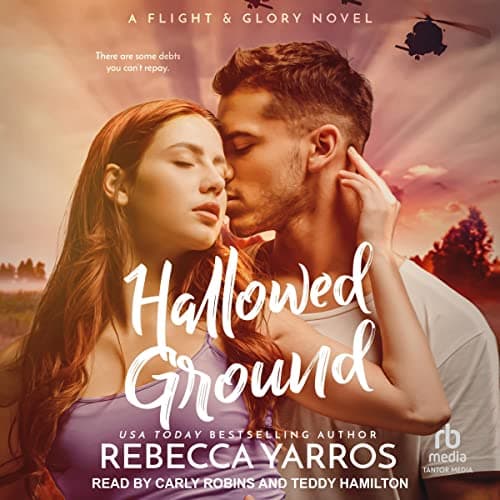
Carly Robins is good — genuinely good — but Paisley's Southern accent slips in and out throughout the listen. I've heard her work at a higher consistency level — Hallowed Ground is a cleaner performance from her, and worth a listen if you want to hear what she sounds like when the accent work holds all the way through. It's the kind of thing that once you catch it, you keep catching it, especially in back-to-back chapter switches where Hamilton's consistency highlights the contrast. On headphones during a focused listen, it's noticeable. On a commute or doing dishes, you'll probably ride right past it. Her emotional range is strong and she captures Paisley's defiance well, so it's not like her chapters are a chore. It's just an inconsistency that keeps the narration from being airtight.
Pacing: at eleven hours, this doesn't drag badly, but there are stretches in the middle where Paisley's internal agonizing circles the same emotional territory one too many times. The military backdrop keeps external pressure building, which helps. When the twists arrive in the final third, they hit with genuine force — Yarros doesn't pull punches, and the emotional payoff earns the slower build.
The romance runs hot. This is not closed-door. The chemistry between Paisley and Jagger crackles in a way that feels organic rather than performative, and the forbidden elements — her father's authority, the existing boyfriend, the career stakes — create real obstacles instead of manufactured drama.
Who Should Listen (And Who Should Skip)
Military romance fans who want stakes that go beyond miscommunication — career consequences, family fallout, a heroine whose literal heartbeat is a ticking clock. Yarros completists working backward from Fourth Wing will find the DNA of her later work here, grounded and contemporary but just as unsparing. Skip it if accent inconsistency in narration is a hard no for you, or if you need a plot that never lets off the gas — the middle third asks for patience.
If you came to Yarros through Fourth Wing, this is a different animal — grounded, contemporary, emotionally raw — but the same instinct for characters who refuse to play it safe is running underneath everything. That same refusal shows up in Iron Flame, though the dramatized format there is a completely different beast — bigger cast, higher noise floor, but that same Yarros willingness to put her characters through genuine hell before they earn anything. It's the kind of audiobook where you show up for the romance and walk away thinking about mortality, agency, and what you'd actually put on your own bucket list if the clock were ticking louder than you'd like.