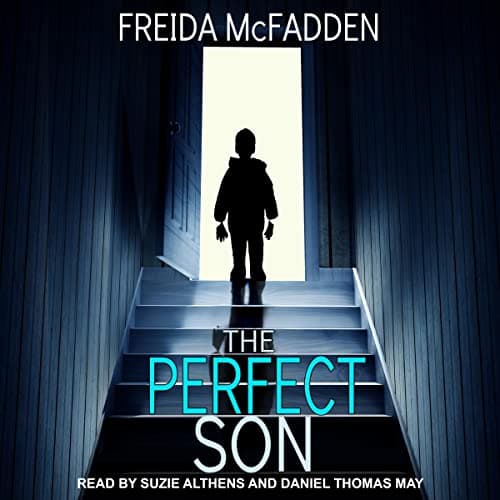

I was folding laundry at 11 PM on a Tuesday — the kind of mindless task where your hands work but your brain needs feeding — when I started The Perfect Son. By midnight, the laundry basket was still half-full and I was sitting on the floor with my back against the dryer, earbuds in, completely locked into Erika Cass's spiral.
The hook is devastatingly simple: two detectives at your front door, asking about your teenage son and a missing girl. Erika has always sensed something off about Liam, her older child. Not the younger one — the younger sibling serves as this quiet foil, the "normal" kid whose existence makes Liam's strangeness sharper by contrast. McFadden uses that two-child dynamic brilliantly. Every parent who's ever compared their children and then felt guilty about it will recognize something in Erika's internal calculations.
What fascinated me psychologically is the architecture of maternal denial. Erika doesn't just defend Liam — she constructs elaborate internal justifications, reinterpreting memories, reframing his behavior, building a case for innocence that she herself doesn't fully believe. It's the kind of cognitive dissonance I find genuinely interesting to sit with. At what exact moment does a mother's protective instinct cross from love into something more dangerous? McFadden maps that threshold carefully, and the first half of this book is essentially Erika walking that line while her marriage buckles under the weight of suspicion she can't voice.
The dual narration serves this internal fracture well. Suzie Althens captures Erika's anxiety with real specificity — the way her voice tightens when she's rationalizing, the slight tremor when she's lying to herself. She was the stronger performer for me. Daniel Thomas May brings a different texture to his chapters, and the structural contrast between perspectives reinforces that central tension between surface and truth. Fair warning though: listener opinions on both narrators split hard. Some found Althens grating over long stretches, and others felt May's vocal quality didn't match the character. I'd suggest sampling a few minutes before committing.
Now, the twist. I need to be straight with you: if you've read three or more McFadden books, you'll likely see the general shape of the reveal forming around the midpoint. Not the exact mechanics, but the direction. She has structural patterns — the way she times certain details, which characters get positioned as obvious suspects, when the perspective shifts land. McFadden's signature moves are actually easier to clock if you've spent time with something like The Inmate first — that one sharpened my eye for exactly how she plants misdirection, which is probably why I caught the shape of this reveal earlier than I wanted to. The back half still delivers satisfying revelations that cascade quickly, and there's genuine emotional punch in how the family dynamics resolve. But the jaw-drop factor that makes her best work (The Housemaid, for instance) stick with you for weeks? It's muted here.
For McFadden newcomers, this calculus changes entirely. If you haven't learned her playbook yet, the final hours will hit much harder, and the eight-hour runtime means the story never drags — she's ruthlessly efficient with pacing.
The darker elements earned their content warnings. Threads of violence and abuse run through the narrative, and there's a psychological horror quality to watching Erika's suburban life disintegrate that feels more unsettling than any genre scare. The neighborhood politics and marriage strain feel lived-in, even when some supporting characters lean stereotypical — the nosy neighbor, the skeptical detective. They serve the plot machinery but don't linger in your mind the way Erika and Liam do.
So here's where I land on the buy-or-skip question, plainly: if you're drawn to parent-child suspicion plots and you're okay with potentially spotting the twist before it drops, this is a solid credit spend. The psychological territory McFadden explores — how far parental love extends before it becomes complicity — gives the book weight beyond its thriller mechanics. The Surrogate Mother works that same territory from a different angle — the complicity there is more biological than emotional, but the psychological framework McFadden builds around it hit me just as hard. The audiobook format genuinely adds dimension through that dual narration.
If you read McFadden primarily for the shock of her endings, or if divisive narration is a dealbreaker for you, wait for a sale or stream it through your library app first. This sits in the middle tier of her catalog — competent, emotionally engaging, but not the book that converts skeptics or represents her at peak form.
The family fracture at the center of this story is what kept me on that laundry room floor. Not the mystery of the missing girl, but the slower, quieter horror of a mother realizing she might not know her own child at all — and the even worse possibility that she always did know, and chose not to look.