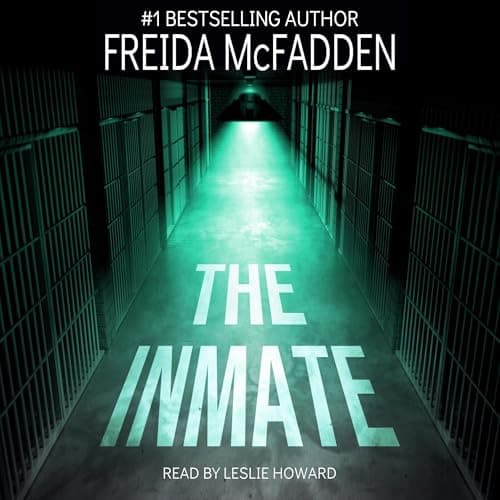

What would you do if the person you helped send to prison for murder was suddenly your patient—and you were locked inside with them every day?
That's the delicious nightmare at the center of The Inmate, and Freida McFadden wastes zero time making you feel the walls closing in. Brooke Sullivan, newly minted nurse practitioner, walks into a men's maximum-security prison where her high school boyfriend Shane Nelson—former star quarterback, current convicted serial killer—is serving life. The kicker? Her testimony helped put him there. And everyone on staff is oblivious to this little detail. Shane, of course, is not.
I listened to this on a long drive, which turned out to be the right call. Eight hours, one sitting, no regrets. McFadden writes chapters like she's being paid per cliffhanger—each one ends at exactly the moment where hitting pause feels physically wrong. The alternating timelines between Brooke's past with Shane and her present inside the prison create a steady drip of "wait, what actually happened?" that kept me leaning forward in my seat for most of the ride. There's a scene where Brooke is nearly strangled with her own necklace that genuinely had me gripping the steering wheel harder than any traffic situation warranted.
Here's where I want to be straight with you, though, because listener opinions on this one are sharply divided and I think both camps have a point.
The plot asks you to accept that a key witness against a convicted murderer would get hired at his exact prison without a single background flag going up. If that kind of logical gap makes you itch, it's going to bother you the entire time. McFadden isn't interested in procedural realism—she's building a pressure cooker, and the implausibility is the price of admission. I was willing to pay it because the suspense payoff justified the cost. But I understand listeners who felt the foundation was too shaky to support the house she built on top of it.
Brooke herself is the other fault line. Some listeners loved watching her evolve from fragile trauma survivor to fierce protector—there's a mama-bear arc in the back half that genuinely lands. Others found her juvenile, reactive, and maddening. I'll say this: McFadden writes her as someone whose judgment was warped by what happened to her, and her bad decisions aren't accidents—they're the engine of the plot. If you need a protagonist who demonstrates basic self-preservation instincts before the final act, Brooke will test your patience. She's the kind of character who walks into rooms you're mentally screaming at her to avoid, and she does it repeatedly.
Now, Leslie Howard's narration. This is where the audiobook experience gets genuinely complicated, because the performance is doing two things at once—one well, one not so much. I ran into a similar split reaction with Howard's work on Wild—strong emotional center, uneven when the cast widens. Howard captures Brooke's emotional arc with real skill. You can hear the shift from vulnerability to steel as the story progresses, and during quiet, menacing scenes, her measured delivery builds dread effectively. The problem is character differentiation. Guards, inmates, male characters, female characters—they all arrive through roughly the same vocal register. In a book set inside a prison full of distinct personalities, this flattening effect means you're relying almost entirely on McFadden's dialogue tags to know who's speaking. It's not catastrophic, but it does sand down the scene-to-scene variety. Some listeners praised Howard as excellent; others called her monotone. I'd split the difference and say she's the right narrator for Brooke's interior life and the wrong narrator for an ensemble cast.
The ending is where McFadden collects on the debt of patience she's been building. Without spoiling anything, the final twist recontextualizes enough earlier scenes that you'll want to mentally rewind through key moments. Fans of The Housemaid or Never Lie might find the architecture slightly less elaborate—this isn't her most complex misdirection—but it hits with genuine emotional force, and the closing chapters move at a dead sprint. My full thoughts on The Housemaid are worth reading alongside this one if you want to trace how McFadden's plotting has evolved—she was already building elaborate traps back then, just in a smaller room.
A note on content: this is darker than some McFadden titles. Violence, abuse, sexual content, and language that earns the maximum-security setting. It's not gratuitous, but it's present.
If you're on the fence about speed, try bumping to 1.25x. Howard's even-keeled delivery actually benefits from slightly increased tempo—it adds urgency without sacrificing comprehension, and it helps offset the monotone quality that bothers some listeners.
The prison setting gives McFadden something her domestic thrillers sometimes lack: genuine physical menace that doesn't have to be manufactured through misunderstanding. The danger here is real, institutional, and constant. That atmospheric upgrade, combined with the emotional stakes of Brooke and Shane's history, makes this one of her more viscerally effective books even if the plot machinery occasionally creaks under inspection.
Who should listen: If you devour twisty thrillers in single sittings and don't mind trading plausibility for pace, this is a great pick—especially for road trips or long commutes. Who should skip: If procedural logic gaps pull you out of a story, or you need a protagonist with solid decision-making skills, you'll spend more time frustrated than thrilled.