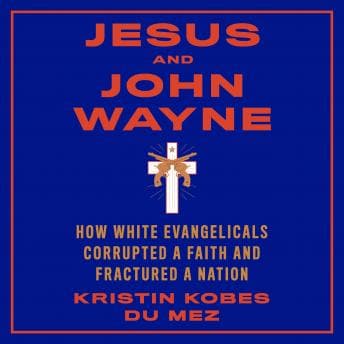

I was halfway through my morning jog along the Charles River when Du Mez dropped a connection between Oliver North and evangelical masculinity that made me literally stop running. Just stood there on the path like an idiot while other joggers swerved around me. That's the kind of book this is—the kind that makes you freeze because suddenly a pattern you've been seeing for years clicks into place.
Look, I study why people do what they do. It's my whole thing. And this book? It's basically a 12-hour case study in collective identity formation, wrapped in American history, delivered with the energy of a very thorough Dateline episode. (That comparison isn't mine—another listener made it—but honestly, it's spot on.)
How a Movement Built Its Heroes
What Du Mez does here is trace how white evangelical Christianity constructed an identity around a very specific kind of masculinity. We're talking John Wayne, obviously—the title isn't subtle—but also Mel Gibson, the Duck Dynasty guys, Ronald Reagan. A whole constellation of "rugged" men who became stand-ins for what it meant to be a godly American male.
From a psychological perspective, this is fascinating stuff. Identity doesn't form in a vacuum. It needs heroes, villains, origin stories. Beyond Good and Evil explores similar questions about how moral frameworks get constructed—though Nietzsche would probably have a lot to say about warrior Christianity. Du Mez shows how evangelical culture systematically built all three over seventy-five years. The research is meticulous. She's pulling from sermons, bestsellers, radio programs, conferences—the whole infrastructure of how a subculture tells itself who it is.
And here's what got me: the Jesus of the Gospels—turn the other cheek, blessed are the meek—doesn't fit the warrior archetype. So what happens? The archetype wins. The faith reshapes around it. That's not me being provocative. That's literally what the book documents.
Althens Behind the Mic
Okay, so the narration. Suzie Althens has this very clear, measured delivery that works well for dense historical material. When you're trying to absorb decades of cultural shifts while dodging puddles on a running path, clarity matters. I appreciated that she didn't try to dramatize the content—this isn't that kind of book.
But. (And this is where I have to be honest.) There were moments where her emphasis felt... off? Like she was reading about unfamiliar territory. Some reviewers called it robotic, which feels harsh. I'd say it's more that you can tell when a narrator is deeply inside the material versus when they're competently delivering it. This felt like the latter. Did it ruin the experience? No. Did I notice it? Yes. Especially during sections about specific evangelical figures where the cultural context really matters for tone.
Who This Is (And Isn't) For
Here's the thing about books that critique religious institutions: they attract two kinds of listeners. People who already agree and want ammunition, and people who are genuinely curious about how we got here. Du Mez writes for the second group, but the first group will probably buy it anyway.
If you've watched American politics for the past decade and thought "how did we get here?"—this book offers a serious, documented answer. Not the whole answer. But a significant piece of it. If you're an evangelical who's open to examining your own tradition critically, this could be valuable. Uncomfortable, but valuable. Du Mez isn't writing from outside the tradition—she's a historian at a Christian college. That matters.
Skip this if you get defensive about any critique of conservative Christianity. The book doesn't pull punches about how evangelical culture has shaped—and been shaped by—political power. You're going to hate it.
Twelve Hours That Reframe Everything
At twelve hours, this isn't a quick listen. I spread it across about two weeks of jogs and cooking sessions. (Made an elaborate dal that turned out surprisingly well, if anyone's wondering.) The pacing is methodical—Du Mez is building a case, not telling a story, and that requires patience.
But the payoff is real. By the end, you understand how 81 percent of white evangelicals voted for a man who couldn't name a Bible verse. Not because they're stupid or hypocritical—that's the lazy take—but because their faith had already been reshaped around values that Trump embodied. Strength. Dominance. Fighting for "our" America.
My therapist would have a field day with the attachment patterns in this movement. (She'd also probably tell me to stop psychoanalyzing entire demographics, but here we are.)
The Glasses You Didn't Know You Needed
This is the kind of book that changes how you see things. Not in a dramatic, road-to-Damascus way. More like putting on glasses you didn't know you needed. Suddenly the blurry stuff comes into focus.
I'd recommend 1.25x speed for the denser historical sections. And maybe don't listen while jogging unless you want to stop abruptly on a public path and confuse everyone around you.