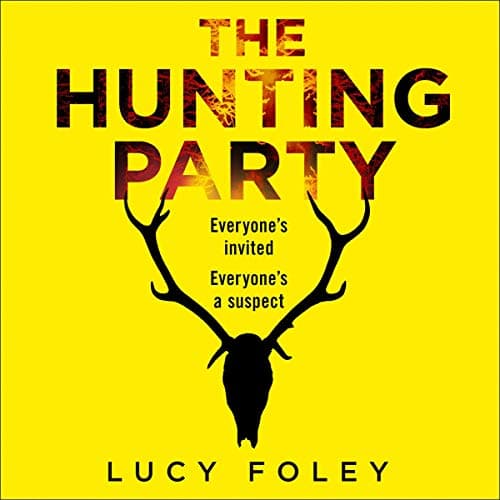
What happens when you lock a group of terrible people in a Scottish hunting lodge and wait for one of them to die?
I was elbow-deep in pancake batter at 8 AM - post-shift, running on fumes, trying to get breakfast going before the kids woke up - when The Hunting Party hit its final act and I just... stood there. Whisk dripping. Carlos walked in and asked if I was okay. I was not okay. Not because the ending wrecked me emotionally, but because I'd spent ten hours with these people and I genuinely could not decide if I cared who killed whom. And that's the weird thing about this book: it kept me listening even when I wanted to shake every single character.
Trapped With People You'd Deliberately Avoid at a Party
Lucy Foley does something clever here - she gives you a group of old Oxford friends reuniting at a remote Highland estate for New Year's, and she makes almost all of them insufferable on purpose. The golden couple performing their perfection. The volatile one stirring drama like it's her cardio. The new parents radiating passive-aggressive exhaustion. You know these people. You've triaged these people at 2 AM after their "quiet dinner party" went sideways.
The atmosphere is the real star. Snow cutting off the lodge from civilization. The woods pressing in. Heather, the lodge manager, and Doug, the gamekeeper, moving through those trees like they're carrying their own buried stories - which they are. All the Tranquil Dead does something similar with isolation - that same sense of a place actively working against the people trapped inside it. Foley builds isolation the way good thrillers should: not just as a plot device but as a pressure cooker for every petty resentment and buried secret in the group. I genuinely felt the cold.
But here's my issue. The characters are archetypes first and people second. "The beautiful one." "The outsider." "The city boy." The book leans into these labels so hard that by hour five, I was still sorting out who was who based on narrator voice rather than any distinct personality. Katie and Miranda blur together. Mark is... there. The perspectives rotate so frequently that just when I started to get invested in one thread - particularly Heather's sections, which had real weight to them - we'd jump to another narrator recounting another petty grudge from the friend group's past.
Five Narrators, Five Accents, One Confused Night Shift Nurse
The five-narrator approach is ambitious. Cathleen McCarron, Laura Kirman, Clare Corbett, Ellie Heydon, and Joshua Manning each take on different character perspectives, and when it works, it works - you feel like you're eavesdropping on each person's private version of events. McCarron's sections have this grounded quality that anchors the more melodramatic stretches. Manning brings a different energy as the lone male narrator, which helps orient you during the he-said portions.
But - and this is a real problem for audiobook listeners specifically - the rotation between narrators combined with the time-jumping structure (we alternate between "then" chapters building to New Year's and "now" chapters after the body is found) meant I kept losing track. Driving home from work at 7 AM with sun in my eyes and five different voices telling me about interconnected grudges from a decade ago? I had to rewind more than once. This is not background listening. This is homework.
The narrators themselves are solid. No weird pronunciation issues, no jarring production cuts. But the material doesn't always give them enough to differentiate - when you're voicing characters who all talk the same way (posh, self-involved, vaguely literary), even good performers can only do so much.
Prognosis (Sort Of)
Look, this isn't a medical thriller. But as someone who's actually worked a code, I notice when a book treats death and violence with realistic weight versus using it as a plot garnish. Foley lands somewhere in between. The murder itself, when you finally get to it, feels appropriately brutal for the setting. But the investigation side is thin - this is much more about the interpersonal unraveling than any procedural element, which is fine if that's what you're after.
The slow burn is genuinely slow. Ten hours is a lot for this story. By hour seven, I was mentally charting suspects like I chart patients - methodically, with decreasing enthusiasm. The payoff is decent but not the kind that makes you want to immediately relisten to catch all the clues you missed. It's more of a "huh, okay" than an "OH" moment.
Who Should Listen (And Who Should Skip)
If you loved The Guest List (Foley's later, tighter book), this is the rough draft version of that formula. Same DNA - awful privileged people, isolated location, someone dies - but less refined. Hex is another one where the setting ends up being the most memorable character in the room - worth a look if that trade-off doesn't bother you. The Scottish Highlands setting does heavy lifting that the character work doesn't always match.
Pick this up if you want atmosphere over action and you're okay spending time with people you'd cross a hospital corridor to avoid. Skip it if you need to care about at least one character to stay invested, or if you're listening in short bursts where the narrator switches will lose you completely.
Post-Shift Prescription
Night shift approved - barely. It kept me awake, which is the minimum bar, and the atmosphere is genuinely creepy in a way that pairs well with dark highways. But I didn't yell at my dashboard once, and honestly? That's not a great sign. There aren't really any medical details to speak of. The mystery mechanics are serviceable. The setting is the best thing here. I wanted to love it, and I landed on "liked it fine." Carlos asked why I was standing frozen over pancake batter. I told him I was thinking about murder. He didn't ask follow-up questions. Smart man.