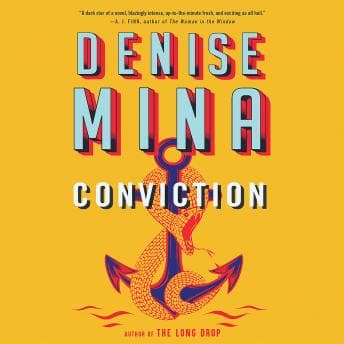

Everyone kept telling me this was a "podcast thriller" and a Reese's Book Club pick, so I went in bracing for something slick and hollow — the literary equivalent of a smoothie bowl with too much açaí and no substance. I was wrong. Mostly.
I started listening while making dal makhani at 9 PM on a Tuesday, which turned out to be the perfect pairing. Something about standing over a pot, hands busy, mind free — Denise Mina's layered plotting just seeped in. By the time I was tempering the spices, Anna McDonald's entire life had detonated, and I was hooked in a way I genuinely didn't expect.
Anna McDonald Is a Psychological Goldmine
The protagonist exhibits classic compartmentalization — and I mean textbook. Anna has constructed an entire identity as a Glasgow trophy wife, scrubbed clean of whatever came before. The research actually shows that people who reinvent themselves this thoroughly tend to be running from something specific, not something vague. And Mina gets this right. Anna doesn't just have "a past." She has a past she's architecturally sealed off from her present, and when her husband walks downstairs and announces he's leaving, the walls don't just crack — they disintegrate in a sequence that feels psychologically honest.
What makes this character compelling is how her coping mechanism — obsessive true crime podcast listening — becomes the very thing that drags her back. She's using other people's tragedies as emotional anesthesia, which, yes, my therapist would have thoughts about this character. But then she recognizes a victim from her former life, and suddenly the podcast isn't distraction anymore. It's a mirror. That's a genuinely clever structural move from Mina.
I found myself asking: why does Anna really go on the run? On the surface, it's about solving the mystery. But psychologically? She's choosing chaos over the void her husband just left. The road trip with Fin, the washed-up musician, isn't just plot convenience — it's Anna selecting a companion who's also broken enough not to judge her. This is a fascinating case study in how people choose their co-conspirators based on shared damage rather than shared competence. I've been tracking this dynamic across the genre — Locked On does something adjacent with its character pairings, though it never quite reaches the same psychological specificity Mina achieves here.
The Podcast Device — Clever Until It Isn't
Here's where I split from the consensus praise. The true crime podcast segments that Mina weaves through the narrative are genuinely smart — they create this meta-layer where Anna is both listener and participant, consumer and subject. For the first half, it works beautifully. The audiobook format amplifies this because Cathleen McCarron shifts her delivery for the podcast portions, giving them a slightly flattened, produced quality that mimics real podcast cadence. It's a subtle choice and it landed for me.
But around the midpoint — and I'm not alone in noticing this — the device starts to create distance rather than tension. The podcast becomes a crutch for exposition dumps. Instead of showing us Anna uncovering connections, we get podcast narration telling us about sunken yachts and international conspiracies. Psychologically, this doesn't track with how someone in Anna's heightened emotional state would actually process information. She'd be frantic, selective, pattern-matching obsessively. Instead, the pacing slows to accommodate the podcast structure, and I caught myself drifting. Not enough to abandon ship, but enough to notice.
McCarron's Voice Does Heavy Lifting
Cathleen McCarron is the reason this audiobook earns its format. Her Scottish lilt gives Anna an immediate groundedness — you believe this woman lives in Glasgow, shops at Waitrose, drives her kids to school. But it's the shifts that got me. When Anna's rage surfaces, McCarron doesn't go loud. She goes cold. Clipped consonants, slightly faster cadence, like someone who learned long ago that showing anger is dangerous. That's not just good acting — that's character psychology rendered in vocal performance.
The European accents are the weak spot, and I'll be honest — when the plot expands to include continental characters, McCarron's French and Italian voices blur together. Not catastrophically, but enough that I occasionally lost track of who was speaking in scenes with multiple European characters. For a story with international conspiracy elements, that's a real limitation.
Still, her handling of Fin is excellent. She gives him this weary, self-deprecating warmth that makes you understand exactly why Anna tolerates him. He's not comic relief — in McCarron's delivery, he's a man who's made peace with his own irrelevance, and that peace is oddly stabilizing for Anna.
Who This Is Really For (And Who Should Walk Away)
If you need your thrillers to move at a constant sprint, this will frustrate you around hour five. If you're someone who finds unreliable narrators annoying rather than interesting, Anna's selective honesty about her past will grate. But if you're the kind of listener who wants to understand why a character makes terrible decisions — not just watch them make them — Mina wrote this for you. She understands human nature in a way that most thriller writers don't bother attempting. That willingness to dig into motive over mechanics is something I also appreciated in Fury, which commits to its characters' psychological unraveling with similar conviction.
This demands your attention. Don't listen while multitasking anything cognitive. Cooking? Perfect. Commuting in traffic? Risky. You'll miss threads.
The Case File, Closed
Denise Mina built something genuinely interesting here — a thriller that's also a study in identity construction and the stories we tell ourselves to survive. It sags in the middle and the international conspiracy elements feel less assured than the domestic psychological ones. But Anna McDonald is one of the more psychologically credible thriller protagonists I've encountered in a while. McCarron's performance earns this the audiobook recommendation. Just don't expect the podcast gimmick to sustain its brilliance for the full ten hours.